Portable Monitors for a Second Screen Anywhere
The ASUS ZenScreen MB16ACE is our top pick for travelers who want a slim USB-C screen that runs on one cable. Gamers should choose the ASUS ROG Strix XG16AHPE for its 144Hz panel, while the Arzopa A1 Gamut is the best value pick.
The ASUS ZenScreen MB16ACE suits most laptop users with a 15.6-inch 1080p IPS panel that draws power and video over a single USB-C cable. Gamers who want high refresh rates or anyone needing a built-in battery should look at a more specialized model instead.
Portable monitors differ mostly in how they connect and what extras they carry, so the right one depends on your device and use. We compared panel quality, refresh rate, USB-C versus HDMI ports, weight, and owner feedback on stands and brightness to match screens to travel work, gaming, and desk setups.
Before you buy
What to look for in a portable monitor Connectivity decides how simple the setup is. A monitor that takes power and video over one USB-C cable is cleanest, but it needs a laptop with a full-function USB-C port. HDMI adds compatibility with consoles and older devices but often requires a separate power cable. Beyond ports, check panel resolution, brightness for the environments you use, and whether the stand is built in or a folding cover.
USB-C versus HDMI connections USB-C carries video and power together when your device supports DisplayPort over USB-C, which most recent laptops do. If your source only has HDMI, or a USB-C port that does not output video, you will use the HDMI input and power the monitor separately. Phones and consoles vary, so confirm your device’s output before buying to avoid a screen that will not turn on.
Stands, weight, and everyday portability Most budget monitors use a folding cover that props the screen in landscape, which is fine on a flat desk but wobbles on soft surfaces. A built-in stand like the ViewSonic VG1655’s adjusts the angle and stays steady, at the cost of extra weight. If you carry the screen daily, balance a sturdy stand against a lighter body and a protective sleeve.
Best portable monitors for gaming and work For office work and travel, a 60Hz 1080p IPS panel with USB-C is plenty and keeps weight down. For gaming, refresh rate matters, so the 144Hz ASUS ROG Strix and its built-in battery suit console and handheld play away from an outlet. Avoid paying for a high-refresh gaming panel if you only run spreadsheets and video calls, since the extra cost buys nothing there.
Our top picks

ASUS ZenScreen MB16ACE
A slim 15.6-inch IPS panel runs on a single USB-C cable for both power and video from a compatible laptop. The hybrid signal solution and included smart cover-stand make it a clean, light second screen for the road.
Pros
- One USB-C cable for power and video
- Slim, light body for a laptop bag
- Cover folds into a landscape stand
Cons
- No built-in battery
- 60Hz panel, not for high-refresh gaming

Arzopa A1 Gamut
This 15.6-inch 1080p IPS screen delivers a bright, sharp picture at a low price. Two USB-C ports and a Mini-HDMI cover most devices, and the light frame with a folding cover makes it easy to carry between desks.
Pros
- Low price for a full HD IPS panel
- Dual USB-C simplifies connections
- Light and easy to pack
Cons
- Cover stand feels less sturdy
- Speakers are quiet and thin

ViewSonic VG1655
A built-in ergonomic stand adjusts the viewing angle without a flimsy folding cover. Two full USB-C ports plus Mini-HDMI and a protective sleeve make this a durable choice for professionals who present or hot-desk often.
Pros
- Sturdy built-in stand adjusts angle
- Two USB-C ports for flexible power
- Includes a protective carrying sleeve
Cons
- Heavier than cover-stand rivals
- 60Hz limits it to work and video

ASUS ROG Strix XG16AHPE
A 144Hz IPS panel with adaptive sync brings smooth motion to portable gaming and console play. A built-in battery lets it run away from an outlet, and the kickstand plus tripod mount give flexible placement.
Pros
- 144Hz refresh smooths fast gaming
- Built-in battery frees it from outlets
- Kickstand and tripod thread for angles
Cons
- Costs more than 60Hz screens
- Battery adds a little weight
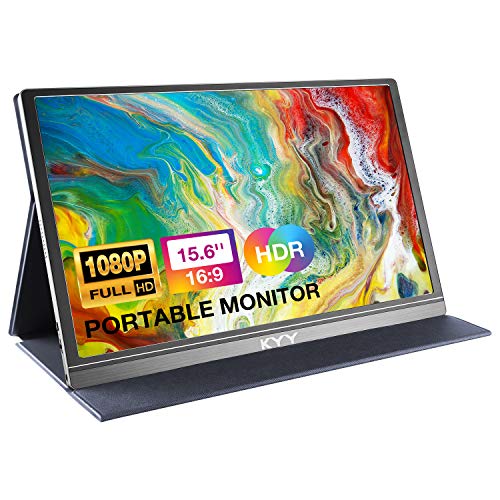
KYY K3 Portable Monitor
A 15.6-inch 1080p IPS panel connects over USB-C or HDMI, so it works with laptops, consoles, and phones. The smart cover props it up, and dual speakers cover basic sound without extra gear.
Pros
- Wide device compatibility over HDMI
- Affordable full HD IPS panel
- Cover stand and speakers included
Cons
- Cover stand tips on uneven surfaces
- Brightness is modest outdoors

InnoView 15.8 Portable Monitor
A slightly larger 15.8-inch IPS panel gives more working space for the money. USB-C and HDMI inputs handle most sources, and the included stand cover plus screen protector round out a practical travel package.
Pros
- Larger panel for the price
- Dual USB-C and HDMI inputs
- Ships with a screen protector
Cons
- Cover stand offers limited angles
- 60Hz only, not for gaming

Lepow C2S Portable Monitor
A thin bezel and light chassis make this 15.6-inch screen easy to slip beside a laptop. Two USB-C ports and Mini-HDMI cover connections, and a smart cover folds into a stand for quick landscape use.
Pros
- Slim bezels and light body
- Two USB-C ports for easy hookup
- Cover doubles as a stand
Cons
- Landscape-only cover stand
- Average speaker volume
How they stack up
| # | Model | Panel | Best for | Score | Price |
|---|---|---|---|---|---|
| 1 | ASUS ZenScreen MB16ACE | 15.6-inch IPS, 1080p | Best overall for travel | 9.1 | Check price |
| 2 | Arzopa A1 Gamut | 15.6-inch IPS, 1080p | Best value | 8.8 | Check price |
| 3 | ViewSonic VG1655 | 15.6-inch IPS, 1080p | Best for business | 8.9 | Check price |
| 4 | ASUS ROG Strix XG16AHPE | 15.6-inch IPS, 1080p, 144Hz | Best for gaming | 9.0 | Check price |
| 5 | KYY K3 Portable Monitor | 15.6-inch IPS, 1080p | Best budget for console | 8.4 | Check price |
| 6 | InnoView 15.8 Portable Monitor | 15.8-inch IPS, 1080p | Best larger screen value | 8.5 | Check price |
| 7 | Lepow C2S Portable Monitor | 15.6-inch IPS, 1080p | Best slim design | 8.3 | Check price |
Questions worth asking
How do portable monitors connect to a laptop?
Most connect over USB-C, carrying both video and power on one cable when the laptop’s port supports DisplayPort output. If your laptop lacks that, you use the Mini-HDMI input and power the monitor with a separate USB-C cable. Check your laptop’s port capabilities first, since not every USB-C port outputs video.
Can a portable monitor run on one USB-C cable?
Yes, if your device provides enough power and video over USB-C. The ASUS ZenScreen MB16ACE and similar monitors run from a single cable on compatible laptops. Some lower-powered devices, or brighter settings, may need a second USB-C cable for extra power, which the monitors include for that reason.
Do portable monitors work with game consoles?
Many do through the HDMI input. Screens like the KYY K3 and ViewSonic VG1655 accept an HDMI signal from a console, though you will power the monitor separately. For fast games, a 144Hz model like the ASUS ROG Strix gives smoother motion than a standard 60Hz portable display.
Do I need a battery in a portable monitor?
Only if you use it away from power. Most portable monitors draw power from the connected device or a wall adapter and have no battery. The ASUS ROG Strix XG16AHPE includes one for cordless use. A battery adds weight and cost, so skip it if you always have an outlet or a powered laptop nearby.
What screen size is best for a portable monitor?
Around 15.6 inches is the common sweet spot, matching many laptop screens while staying light. A slightly larger 15.8-inch panel like the InnoView adds a little space. Smaller sizes pack easier but give less room, so match the size to whether portability or working area matters more to you.
Can I use a portable monitor with my phone?
Often yes, if the phone supports video output over USB-C, sometimes called a desktop or extended mode. The monitor then shows the phone’s screen or a desktop interface. Support varies by phone model, so confirm your device offers USB-C display output before relying on it with a portable monitor.
Are portable monitors good enough for photo work?
For general editing on the go they help by adding space, but most budget models cover standard color rather than wide professional gamuts. An IPS panel gives decent color and viewing angles. For critical color work, a desktop monitor with verified color coverage remains the better tool, with the portable as a travel supplement.
How do I stand a portable monitor up?
Budget monitors usually include a smart cover that folds into a landscape stand. Sturdier models like the ViewSonic VG1655 have a built-in adjustable stand. Some, such as the ASUS ROG Strix, add a tripod mount for flexible angles. Consider a small separate stand if the folding cover feels unstable on your desk.
The bottom line
For most laptop users on the move, the ASUS ZenScreen MB16ACE is the cleanest pick, running on a single USB-C cable in a slim, light body. Gamers should skip the office-focused screens and spend on the 144Hz ASUS ROG Strix XG16AHPE with its built-in battery, while anyone watching the budget gets a bright, capable full HD panel from the Arzopa A1 Gamut.
You might also need
Portable Breeze: Top Wireless Fans for Cooling Anywhere
Top Scanners for Every Workspace: Flatbed, Sheet-Fed, and Portable

Portable Mesh WiFi for Travel: Top Picks for On-the-Go Coverage
