Which Portable Power Station Fits Your Camping Trip?
The EcoFlow DELTA 2 is the best all round portable power station thanks to fast recharging and expandable capacity, the Anker SOLIX C1000 offers the best balance of output and weight, and the Jackery Explorer 300 Plus is the pick for lightweight camping trips.
The EcoFlow DELTA 2 is the portable power station that suits the widest set of needs, combining a kilowatt class inverter, long life lithium iron phosphate cells and recharging fast enough to top up during a short mains window. The Anker SOLIX C1000 is the better carry weight compromise, and the Jackery Explorer 300 Plus covers light camping.
These units are hard to compare because the headline watt hour figure says nothing about how much power you can actually draw at once, and inverter surge limits are what determine whether a kettle or a compressor fridge will run. We compared published capacity, continuous and surge wattage, cell chemistry and rated cycle life, recharge times and port layouts, then weighed what owners report about fan noise and cold weather behaviour.
What we recommend
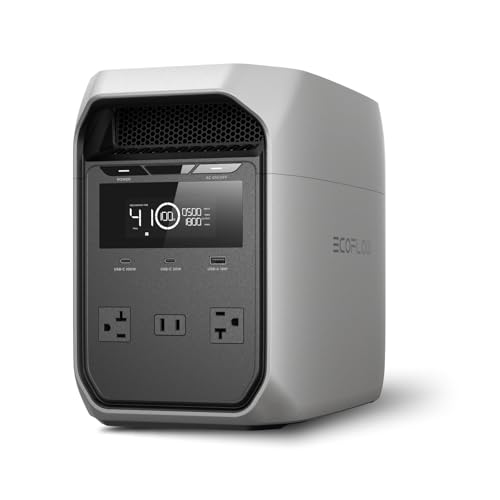
EcoFlow DELTA 2
The DELTA 2 pairs a genuinely useful inverter output with the fastest mains recharging in its class, which changes how you use a power station during an outage or a road trip. Lithium iron phosphate cells give it a long rated cycle life. It also accepts an extra battery, so capacity can grow later rather than being fixed at purchase.
Pros
- Very fast mains recharging
- Expandable with an extra battery
- Long rated cycle life
Cons
- Fans are audible under heavy load
- Heavy to carry any distance

Anker SOLIX C1000
Anker packages a kilowatt hour of capacity and a strong inverter into a case lighter than most rivals, which makes it the practical choice if the unit has to be carried rather than wheeled. Surge headroom covers motor driven appliances. Owners report it is noticeably quieter than competing units at moderate load.
Pros
- Light for a kilowatt class unit
- Quiet under moderate load
- Strong surge headroom
Cons
- Expansion battery adds significant cost
- Fewer AC outlets than some rivals

Jackery Explorer 1000 v2
Jackery’s interface is the easiest to understand, with a clear display and an app that does not demand configuration before it is useful. The v2 moves to lithium iron phosphate cells and drops weight compared with the original. It is the unit to buy if you want something that just works without studying the manual.
Pros
- Very approachable interface
- Lighter than the previous generation
- Reliable solar input handling
Cons
- Lower continuous output than rivals
- Slower mains recharge than EcoFlow

Bluetti AC180
The AC180 offers a high surge rating and a power lifting mode that lets it run resistive loads above its nominal ceiling at reduced power. That makes it more forgiving with kettles, heaters and hair dryers than the numbers suggest. It is a sensible pick for outage use where appliance compatibility matters most.
Pros
- Generous surge capability
- Power lifting mode for resistive loads
- Good capacity for the class
Cons
- Chunky shape for storage
- App connectivity can be inconsistent

EcoFlow RIVER 2 Pro
The RIVER 2 Pro sits in the useful middle ground, big enough to run a compressor fridge overnight or charge everything a family carries, yet small enough to lift with one hand. Recharging is very quick from mains. It suits weekend camping better than whole home backup.
Pros
- Easy to carry one handed
- Very fast recharging
- Good runtime for fridges and devices
Cons
- Not enough output for high draw appliances
- Limited AC outlet count

Jackery Explorer 300 Plus
At around eight pounds this is the unit you actually take on a hike or a small tent trip rather than leaving in the car. It runs laptops, lights, cameras and a small fan comfortably. The compact case and USB-C fast charging make it a strong travel companion.
Pros
- Genuinely portable weight
- Fast USB-C charging both ways
- Long rated cycle life
Cons
- Too small for appliances
- Single AC outlet

Goal Zero Yeti 500
The Yeti 500 runs quietly and pairs well with Goal Zero’s own solar panels, which suits people who want a simple off grid setup rather than the fastest specification. The display is clear and the app is straightforward. Output is modest, so treat it as a device and lighting station rather than an appliance one.
Pros
- Quiet in normal use
- Well matched solar ecosystem
- Clear and simple display
Cons
- Lower output than similarly sized rivals
- Lithium ion cells rate fewer cycles than LiFePO4
Side by side
| # | Model | Capacity | Best for | Score | Price |
|---|---|---|---|---|---|
| 1 | EcoFlow DELTA 2 | 1024Wh | Best overall | 9.4 | Check price |
| 2 | Anker SOLIX C1000 | 1056Wh | Best balance of power and weight | 9.2 | Check price |
| 3 | Jackery Explorer 1000 v2 | 1070Wh | Best for beginners | 9.0 | Check price |
| 4 | Bluetti AC180 | 1152Wh | Best for appliance surges | 8.8 | Check price |
| 5 | EcoFlow RIVER 2 Pro | 768Wh | Best mid size unit | 8.6 | Check price |
| 6 | Jackery Explorer 300 Plus | 288Wh | Best for lightweight camping | 8.3 | Check price |
| 7 | Goal Zero Yeti 500 | 499Wh | Best for quiet operation | 8.0 | Check price |
How to pick the right one
Size it by watt hours, not by feeling Add up what you actually plan to run. A phone charge is roughly 15 to 25 watt hours, a laptop 50 to 100, a 12 volt compressor fridge around 300 to 600 per day, and a kettle can pull 1500 watts for a few minutes. Multiply the wattage of each device by the hours you will use it, then add roughly 20 percent headroom for conversion losses.
Continuous output decides what will run at all Capacity determines how long something runs, but the inverter’s continuous wattage decides whether it starts. Kettles, heaters, microwaves and hair dryers commonly need 1200 to 1800 watts, while motors in fridges and pumps draw a brief surge several times their running figure. Check both the continuous and surge ratings against your highest draw appliance.
Cell chemistry and lifespan Most current units use lithium iron phosphate, usually written as LiFePO4, which is rated for several thousand charge cycles and is more tolerant of heat than older lithium ion packs. Older or very light units may still use standard lithium ion, which is lighter but rated for fewer cycles. If the unit will be cycled regularly, chemistry matters more than a small capacity difference.
Recharging from mains, car and solar Mains recharge speed changes how usable a station is during a rolling outage or a short stop on a road trip. Solar input has a stated maximum voltage and wattage that panels must match, so check compatibility before buying panels separately. Car charging is slow and mainly useful for topping up while driving between camps.
Good to know
What size power station do I need for camping?
For phones, lights, a laptop and a fan, roughly 300 watt hours is enough for a weekend. If you run a compressor fridge, plan on 1000 watt hours or more, or pair a smaller unit with a solar panel.
Can a portable power station run a fridge?
A domestic fridge needs an inverter rated around 1000 watts or more to handle the compressor surge, and a large capacity to last a day. A 12 volt camping fridge is far less demanding and runs comfortably from mid size units.
How long do these batteries last?
Lithium iron phosphate packs are commonly rated for around 3000 charge cycles to 80 percent of original capacity, which is many years of weekend use. Older lithium ion designs typically rate several hundred cycles.
Do I need solar panels?
Only if you stay off grid longer than the battery lasts. For weekend trips, charging fully before you leave is usually simpler. For van life or extended outages, solar becomes essential rather than optional.
Can I take one on a plane?
No. Airlines limit lithium batteries in carry on to a low watt hour threshold, far below any power station on this list, and they are not permitted in checked baggage either.
Will it work in cold weather?
Capacity drops in cold conditions and many units will not accept a charge below freezing, though they will still discharge. Keeping the unit inside a tent or vehicle overnight helps considerably.
Are they noisy?
Most are silent at low draw and spin up cooling fans under heavy load or fast charging. If night time quiet matters, favour units with a reputation for low fan noise and avoid fast charging overnight.
Can I use one for home backup?
A kilowatt class unit will keep phones, routers, lights and a fridge running for hours, which covers most short outages. Whole home backup needs a much larger system with transfer switching.
The verdict
The EcoFlow DELTA 2 is the portable power station that handles the widest range of jobs, with the output for real appliances and recharging quick enough to be useful mid outage. Choose the Anker SOLIX C1000 if you carry the unit often, or the Jackery Explorer 300 Plus if weight matters more than capacity.


