Portable Door Alarms for Safer Hotel Stays
The SABRE Door Stop Alarm with 120 dB siren is our top pick for most travelers. It combines a doorstop wedge, a loud alarm, and a built-in motion detector, making it a versatile and reliable security tool. Its main limitation is that it only works on inward-opening doors, so verify your door swing before relying on it.
Hotel room doors, Airbnb entrances, and dormitory doors often have flimsy locks that are easy to bypass. A portable door alarm adds an extra layer of security, giving you peace of mind while you sleep. These compact devices can be installed without tools and alert you if someone tries to enter.
We compared the most popular models on the market to help you choose. Our picks range from simple wedge alarms to sophisticated motion detectors. We considered real user feedback, decibel ratings, and portability to narrow down the list. Read on to find the best travel companion for your next trip.
What we recommend

SABRE Door Stop Alarm with 120 dB Siren and Motion Detector
This wedge-style alarm slides under the door and emits a piercing 120 dB siren if the door is pushed. It also has a motion detector that can be set to chime or alarm mode. Owners report it is sturdy and effective, though it only works on inward-swinging doors.
Pros
- Dual function: wedge and motion detector
- Loud siren deters intruders
- Compact and easy to pack
Cons
- Not effective on outward-opening doors
- Batteries not included

Addalock Portable Door Lock
The Addalock is a portable lock that installs without tools and reinforces any door. It is not an alarm but works with your existing lock to prevent entry. Many travelers pair it with a door stop alarm for maximum security. It is made of heavy-duty steel.
Pros
- Provides physical barrier against entry
- Works on inward and outward opening doors
- No batteries or maintenance
Cons
- No alarm feature
- May not fit all door frames

GE Wireless Door Alarm with Chime and Off Switch
This simple magnetic contact alarm is a budget-friendly choice. It has a 100 dB siren and can be set to chime or alarm mode. It is lightweight and easy to install with double-sided tape. However, it is not as portable as wedge alarms since the magnet must align with the sensor.
Pros
- Very affordable
- Multiple modes (chime and alarm)
- Adjustable volume
Cons
- Requires proper alignment for installation
- Adhesive may leave residue

Lewis N. Clark Door Alarm
Designed by travel gear specialists, this door alarm is lightweight and compact. It attaches to the door with an adjustable loop and a pin, creating an alarm that sounds if the door opens. It is easy to set up and remove. Some users find the pin mechanism a bit finicky.
Pros
- Very portable and lightweight
- No tools or adhesive needed
- Battery included
Cons
- Setup can be tricky
- Not as loud as wedge alarms

Fosman Mini Door Alarm with Magnetic Sensor
This mini alarm is ideal for dorm rooms or apartments. It features a magnetic sensor and can be used as a door alarm or a window alarm. The 120 dB siren is loud and can be set to different tones. It comes with a remote control for arming and disarming.
Pros
- Loud 120 dB siren
- Remote control convenience
- Can be used on windows
Cons
- Adhesive mounting may not be ideal for travel
- Bulky compared to wedge alarms

Vivint Door Stop Alarm with 100 dB Siren
Vivint offers a basic door stop alarm that is lightweight and budget-friendly. It works similarly to the SABRE but with a lower decibel rating. It is simple to use: slide it under the door and turn it on. While it is not as feature-rich, it gets the job done for a low price.
Pros
- Very affordable
- Lightweight and portable
- Easy to operate
Cons
- Lower volume than some competitors
- No motion detection feature
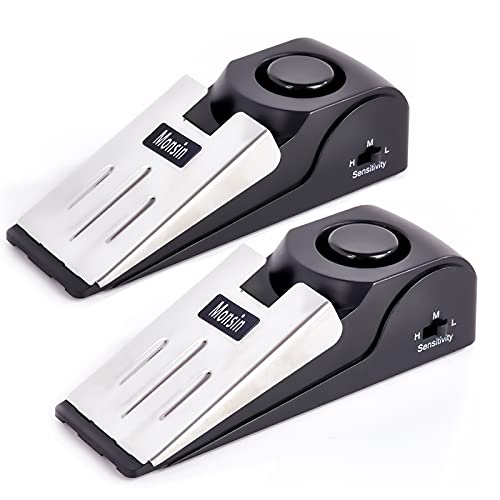
Doberman Security Door Stop Alarm
The Doberman Security door stop alarm offers a robust design and a loud 120 dB siren. It features a built-in night light and a bypass switch for temporary disabling. It is slightly heavier than other models, but it provides reliable protection. Some users report the night light drains batteries faster.
Pros
- Very loud alarm
- Built-in night light
- Bypass switch for quiet entry
Cons
- Heavier and bulkier
- Uses 3 AA batteries
How to pick the right one
Compared at a glance
| # | Model | Decibel Rating | Best for | Score | Price |
|---|---|---|---|---|---|
| 1 | SABRE Door Stop Alarm with 120 dB Siren and Motion Detector | 120 dB | Best Overall | 9.6 | Check price |
| 2 | Addalock Portable Door Lock | Physical lock | Best for Extra Security | 9.4 | Check price |
| 3 | GE Wireless Door Alarm with Chime and Off Switch | 100 dB | Best Budget Pick | 8.8 | Check price |
| 4 | Lewis N. Clark Door Alarm | 110 dB | Best for Frequent Travelers | 9.1 | Check price |
| 5 | Fosman Mini Door Alarm with Magnetic Sensor | 120 dB | Best for Dorm Rooms | 8.7 | Check price |
| 6 | Vivint Door Stop Alarm with 100 dB Siren | 100 dB | Best Lightweight Option | 8.2 | Check price |
| 7 | Doberman Security Door Stop Alarm | 120 dB | Best for High Security Needs | 8.5 | Check price |
Good to know
Are portable door alarms effective?
Yes, portable door alarms are effective as a deterrent and an alert system. They do not physically stop entry but sound a loud alarm that can scare off intruders and alert you to potential danger. For maximum security, combine an alarm with a physical door lock like the Addalock.
Can I use a portable door alarm on any type of door?
Most portable alarms work on standard inward-opening doors. Wedge alarms require a gap under the door. Magnetic alarms can be installed on any door, but the sensor and magnet must align. For outward-opening doors, a portable lock or a door jammer is more suitable.
Do portable door alarms require batteries?
Yes, most portable door alarms require batteries. Common types include AAA, AA, and CR2032 coin cell batteries. Some models include batteries, while others do not. Always check the product description and consider carrying spare batteries.
How loud is a 120 dB alarm?
A 120 dB alarm is extremely loud, about the same as a jet engine at takeoff or a rock concert. It is designed to be painful to the ears, which can disorient an intruder and alert people nearby. Even a 100 dB alarm is sufficient for most hotel rooms.
Will a door stop alarm damage the door?
No, door stop alarms are designed to be non-damaging. They are placed under the door and do not require drilling or adhesive. However, they may leave marks on the floor if the door is moved forcefully. Using a protective pad can prevent scuffs.
Can I use a portable door alarm on a sliding door?
Some magnetic contact alarms can be used on sliding doors. You can attach the magnet to the sliding panel and the sensor to the frame. However, travel alarms are primarily designed for hinged doors. For sliding doors, consider a dedicated sliding door alarm or a simple wooden dowel as a bar.
What is the difference between a door alarm and a door lock?
A door alarm emits a sound when the door is opened or tampered with, alerting you to potential entry. A door lock physically prevents the door from opening. For comprehensive security, use both: a lock to stop entry and an alarm to alert you if someone attempts to open the door.
Are portable door alarms TSA approved?
Portable door alarms are generally allowed in carry-on and checked luggage, but they are not specifically TSA approved. Since they contain batteries, they are subject to airline regulations. Check with your airline for any restrictions on batteries. It is best to pack them in your carry-on for easy access.
Our take
For most travelers, the SABRE Door Stop Alarm is the best choice because it combines a loud 120 dB siren with a motion detector, offering both a physical barrier and an alert system. If you prefer a physical lock instead of an alarm, the Addalock is an excellent complement. For budget-conscious users, the GE Wireless Door Alarm provides reliable protection at a lower cost, but it is not as portable. Consider your specific travel needs and choose accordingly.