Premium AV Receivers That Elevate Your Home Theater
For most premium home theaters, the Denon AVR-X4800H stands out as the top pick, offering a balanced mix of 9.4 channels, Dirac Live capability, and robust build quality, but its lack of HDMI 2.1 on all inputs might be a limitation for some. We compared seven leading models based on specifications, user feedback, and features to help you choose.
Investing in a premium AV receiver is about more than just power. It’s about future-proofing your home theater with the latest audio formats, video specs, and smart features.
We compared seven top-tier models from leading brands, analyzing their channel configurations, amplification, calibration systems, and connectivity. Owners’ reports and expert reviews shaped our insights, helping you find a receiver that truly elevates your movie, music, and gaming experiences.
Our top picks

Denon AVR-X4800H
The Denon AVR-X4800H is a 9.4-channel receiver that delivers exceptional audio fidelity and a wealth of features. It supports 8K/60Hz and 4K/120Hz passthrough, Dolby Atmos, DTS:X, and Auro-3D, making it a versatile centerpiece for any high-end home theater. Its Audyssey MultEQ XT32 calibration is user-friendly, and it also offers Dirac Live upgrade capability for advanced users. With HEOS built-in, multi-room audio is a breeze.
Pros
- Powerful and clean amplification
- Extensive streaming options with HEOS
- Dirac Live upgrade available
Cons
- Not all HDMI inputs are 8K capable
- Runs warm, needs ventilation
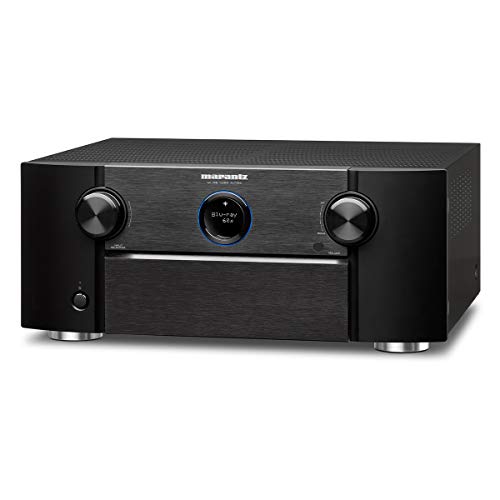
Marantz SR8015
Marantz’s flagship SR8015 is an 11.2-channel receiver with 140W per channel, designed to drive demanding speaker setups with ease. It features Marantz’s proprietary HDAM circuitry for low distortion, supports 8K/60Hz and 4K/120Hz, and includes Audyssey MultEQ XT32. Its robust build and premium components make it a favorite among purists.
Pros
- High current output for demanding speakers
- Supports Auro-3D and IMAX Enhanced
- Premium build quality
Cons
- Premium price tag
- Large and heavy

Yamaha RX-A8A
The Yamaha RX-A8A is an 11.2-channel receiver featuring Yamaha’s renowned Cinema DSP HD3, which creates expansive sound fields. It supports 8K/60Hz and 4K/120Hz, Dolby Atmos, DTS:X, and Auro-3D. With YPAO R.S.C. calibration and multiple parametric EQ, it offers precise tuning. MusicCast enables multi-room audio, and its aluminum front panel adds a touch of elegance.
Pros
- Immersive sound field processing
- Excellent build quality
- Surround:AI automatically optimizes audio
Cons
- YPAO less advanced than some competitors
- Menu system can be complex

Sony STR-AZ5000ES
Sony’s STR-AZ5000ES is a 9.2-channel receiver with 120W per channel, tailored for both home theater and gaming. It features HDMI 2.1 with 8K/60Hz and 4K/120Hz, VRR, ALLM, and QFT for smooth gameplay. Its Digital Cinema Sound and 360 Spatial Sound Mapping create a wide soundstage. With Chromecast built-in and AirPlay 2, streaming is seamless.
Pros
- Perfect for next-gen gaming features
- Immersive 360 Spatial Sound Mapping
- Sleek design
Cons
- Fewer channels than some rivals
- No Auro-3D support
Anthem MRX 740
Anthem’s MRX 740 is an 11.2-channel receiver with 140W per channel, renowned for its ARC Genesis room correction system. It offers highly precise equalization that adapts to your room’s acoustics. Supports 8K/60Hz, 4K/120Hz, Dolby Atmos, DTS:X, and includes Dolby Vision and HDR10+. Its clean, minimalist design appeals to audiophiles.
Pros
- ARC Genesis is among the best calibration systems
- Excellent build quality
- Supports latest video formats
Cons
- Higher price point
- Limited streaming services built-in

Arcam AVR10
The Arcam AVR10 is a 7.1.4-channel receiver with 110W per channel, but it shines in stereo music reproduction. It includes Dirac Live room correction (full bandwidth version) out of the box, providing top-tier calibration. Supports 8K/60Hz and 4K/120Hz, and features Class G amplification for efficiency and low distortion.
Pros
- Exceptional stereo sound quality
- Dirac Live included
- Class G amp design
Cons
- Fewer channels than some rivals
- Limited to one subwoofer output
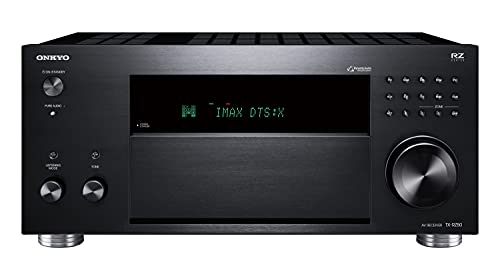
Onkyo TX-RZ50
The Onkyo TX-RZ50 is a 9.2-channel receiver that offers premium features at a more accessible price. It supports 8K/60Hz and 4K/120Hz, Dolby Atmos, DTS:X, and includes Dirac Live (limited bandwidth) for room correction. With THX Certified Select, it ensures reliable performance. It also has a comprehensive set of streaming options.
Pros
- Dirac Live at a lower price
- THX certified
- Good connectivity options
Cons
- Build quality feels less premium
- Dirac Live is limited, upgrade costs extra
Compared at a glance
| # | Model | Channels | Best for | Score | Price |
|---|---|---|---|---|---|
| 1 | Denon AVR-X4800H | 9.4 | Overall premium choice | 9.4 | Check price |
| 2 | Marantz SR8015 | 11.2 | High-end home theater with reference power | 9.2 | Check price |
| 3 | Yamaha RX-A8A | 11.2 | Cinematic sound with advanced DSP | 9.0 | Check price |
| 4 | Sony STR-AZ5000ES | 9.2 | Gaming and modern connectivity | 8.8 | Check price |
| 5 | Anthem MRX 740 | 11.2 | Audiophile-grade room correction | 9.1 | Check price |
| 6 | Arcam AVR10 | 7.1.4 | Musical fidelity and Dirac Live | 8.9 | Check price |
| 7 | Onkyo TX-RZ50 | 9.2 | Value for money | 8.6 | Check price |
How to pick the right one
Frequently asked questions
What is the difference between 7.1.4 and 11.2 channels?
7.1.4 means 7 ear-level channels, 1 subwoofer, and 4 overhead or height channels. 11.2 increases the ear-level channels to 11 and adds a second subwoofer. More channels allow for more precise object-based audio placement, like Dolby Atmos.
Do I need an 8K receiver if I don’t have an 8K TV?
Not necessarily, but having an 8K receiver future-proofs your setup. If you plan to upgrade your TV soon, it’s wise to invest in 8K support. Otherwise, a receiver with 4K/120Hz is sufficient for current consoles.
What is Dirac Live and is it worth it?
Dirac Live is an advanced room correction system that uses digital filters to optimize sound. It is highly regarded for its ability to correct frequency response and impulse response. Many audiophiles find it superior to other systems, but it can be complex to set up.
How much power do I need for my speakers?
It depends on your speakers’ sensitivity and room size. Typically, 100W per channel is sufficient for moderate rooms. High-efficiency speakers require less power. Always match the receiver’s power output to your speakers’ recommended power range.
Can I use a premium AV receiver for music streaming?
Yes, most premium receivers include built-in streaming services like Spotify, Tidal, and Apple Music. They also support AirPlay 2, Chromecast, and Bluetooth. Some have multi-room audio capabilities, allowing you to play different music in different zones.
What is the best room calibration system?
Many experts consider Dirac Live and Anthem ARC to be among the best for their precision. Audyssey MultEQ XT32 is also highly regarded and user-friendly. The best one for you depends on your willingness to tweak settings and your room’s acoustics.
Do premium receivers support both Dolby Atmos and DTS:X?
Yes, virtually all premium AV receivers support both formats, along with others like Auro-3D and IMAX Enhanced. This ensures compatibility with most Blu-ray discs and streaming content.
How important is HDMI 2.1 for gaming?
HDMI 2.1 is essential for 4K/120Hz gaming on next-gen consoles. It enables features like VRR and ALLM, which reduce lag and screen tearing. If you game heavily, look for a receiver with multiple HDMI 2.1 inputs that support these features.
What is the difference between a receiver and an amplifier?
An amplifier only amplifies audio signals. A receiver combines an amplifier, a preamplifier, a radio tuner, and often video processing. Receivers are the central hub for audio and video sources.
Are expensive receivers worth the money?
Premium receivers offer better amplification, more advanced room correction, and superior build quality. They also support the latest audio formats and video specs. For serious home theater enthusiasts, they can be worth the investment for a significant improvement in sound quality.
Our pick
If you want the best all-around premium receiver that balances performance and features, choose the Denon AVR-X4800H. For those with a larger budget and a passion for audiophile-grade calibration, the Anthem MRX 740 is a superior choice. Gamers should prioritize the Sony STR-AZ5000ES for its HDMI 2.1 gaming features, while music lovers might prefer the Arcam AVR10 for its musicality.


