Freshwater vs Reef Water Test Kits: Which One Fits Your Tank
The API Freshwater Master Test Kit covers the core parameters most freshwater tanks need in one box. Reef keepers gain more precision from the Hanna Instruments Marine Master Kit, while the Salifert Reef Master handles advanced coral chemistry. Tank type, not brand, should drive the choice.
The API Freshwater Master Test Kit measures ammonia, nitrite, nitrate, and pH in a single box, enough for most freshwater tanks. Reef tanks need more than that baseline, since coral growth depends on calcium and alkalinity readings the Hanna Instruments Marine Master Kit tracks with a digital display.
Freshwater and reef tanks track different chemistry, and method type changes both accuracy and how often reagents need restocking. We compared parameter lists, test counts, and method type against manufacturer documentation to rank these seven kits.
The shortlist, ranked

API Freshwater Master Test Kit
Liquid reagents test pH, high-range pH, ammonia, nitrite, and nitrate, the five parameters most freshwater owners check weekly. Color-matching cards ship alongside each vial for visual reading. Owners report roughly 800 tests per kit, depending on how parameters are split.
Pros
- Covers all core freshwater parameters in one kit
- High test count stretches the kit over months
- Color charts make results easy to read
Cons
- Color matching leaves room for reader error
- No digital display for an exact numeric value

Hanna Instruments Marine Master Test Kit HI-Master Check
Checker-style meters return digital numeric readings for calcium, alkalinity, magnesium, and phosphate instead of a color card. Reef keepers dosing supplements rely on this precision to avoid overshooting target ranges. Each parameter runs through its own dedicated checker unit.
Pros
- Digital readout removes color-matching guesswork
- Precision suits dosing coral supplements accurately
- Separate checkers limit cross-contamination between tests
Cons
- Costs more upfront than liquid reagent kits
- Each checker needs its own reagent refills

Salifert Reef Master Test Kit
Individual kits for calcium, alkalinity, magnesium, nitrate, and phosphate bundle into one package aimed at serious reef keepers. Titration steps give finer resolution than color cards for calcium and alkalinity readings. Coral growth tracking benefits most from this level of detail.
Pros
- Titration improves calcium and alkalinity precision
- Covers a full reef chemistry panel in one kit
- Long-favored by experienced reef hobbyists
Cons
- Titration takes longer than checker-based testing
- Bottles need careful labeling to avoid mix-ups
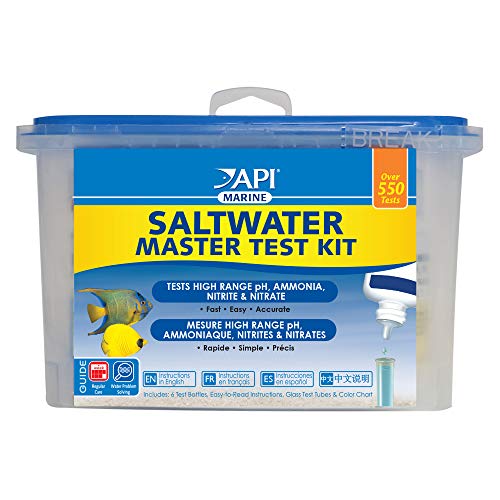
API Saltwater Master Test Kit
The same color-match liquid reagent system as API’s freshwater kit tests pH, ammonia, nitrite, and nitrate here. Calcium and alkalinity are left out, so fish-only saltwater tanks fit this kit better than reef setups. Lower cost suits owners without live coral to manage.
Pros
- Affordable entry point into saltwater testing
- Familiar color-match format shared with API’s freshwater kit
- Covers the essentials for fish-only tanks
Cons
- No calcium or alkalinity testing for reef needs
- Fewer tests included than the freshwater version

Tetra EasyStrips Complete 6-in-1 Test Strips
Strips dip straight into tank water and change color across six pads covering pH, hardness, alkalinity, nitrite, and nitrate. Results appear in about a minute, faster than any liquid reagent kit here. Precision trails titration and digital methods, so quick trend checks suit this format best.
Pros
- Fast results without mixing reagents
- Convenient for quick weekly trend checks
- Simple enough for aquarium beginners
Cons
- Less precise than liquid or digital methods
- Humidity exposure can degrade strip accuracy

Red Sea Reef Foundation Pro Multi Test Kit
Calcium, alkalinity, and magnesium titration tests combine into one box built for coral-dense reef systems. Titration syringes offer finer gradations than color cards alone. Roughly 50 tests per parameter come included before refills are needed.
Pros
- Titration syringes sharpen measurement precision
- Panel focuses on coral-heavy tank needs
- Refill kits are sold separately when reagents run low
Cons
- Parameter list is narrower than full reef master kits
- More manual steps than a strip-based test
API GH & KH Test Kit
General hardness and carbonate hardness get isolated here, two parameters missing from many all-in-one kits. Drop-count titration produces a numeric hardness reading instead of a color estimate. Shrimp and planted tank keepers use it to fine-tune mineral content precisely.
Pros
- Fills a gap most master kits leave open
- Drop-count reading stays repeatable test to test
- Useful for shrimp and planted tank owners
Cons
- Does not test ammonia, nitrite, or nitrate
- Works best paired with a separate master kit
Before you buy
What premium kits measure beyond the basics Entry-level strips typically cover pH and nitrogen compounds like ammonia and nitrite. Premium kits add calcium, alkalinity, magnesium, or hardness on top of that baseline. Reef tanks depend on calcium and alkalinity stability for coral growth, while planted freshwater tanks lean more on GH and KH.
Liquid reagent versus digital colorimeter accuracy Liquid kits like API’s rely on matching color against a printed card, which leaves room for reader variability. Digital colorimeters, such as Hanna’s checkers, swap that card for a numeric display. Reef keepers dosing exact supplement amounts benefit most from that added accuracy.
Picking a kit for reef tanks versus fish-only saltwater Fish-only saltwater tanks need pH, ammonia, nitrite, and nitrate, covered by simpler kits like the API Saltwater Master. Live coral raises the bar, requiring calcium, alkalinity, and magnesium tracking to prevent bleaching. Pairing a fish-only kit with a coral tank leaves major chemistry gaps unmonitored.
When test strips are enough, and when they are not Strips such as Tetra’s EasyStrips suit quick trend checks between more precise tests, not sole monitoring for sensitive tanks. New tanks cycling for the first month benefit from strip speed to catch ammonia spikes early. Established reef tanks should lean on titration or digital methods before dosing anything.
Side by side
| # | Model | Parameters tested | Best for | Score | Price |
|---|---|---|---|---|---|
| 1 | API Freshwater Master Test Kit | pH, high pH, ammonia, nitrite, nitrate | Best overall | 9.2 | Check price |
| 2 | Hanna Instruments Marine Master Test Kit HI-Master Check | Calcium, alkalinity, magnesium, phosphate | Best for reef tanks | 9.4 | Check price |
| 3 | Salifert Reef Master Test Kit | Calcium, alkalinity, magnesium, nitrate, phosphate | Best for advanced reef chemistry | 9.1 | Check price |
| 4 | API Saltwater Master Test Kit | pH, ammonia, nitrite, nitrate | Best value | 8.7 | Check price |
| 5 | Tetra EasyStrips Complete 6-in-1 Test Strips | pH, KH, GH, nitrite, nitrate, chlorine | Best for quick checks | 8.3 | Check price |
| 6 | Red Sea Reef Foundation Pro Multi Test Kit | Calcium, alkalinity, magnesium | Best for coral-heavy tanks | 9.0 | Check price |
| 7 | API GH & KH Test Kit | General hardness, carbonate hardness | Best for hardness monitoring | 8.5 | Check price |
Common questions
What is the difference between liquid and strip water test kits?
Liquid kits use drop-based color matching for more precise results, while strips dip into water for a faster but less exact reading.
Which water test kit works best for reef tanks?
The Hanna Instruments Marine Master Kit gives digital calcium, alkalinity, and magnesium readings suited to dosing coral supplements precisely.
Do freshwater tanks need calcium and alkalinity testing?
Most freshwater fish tanks skip calcium and alkalinity; GH and KH kits like API’s cover the hardness parameters that matter instead.
How often should aquarium water get tested?
Weekly testing catches ammonia and nitrite spikes early, though tanks cycling in their first month benefit from testing every two to three days.
Is a digital water tester more accurate than liquid reagent?
Digital colorimeters like Hanna’s checkers remove color-matching subjectivity, generally landing closer to lab results than a printed color card.
Can a saltwater test kit be used on a freshwater tank?
No. Saltwater kits calibrate for ranges and parameters, like alkalinity and magnesium, that freshwater tanks rarely need tracked.
What do GH and KH mean in aquarium testing?
GH measures general hardness from calcium and magnesium, while KH measures carbonate hardness, which buffers pH against sudden swings.
How many tests come in a typical master test kit?
Kits like the API Freshwater Master Test Kit include enough reagent for around 800 tests across all five parameters combined.
API Freshwater Master vs Saltwater Master, what changes?
The saltwater version drops calcium and alkalinity testing and focuses on pH, ammonia, nitrite, and nitrate for fish-only tanks.
Our take
Freshwater tank owners get full coverage from the API Freshwater Master Test Kit without a second purchase. Reef keepers dosing calcium or alkalinity supplements should invest in the Hanna Instruments Marine Master Kit instead, for its digital precision. Fish-only saltwater tanks can skip reef-focused kits entirely and save money with the API Saltwater Master Test Kit.