Tempo, Speed or Impact: Picking the Right Swing Trainer
Orange Whip Full Swing Trainer leads for versatility, since its counterweighted flex builds tempo and balance together. Golfers chasing raw distance turn to the SuperSpeed Golf Training System’s overspeed protocol. Fixing a broken impact position calls for the Tour Striker Smart Ball, which isolates arm connection directly.
Orange Whip Full Swing Trainer tops this comparison, since its counterweighted fiberglass shaft builds tempo, balance and flexibility in one motion. Any rushed transition throws the whole swing off balance, punishing the fault directly. It gives no clubhead speed number, though, so golfers chasing raw distance should look at the SuperSpeed system instead.
Advanced golfers rarely need beginner basics. They need an aid that isolates one fault, tempo, speed, path or impact position, without retraining the whole swing. Picking the wrong category burns range time on a problem that was never broken. We compared shaft or club weighting, feedback mechanism, setup space and portability, then checked how each aid maps to a distinct fault against owner reports of results and durability.
What to look for
What golf training aids actually fix Every aid in this category isolates one narrow fault instead of rebuilding a swing from scratch. Weighted flexible shafts train sequencing and tempo. Graduated-weight systems overload the nervous system to raise clubhead speed. Rods, gates and hoops give a visual or physical limit on path and plane. Squeeze balls target arm connection at impact. Buying the wrong category for your actual miss wastes practice time on a fault that was never there.
Tempo, speed and mechanics are different problems A golfer with smooth tempo but low clubhead speed needs an overspeed protocol, not another flex-shaft trainer. Someone who already swings fast but strikes the ball thin needs an impact aid like a squeeze ball, not more speed work. Path and plane faults respond to a physical gate or hoop, since verbal cues rarely stick under pressure. Matching the aid to the actual miss matters more than price or reputation.
Which skill level benefits from which aid These seven aids assume a golfer already owns a repeatable swing and wants to refine one part of it. Complete beginners get more from a few lessons on grip and setup than from any weighted club. Single-digit handicappers reach for overspeed systems and plane hoops to chase marginal gains once fundamentals hold. Mid-handicappers chasing consistency lean toward impact and path aids, since those faults cost more strokes than raw speed.
Using a trainer without ingraining bad habits Drill reps should stay a minority of a practice session, not the whole thing. Alternate a set of aid swings with a set of normal ball strikes, so the new feel transfers to a real shot. Structured protocols exist for a reason, like SuperSpeed’s three-session weekly plan. Recording a few swings on a phone, or checking a mirror, confirms the aid is producing the intended change rather than a new compensation.
The top picks, ranked

Orange Whip Full Swing Trainer
A counterweighted ball sits at the tip of a flexible fiberglass shaft, so any rushed transition throws the whole swing off balance. Instructors lean on it to teach sequencing without a single verbal cue. Loading happens on both the backswing and downswing, letting golfers groove tempo and release in the same rep.
Pros
- Counterweight punishes an early release automatically
- Trains backswing and downswing loading together
- Light overall weight keeps injury risk low
Cons
- Delivers no numeric speed or plane feedback
- Needs open overhead space for a full swing

SuperSpeed Golf Training System
Three clubs at graduated weights, below and above standard driver swingweight, form the core of this overspeed protocol. Golfers rotate through them in a set order, training the nervous system to swing faster before returning to normal weight. A radar, sold separately, confirms whether the speed gains are real.
Pros
- Overspeed protocol is backed by published training research
- Long drive competitors and tour players use the same system
- Structured plan removes guesswork from practice
Cons
- Radar purchase adds to the total setup cost
- Gains need weeks of consistent sessions to show

SKLZ Gold Flex Swing Trainer
A shaft that flexes well beyond a standard iron forces a wide, unhurried arc, since a quick transition collapses the loading early. The weighted head builds a sense of lag through impact. Compact enough for a backyard or hallway, it doubles as a stretching aid before a round.
Pros
- Builds a wide, connected swing arc over reps
- Doubles as a pre-round stretching tool
- Costs less than multi-piece training systems
Cons
- Exaggerated flex feels odd for the first few sessions
- Gives no digital or numeric feedback

Tour Striker Smart Ball
An inflatable ball, squeezed between the forearms through the swing, keeps the arms connected and stops a chicken wing at the finish. A hand pump sets firmness to match sensitivity. Deflated, it folds small enough for a golf bag pocket, so it travels to the range without adding bulk.
Pros
- Targets a broken impact position directly
- Deflates small enough for a travel bag
- Works for chipping drills as well as full swings
Cons
- Losing the ball mid-swing takes practice to avoid
- Pairs best with a mirror or recorded swing

Eyeline Golf Speed Trap 2.0
Alignment rods click into a base to form an adjustable gate at the ball, so the clubhead either passes clean through or clips a rod on a bad path. The visual gate replaces a swing thought with something you can actually see. Rods roll into a slim pouch light enough for a range bag pocket.
Pros
- Rolls up small enough for a range bag
- Visual gate teaches path with no swing thoughts needed
- Rods double as standard alignment sticks
Cons
- Needs flat turf or a mat to seat the base
- A mishit can knock the gate out of position

Explanar Golf Swing Trainer
A large adjustable hoop sets one swing plane and holds the club to it on every rep, making an out-to-in or overly steep path physically impossible mid swing. The frame adjusts for different clubs and player heights. It stays at home or in a range bay rather than traveling to the course.
Pros
- Removes plane variability through physical limitation
- Adjusts for different clubs and player heights
- Reinforces the identical path on every rep
Cons
- Bulky frame is not practical to travel with
- Requires dedicated space to assemble and store
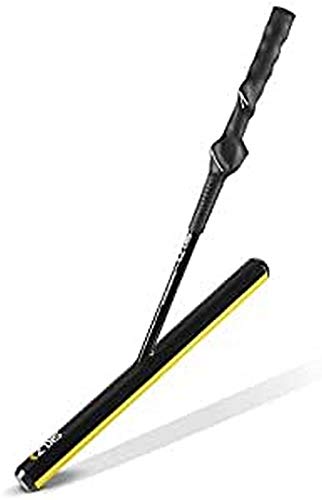
Momentus Power Swing Fatgrip Trainer
An oversized fat grip quiets excess hand and wrist action, while added head weight builds swing strength over repeated reps. One club covers the whole routine, with no radar or extra parts to buy. It suits backyard or garage practice more than fine-tuned feedback work.
Pros
- Fat grip curbs excess hand and wrist action
- Builds swing strength through added head weight
- Costs less than multi-piece training systems
Cons
- Heavy swings can groove a slower tempo if overused
- Gives no precision path or plane feedback
How they stack up
| # | Model | Length | Best for | Score | Price |
|---|---|---|---|---|---|
| 1 | Orange Whip Full Swing Trainer | 47 inches (full swing model) | Best overall | 9.4 | Check price |
| 2 | SuperSpeed Golf Training System | Three graduated-weight training clubs | Best for swing speed and power gains | 9.2 | Check price |
| 3 | SKLZ Gold Flex Swing Trainer | Mid iron length | Best for swing tempo | 9.0 | Check price |
| 4 | Tour Striker Smart Ball | Inflatable squeeze ball with hand pump | Best for ball striking and impact position | 8.8 | Check price |
| 5 | Eyeline Golf Speed Trap 2.0 | Alignment rods, base connector, carry pouch | Best for range portability | 8.6 | Check price |
| 6 | Explanar Golf Swing Trainer | Adjustable circular frame with freestanding base | Best for swing plane consistency | 8.3 | Check price |
| 7 | Momentus Power Swing Fatgrip Trainer | Oversized fat grip design | Best value | 8.0 | Check price |
Frequently asked questions
Do golf swing trainers actually work?
They work when matched to a real fault and used alongside normal range practice, not instead of it. Owners report the clearest gains from aids that give direct feedback, like a gate you clip or a speed number you track, over aids that rely on a vague feel.
Which training aid helps fix a slice?
A slice usually comes from an out-to-in path, so the Eyeline Golf Speed Trap 2.0 gate or the Explanar hoop address it directly by making the correct path visible or physically enforced. A weighted tempo trainer will not fix a path fault on its own.
Can I use a golf swing trainer indoors?
Compact aids like the Tour Striker Smart Ball or the Momentus Fatgrip trainer suit shorter, controlled indoor swings. Full-length aids like the Orange Whip or SKLZ Gold Flex need garage or backyard clearance overhead and to the sides.
How often should I practice with a swing trainer?
SuperSpeed’s protocol calls for three sessions a week with rest days between. Feel-based aids like the Orange Whip or Tour Striker Smart Ball work well as a five-to-ten-minute warmup before range balls rather than a standalone session.
Are weighted golf clubs bad for your swing?
Overly heavy clubs used for long stretches can slow natural tempo and add wrist strain. Aids like the Momentus Fatgrip or SuperSpeed sticks stay within a tested weight range and a set protocol, so following the included guidance keeps risk low.
Do beginners need golf training aids?
Most beginners get more value from a few lessons on grip, stance and setup first. Once a swing repeats reasonably well, aids like the SKLZ Gold Flex or Momentus Fatgrip start adding real value by refining tempo and strength.
Can training aids increase swing speed?
Overspeed systems like SuperSpeed are built specifically for that goal, using graduated weights and a structured protocol. A radar or launch monitor is the only way to confirm actual gains, since perceived speed and measured speed often differ.
Can swing trainers replace lessons with a coach?
No. They reinforce a specific feel or position but cannot diagnose a full swing the way a coach watching video can. Pairing an aid with occasional lesson check-ins or self-recorded video catches compensations an aid alone would miss.
Orange Whip vs SuperSpeed: which trainer fits my goal?
The Orange Whip builds tempo, balance and flexibility in one flowing motion, with no speed number attached. SuperSpeed isolates raw clubhead speed through a graduated-weight overspeed protocol, best paired with a radar. Pick tempo work first if your swing already feels rushed, and speed work once tempo holds up.
Our take
Golfers who want tempo, balance and flexibility from one aid should start with the Orange Whip Full Swing Trainer. Anyone chasing measurable distance gains gets more from the SuperSpeed Golf Training System’s overspeed protocol, provided a radar is on hand to track it. For a broken impact position specifically, skip general trainers and go straight to the Tour Striker Smart Ball.