Professional Headlamps Compared: Runtime, Beam, and Weight
The Black Diamond Spot 400 suits most hikers and campers who want reliable brightness on AAA batteries. Runners get faster reaction from the Petzl Swift RL’s automatic brightness adjustment. Backpackers needing long throw and rechargeable convenience should look at the Fenix HM65R. All three balance weight against output.
Most hikers and campers do best with the Black Diamond Spot 400, which delivers 400 lumens from three AAA batteries through a simple button interface. Its main tradeoff is a bulkier housing than ultralight running headlamps, so distance runners may prefer a lighter rechargeable option instead.
Lumen ratings alone do not reveal how a beam performs in fog, rain, or a cave passage, and rechargeable batteries behave differently in cold weather than AAA cells. We compared manufacturer specifications, waterproof ratings, and owner feedback across seven current headlamp models to sort them by realistic use case.
The shortlist, ranked

Black Diamond Spot 400
Three AAA batteries push the Spot 400 up to 400 lumens, paired with a lock mode that blocks accidental activation in a pack. A red night vision setting and a dimming memory feature round out the interface, recalling the last brightness level used. IP67 waterproofing means a sudden downpour on a hike will not disable it.
Pros
- Runs on easily replaceable AAA batteries
- Lock mode prevents accidental power-on in a pack
- Red night vision mode preserves natural sight
Cons
- Bulkier housing than minimalist running headlamps
- No USB-C rechargeable option on this version

Petzl Swift RL
Reactive lighting sensors let the Swift RL adjust its brightness automatically, from 900 lumens down, as a runner’s eyes meet oncoming light or a dark patch of trail. A built-in rechargeable battery charges over USB, and a low-profile band sits close to the head to cut bounce. IP67 protection covers wet trail conditions.
Pros
- Reactive sensor adjusts brightness without manual input
- Low-profile design reduces bounce while running
- Rechargeable battery avoids ongoing AAA costs
Cons
- Runtime drops fast at maximum brightness
- Battery is not swappable in the field

Fenix HM65R
Spot and flood LEDs combine in the HM65R to reach 1400 lumens, with beam distance built for spotting trail markers well ahead of camp. Its 3200mAh battery charges through USB-C and can reverse-charge small devices in a pinch. IP68 housing tolerates submersion near a stream, not just heavy rain.
Pros
- Dual LED setup covers both spot and flood beams
- USB-C battery can charge phones and other gear
- IP68 rating withstands submersion, not just splashes
Cons
- Heavier than dedicated running headlamps
- Runs warm at maximum output for extended periods

Coast FL75R
A twist-focus lens switches the FL75R between a wide flood beam and a tight spot beam, useful for reading a schematic or checking under a hood. Rechargeable lithium-ion power or three AAA batteries keep it running when a charger is not available. Its pivoting head lets a mechanic angle light without repositioning their head.
Pros
- Twist focus adjusts beam from flood to spot
- Works on rechargeable pack or AAA backup
- Pivoting head aims light without head movement
Cons
- IPX4 rating only handles splashes, not heavy rain
- Focus ring can loosen with heavy daily use
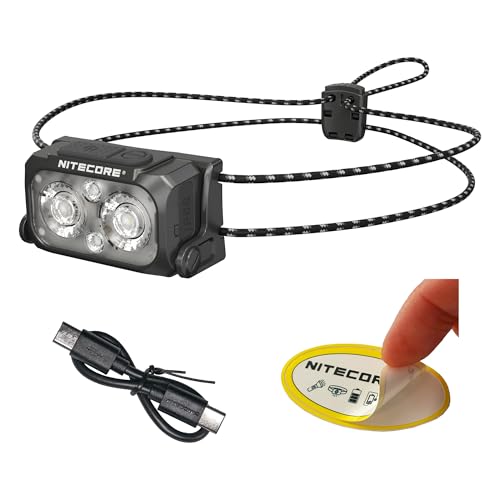
Nitecore NU25
Weighing roughly 1 ounce, the NU25 ranks among the lightest rechargeable headlamps in regular rotation among gram-counting hikers. A built-in battery charges over USB-C in about two hours and outputs up to 400 lumens. Auxiliary red and high-CRI white LEDs cover close-up tasks like map reading without draining the main light.
Pros
- Very light for all-day wear on a cap or band
- USB-C charging is fast and widely compatible
- Auxiliary red and high-CRI LEDs save main battery
Cons
- Smaller battery limits runtime at high brightness
- Beam throw is shorter than dedicated hiking headlamps

Ledlenser MH11
Mounting on a helmet as easily as a headband, the MH11 reaches 1000 lumens for climbers and cavers who need hands-free light in tight spaces. Its rechargeable 18650 battery connects through a magnetic charging cable, easier to align with gloves on. A rear red safety light adds visibility for other climbers on the same route.
Pros
- Magnetic charging port is easier to use with gloves
- Rear red safety light adds visibility to a group
- Helmet-compatible mount suits climbing and caving setups
Cons
- IP54 rating is lower than fully waterproof competitors
- Heavier on the head than minimalist trail headlamps

Olight Perun 2
A right-angle body lets the Perun 2 clip onto a headband or work as a handheld flashlight, reaching 2500 lumens at its brightest setting. A built-in 5000mAh 21700 battery charges over USB-C, with enough capacity for extended overnight use on lower settings. IPX8 sealing suits search and rescue work in wet conditions.
Pros
- Converts between headlamp and handheld flashlight use
- Large 5000mAh battery supports long overnight sessions
- IPX8 rating tolerates sustained wet conditions
Cons
- Noticeably heavier and bulkier than trail headlamps
- Maximum brightness drains the battery within minutes
Compared at a glance
| # | Model | Max lumens | Best for | Score | Price |
|---|---|---|---|---|---|
| 1 | Black Diamond Spot 400 | 400 | Best overall | 9.4 | Check price |
| 2 | Petzl Swift RL | 900 | Best for trail running | 9.1 | Check price |
| 3 | Fenix HM65R | 1400 | Best for camping and backpacking | 8.8 | Check price |
| 4 | Coast FL75R | 530 | Best for mechanics and work sites | 8.6 | Check price |
| 5 | Nitecore NU25 | 400 | Best budget pick | 8.3 | Check price |
| 6 | Ledlenser MH11 | 1000 | Best for climbing and caving | 8.1 | Check price |
| 7 | Olight Perun 2 | 2500 | Best for heavy-duty and tactical use | 8.0 | Check price |
How to pick the right one
What lumen output actually tells you Lumen figures measure total light output, not how far or wide a beam reaches. A 1000-lumen headlamp with a narrow spot lens can outshine a 400-lumen flood light at distance, yet leave trail edges dark. Manufacturers list a maximum rating measured at turn-on, and that number typically drops within minutes as the LED settles into sustained output. Beam distance and battery runtime matter alongside brightness, not brightness alone.
Rechargeable vs AAA battery headlamps Built-in lithium-ion cells power headlamps like the Petzl Swift RL and Fenix HM65R, charging over USB or USB-C and lowering long-term cost. Without an outlet nearby, though, a dead rechargeable stays dead. AAA-powered models such as the Black Diamond Spot 400 let hikers carry spare batteries and swap them in seconds, useful on multi-day trips far from power. Some headlamps, including the Coast FL75R, support both a rechargeable pack and AAA cells, giving daily users a fallback.
Which headlamp fits running, camping, or work Automatic brightness control suits runners best, since adjusting a dial mid-stride is awkward. Campers and backpackers benefit from longer beam distance and flood coverage to light a tent site or trail junction. Mechanics need a beam that switches between wide flood for a workspace and a tight spot for reading small print, plus a pivoting head to aim light without bending the neck. Climbers and cavers add helmet compatibility and a rear safety light to that list.
Beam type, weight, and head comfort Flood beams spread light evenly across a wide area, useful for camp chores and close work. Spot beams concentrate light for distance, useful on dark trails or search tasks. Dual-LED headlamps like the Fenix HM65R combine both in one unit, controlled by separate switches. Weight matters more than most buyers expect: anything over about 4 ounces starts to feel noticeable on a headband after an hour, so lighter options like the Nitecore NU25 suit long-duration wear better than heavier tactical units.
Questions worth asking
How many lumens does a professional headlamp need?
For general hiking and camping, 300 to 500 lumens on a flood or mixed beam is usually enough to light a trail or campsite. Search and rescue or tactical use often calls for 1000 lumens or more, like the Fenix HM65R or Olight Perun 2 provide, to cover longer distances or larger areas.
What is the difference between a rechargeable and AAA headlamp?
Rechargeable headlamps use a built-in lithium-ion battery charged over USB, which costs less over time but requires access to power. AAA headlamps run on replaceable batteries that can be swapped instantly in the field, a benefit on multi-day trips without charging access.
Which headlamp is best for trail running?
The Petzl Swift RL suits trail running well because its reactive lighting sensor adjusts brightness automatically based on ambient light, and its low-profile band reduces bounce compared to bulkier camping headlamps.
Can a headlamp be used for caving or climbing?
Yes, though caving and climbing favor headlamps with helmet compatibility, a secure mount, and a rear safety light, like the Ledlenser MH11. A basic running headlamp without a helmet clip is harder to secure reliably.
Is a high-lumen headlamp worth it for camping?
A high-lumen headlamp helps when scanning a campsite perimeter or setting up in the dark, but most in-camp tasks only need a few hundred lumens. Buyers who mostly camp rather than hike long distances at night can save weight with a lower-output model.
What waterproof rating should a headlamp have for hiking in rain?
An IP67 or higher rating, found on the Black Diamond Spot 400 and Petzl Swift RL, handles sustained rain and brief submersion. Lower ratings like IPX4, seen on the Coast FL75R, only resist splashes and light drizzle.
Ledlenser vs Petzl headlamps: which lasts longer on a charge?
Runtime depends on the brightness setting more than the brand. The Ledlenser MH11’s 18650 battery generally holds more capacity than the Petzl Swift RL’s internal cell, giving it an edge on extended low-brightness runtime, though the Swift RL’s reactive sensor can stretch battery life by dimming automatically in bright conditions.
Is a rechargeable headlamp better than AAA for daily work use?
For daily charging at home or a shop, rechargeable models like the Coast FL75R or Fenix HM65R avoid the ongoing cost of replacing batteries. Workers without reliable charging access, such as those on remote job sites, may prefer AAA compatibility as a backup.
How much should a headlamp weigh for all-day wear?
Headlamps under 4 ounces, such as the Nitecore NU25 at 1 ounce, stay comfortable through hours of continuous wear. Heavier tactical models like the Olight Perun 2 make more sense for short, high-output tasks than all-day use.
What is the difference between a flood beam and a spot beam?
A flood beam spreads light evenly across a wide area for close-range tasks, while a spot beam concentrates light into a narrow, longer-reaching column for distance viewing on trails or job sites.
Our pick
Most buyers who want dependable brightness without managing a battery pack should choose the Black Diamond Spot 400, thanks to its AAA compatibility and simple interface. Trail runners needing automatic brightness adjustment get more from the Petzl Swift RL instead. Anyone working on vehicles or job sites will find the Coast FL75R’s focusing beam and dual power option more useful day to day.


