Tennis Rackets for Power, Control and Comfort
The Babolat Pure Drive is the best all round tennis racket for club players who want free power, the Wilson Clash 100 v2 is the most comfortable frame on off centre hits, and the Head Ti.S6 remains the easiest entry point for beginners. The Yonex EZONE 100 splits the difference between the two.
The Babolat Pure Drive is our top overall pick for club level play, the Wilson Clash 100 v2 is the kindest frame on the arm, and the Head Ti.S6 is the lightest and most forgiving choice for a genuine beginner.
Racket choice is difficult because the specifications that actually matter, weight, balance and stiffness, are buried under marketing language about spin and speed. We compared published head sizes, unstrung weights, balance points, stiffness ratings and string patterns, alongside what owners and coaches report about comfort and swing feel.
How to choose
Weight and balance matter more than head size A light head heavy racket feels easy at first but gets pushed around by pace, while a heavier head light racket feels demanding early and rewards a developed swing. As a rough guide, beginners do well under 270 grams unstrung, improvers around 280 to 300, and experienced club players from 300 upward. Balance point tells you where that weight sits, and head light frames are far quicker at the net.
Head size, sweet spot and control Larger heads from 105 square inches upward give a bigger forgiving area and more power, which is why beginner frames are oversized. Frames at 97 to 100 square inches give more precise feedback and better directional control, which experienced players prefer. Most club players land on 100 square inches because it balances the two without committing to either extreme.
Stiffness, strings and arm health A stiff frame returns more energy to the ball but also more shock to the arm, which is the usual culprit behind tennis elbow. If you have any history of arm pain, prioritise a flexible frame such as the Clash and avoid stringing a full polyester bed at high tension. A soft multifilament string at moderate tension can transform how a stiff racket feels, often more than switching frames would.
Grip size and why it is worth measuring A grip that is too small encourages over gripping, which contributes to arm strain and lost control. Measure from the tip of your ring finger along the palm to the second crease, then match that to the grip chart. If you fall between sizes, choose the smaller one and build it up with an overgrip, because you can add material but you cannot remove it.
The top picks, ranked

Babolat Pure Drive
The Pure Drive has been the default club racket for two decades because it produces easy depth without a long swing. The 100 square inch head and open string pattern give plenty of spin potential on top of that power. It is a stiff frame, so players with elbow or wrist history should string it with a soft multifilament rather than a full polyester bed.
Pros
- Generous power without a big swing
- Open pattern helps spin
- Suits a very wide range of playing styles
Cons
- Stiff frame transmits shock
- Can feel uncontrolled for flat hitters

Wilson Clash 100 v2
The Clash 100 v2 is built around a flexible layup that bends noticeably through the ball, which is why players with tennis elbow gravitate to it. Despite the flex it holds its line on off centre contact better than most soft frames. The trade off is less raw power than the Pure Drive, so you have to generate more of it yourself.
Pros
- Among the most comfortable frames available
- Stable despite the flex
- Good control on flatter drives
Cons
- Less free power than stiffer rivals
- Feel is unusual coming from a classic frame
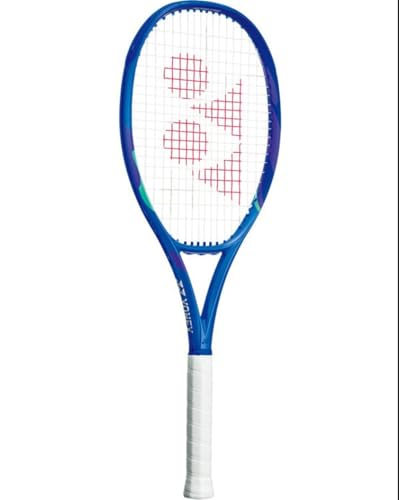
Yonex EZONE 100
The EZONE 100 sits between the Pure Drive’s power and the Clash’s comfort, with an isometric head shape that enlarges the effective sweet spot. Players report predictable depth on serves and a plush feel on volleys. It is the safest recommendation for someone who plays every part of the court rather than specialising.
Pros
- Large effective sweet spot
- Balanced power and comfort
- Plush feel at the net
Cons
- Neither the most powerful nor the softest
- Premium pricing

Head Boom MP
The Boom MP is aimed at the player moving from a light beginner frame to something with real substance, offering a soft flex profile with enough mass to stay stable against pace. Graphene reinforcement helps it resist twisting on the frame edge. It rewards a fuller swing than a beginner racket, which is exactly the habit an improver should be building.
Pros
- Good stepping stone from beginner frames
- Soft feel with real stability
- Encourages a fuller swing
Cons
- Not powerful enough for very short swings
- Beginners may find it heavy

Wilson Pro Staff 97 v14
The Pro Staff 97 is a heavy, dense patterned control racket that goes exactly where you aim it and gives nothing for free. Advanced players who supply their own pace value the flat trajectory and the composure on volleys. It is unsuitable for beginners and improvers, because a short swing produces almost no depth with this frame.
Pros
- Exceptional directional control
- Very stable against heavy pace
- Excellent feel on volleys and touch shots
Cons
- Demands a full fast swing
- Almost no free power

Babolat Pure Aero
The Pure Aero is built around aerodynamic hoop shaping and a spin friendly string bed, so the same swing produces a noticeably higher launch and heavier rotation. Baseline players who hit with a western grip get the most from it. It is stiff and can feel harsh on mishits, so string tension and material choice matter more here than on most frames.
Pros
- Produces very heavy topspin
- High launch angle gives net clearance
- Fast through the air
Cons
- Stiff and harsh on off centre hits
- Flat hitters may find balls sailing

Head Ti.S6
The Ti.S6 has stayed in the catalogue for decades because it solves the beginner’s core problem, which is getting the ball deep without a developed swing. It is extremely light with a large oversize head, so it is easy to swing and forgiving on mishits. Players who develop a real swing usually outgrow it within a season or two.
Pros
- Very light and easy to swing
- Oversize head is highly forgiving
- Lowest cost frame here
Cons
- Lacks stability against strong opponents
- Players outgrow it as technique improves
How they compare
| # | Model | Head size | Best for | Score | Price |
|---|---|---|---|---|---|
| 1 | Babolat Pure Drive | 100 square inches | Best overall | 9.4 | Check price |
| 2 | Wilson Clash 100 v2 | 100 square inches | Best for arm comfort | 9.2 | Check price |
| 3 | Yonex EZONE 100 | 100 square inches | Best for all court players | 9.0 | Check price |
| 4 | Head Boom MP | 100 square inches | Best for improvers | 8.8 | Check price |
| 5 | Wilson Pro Staff 97 v14 | 97 square inches | Best for control players | 8.6 | Check price |
| 6 | Babolat Pure Aero | 100 square inches | Best for heavy topspin | 8.3 | Check price |
| 7 | Head Ti.S6 | 115 square inches | Best budget | 8.0 | Check price |
Questions worth asking
What racket should a complete beginner buy?
Something light with a large head, such as the Head Ti.S6. It produces depth without a full swing and is forgiving on mishits, which keeps early rallies going while technique develops.
Does a more expensive racket improve my game?
Only if it suits your swing. A premium control frame in the hands of a beginner performs worse than a cheap oversize racket. Match the frame to your current level, then upgrade as your swing lengthens.
Which racket is best for tennis elbow?
The Wilson Clash 100 v2 is the most flexible frame here and is widely reported to reduce arm discomfort. String choice matters just as much, so pair it with a soft multifilament at moderate tension and consult a physiotherapist about any persistent pain.
How often should I restring my racket?
A common guideline is to restring as many times per year as you play per week. Strings lose tension steadily even when unbroken, and dead strings cost more control than most players realise.
What string tension should I use?
Lower tension gives more power and more comfort, higher tension gives more control. Most club players sit in the middle of the range printed on the frame and adjust a couple of pounds at a time to find their preference.
Does a heavier racket give more power?
It gives more plough through against incoming pace and more stability, which often reads as power. Light rackets with a head heavy balance generate easy power on a short swing instead. They achieve a similar result by different means.
What is the difference between a 16 by 19 and 18 by 20 string pattern?
Open patterns like 16 by 19 let the ball bite into the string bed for more spin and a livelier response. Denser 18 by 20 patterns give a more controlled, flatter response and last longer before breaking.
Should I buy a racket strung or unstrung?
Beginners are usually fine with a factory strung racket. Anyone playing regularly should buy unstrung and choose string and tension deliberately, because that combination affects feel more than most frame differences do.
The bottom line
The Babolat Pure Drive remains the racket that suits the widest range of club players, delivering easy depth and spin without demanding a perfect swing. Anyone with arm sensitivity should look at the Wilson Clash 100 v2 first, and genuine beginners will progress faster with the light, forgiving Head Ti.S6. Whichever frame you choose, get the grip size measured and the strings matched to your arm, because both change how a racket plays more than the model name does.


