Tennis Racquets Compared: Power vs Control Frames
The Babolat Pure Drive remains the strongest all round frame for club players who generate their own pace. The Wilson Clash 100 v3 is the pick for arm comfort, and the HEAD Ti.S6 is the value option for beginners who need free power from a light, oversized head.
For most intermediate club players the Babolat Pure Drive is still the reference frame, offering easy depth without feeling uncontrollable. The Wilson Clash 100 v3 is the better choice if your elbow or shoulder complains, and the HEAD Ti.S6 suits newer players who need the racquet to supply the power.
Racquet marketing sorts frames by player level, which is misleading. What actually matters is whether you take long fast swings or short compact ones. Long swingers need a heavier, tighter patterned control frame or the ball sails. Compact swingers need a light oversized head or nothing goes deep. We compared published head sizes, strung weights, balance points, stiffness ratings and string patterns, then weighed those against what owners report about comfort and stability against heavy hitters.
How to pick the right one
Match the frame to your swing, not your rating The most useful question is how long and fast your swing is. Players who take a full loop and accelerate through the ball need mass and a tighter pattern to keep it in the court, which points to control frames around 97 to 100 square inches at 11.5 ounces or more. Players with compact or slower swings need the racquet to supply power, which means a larger head, lighter weight and a head heavier balance.
Stiffness is the comfort variable A stiffer frame returns more energy to the ball and more shock to your arm. If you have had tennis elbow or wrist trouble, a flexible frame combined with a softer multifilament string does more for comfort than any grip or dampener. If you are healthy and want free depth, stiffness is your friend. This single trade off explains most of the difference between the Pure Drive and the Clash.
String pattern shapes spin and durability An open pattern such as 16 x 19 lets the strings move and snap back, which produces more spin and a softer feel, but the strings wear faster. A denser 18 x 20 pattern gives flatter, more predictable directional control and lasts longer. Most club players are better served by the open pattern unless they break strings weekly.
Grip size and string tension are not afterthoughts A grip that is too small makes you squeeze harder, which is a common contributor to arm pain. Measure from the middle crease of your palm to the tip of your ring finger to get a starting point, and remember overgrips add roughly a sixteenth of an inch. Tension changes the same frame significantly, so if a racquet feels too powerful or too harsh, try adjusting tension before replacing it.
What we recommend

Babolat Pure Drive
The frame that defined the modern power baseline racquet, with a stiff layup and open string spacing that turns a fast swing into heavy topspin depth. It is forgiving enough for club level play while still rewarding technique. Owners report it is unforgiving on the arm if your strings are too tight or your technique is late.
Pros
- Effortless depth on baseline drives
- Open pattern generates heavy topspin
- Stable enough to block back pace
Cons
- Stiff frame transmits shock to the arm
- Can overpower touch shots near the net

Wilson Clash 100 v3
A deliberately flexible frame that bends through contact rather than resisting it, which is why players with elbow trouble gravitate to it. Despite the flex it holds its shape well enough to stay accurate on aggressive swings. It is the frame to consider if stiffness has forced you off court before.
Pros
- Notably comfortable through contact
- Flexible feel without losing directional control
- Manoeuvrable at the net
Cons
- Less raw power than stiffer frames
- Can feel soft against very heavy hitters
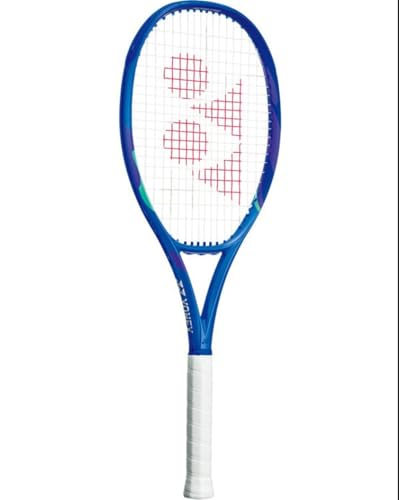
Yonex EZONE 100
The isometric head shape stretches the effective hitting area toward the upper hoop, which flatters off centre contact. It sits between the Pure Drive and the Clash on stiffness, giving power without the harshest feedback. Owners report it is particularly good on serve returns where timing is imperfect.
Pros
- Large usable sweetspot from the square head shape
- Balanced power and comfort
- Reliable on mishit returns
Cons
- Less plush than the softest frames
- Not a control frame for flat big swingers

Wilson Pro Staff 97 v14
A heavier, denser strung control frame built for players who supply their own power and want the racquet to keep the ball in the court. The smaller head demands cleaner contact and punishes lazy footwork. It is the wrong frame for a beginner and the right one for a strong flat hitter.
Pros
- Excellent directional control on flat drives
- Stable against pace with real plough through
- Classic connected feel on volleys
Cons
- Demands a full fast swing to produce depth
- Small sweetspot punishes off centre contact

HEAD Boom MP
A middle weight frame that leans slightly toward comfort while still offering enough mass to hold up in doubles exchanges. It suits players moving on from a light beginner racquet who are not yet ready for a full control frame. The open string spacing keeps topspin accessible.
Pros
- Easy transition frame from lighter racquets
- Comfortable feel without going too soft
- Handles both baseline and net play
Cons
- Neither the most powerful nor the most precise
- Less distinctive character than rivals

HEAD Ti.S6
An extremely light oversized frame that has stayed popular for decades because it makes the ball go deep with minimal effort. That comes at the cost of stability, so it struggles against players who hit hard. It is the sensible starting racquet for social players and returning beginners.
Pros
- Very light and easy to swing
- Oversized head is highly forgiving
- Generates depth without a long swing
Cons
- Twists and destabilises against heavy pace
- Head heavy balance tires the wrist

Wilson Ultra Power 100
A light, pre strung recreational frame aimed at occasional players and holiday courts rather than league matches. It is easy to swing and comfortable, with enough head size to keep rallies going. Serious improvers will outgrow it, but it does the job it was designed for.
Pros
- Arrives pre strung and ready to play
- Light enough for occasional players
- Comfortable on mishits
Cons
- Lacks stability for competitive matches
- Limited control on aggressive swings
The lineup, side by side
| # | Model | Head size | Best for | Score | Price |
|---|---|---|---|---|---|
| 1 | Babolat Pure Drive | 100 square inches | Best overall | 9.4 | Check price |
| 2 | Wilson Clash 100 v3 | 100 square inches | Best for arm comfort | 9.2 | Check price |
| 3 | Yonex EZONE 100 | 100 square inches | Best for spin and feel | 9.0 | Check price |
| 4 | Wilson Pro Staff 97 v14 | 97 square inches | Best for control players | 8.8 | Check price |
| 5 | HEAD Boom MP | 100 square inches | Best for improving intermediates | 8.6 | Check price |
| 6 | HEAD Ti.S6 | 115 square inches | Best budget | 8.3 | Check price |
| 7 | Wilson Ultra Power 100 | 100 square inches | Best for casual social play | 8.0 | Check price |
Questions worth asking
What racquet should a beginner buy?
Something light, around 9 to 10 ounces strung, with a head size of 100 square inches or larger. That combination is easy to swing and forgiving on off centre contact. Avoid heavy control frames early, because they require a developed swing to produce any depth.
Does a heavier racquet really help?
It helps against pace, because mass resists twisting and pushes through the ball. It hurts if you cannot swing it comfortably for a full match. The right weight is the heaviest frame you can still swing with good form in the third set, not the heaviest you can lift.
Which racquet is best for tennis elbow?
A flexible frame paired with a soft multifilament or natural gut string at moderate tension. The Clash is the most commonly recommended flexible frame here. Technique and string choice matter at least as much as the racquet, so treat it as one part of a broader fix.
How often should I restring?
A common guideline is to restring as many times per year as you play per week, at minimum. Polyester strings lose tension and playability well before they break, so waiting for a snapped string means playing on dead strings for weeks.
Does head size change how much spin I get?
Indirectly. Larger heads have longer main strings that move more, which can help spin, but string pattern and string type matter more. An open pattern with a shaped polyester string is the usual combination for players chasing heavy topspin.
Should I buy the same racquet the pros use?
Only if your swing resembles theirs. Professional frames are usually customised with added weight and strung far tighter than the retail versions. The retail model with a stock setup is a genuinely different racquet from the one on television.
How do I choose a grip size?
Hold the racquet and check that a finger fits in the gap between your fingertips and palm. If you are between sizes, choose the smaller one and build it up with an overgrip, because you can add material but you cannot remove it.
Is a pre strung racquet good enough?
For social and occasional play, yes. Factory strings are generally basic synthetic gut at a middling tension, which is perfectly serviceable. Once you are playing weekly and caring about spin or comfort, a custom string job changes the racquet more than most people expect.
The verdict
The Babolat Pure Drive is the pick for club players who swing fast and want depth without fighting for it. Choose the Wilson Clash 100 v3 if arm comfort is your limiting factor, and the Wilson Pro Staff 97 v14 if you already generate plenty of pace and need control instead. Beginners should start light with the HEAD Ti.S6 and upgrade once the swing develops.