7 Propane Heaters That Keep Garages and Patios Warm
Mr. Heater’s MH9BX Buddy leads this list, pairing 4,000 to 9,000 BTU output with an oxygen depletion sensor for indoor rated use. The MH18B Big Buddy doubles that output for larger garages. Dyna-Glo’s 18,000 BTU cabinet heater suits a room you heat every winter.
Mr. Heater’s MH9BX Buddy tops this list because it carries indoor use approval and covers roughly 225 square feet from a single pound cylinder. Larger spaces need the MH18B Big Buddy and its 18,000 BTU ceiling. A room heated regularly calls for a Dyna-Glo cabinet unit running off a 20 pound tank instead.
BTU figures alone tell you little, since output means nothing without insulation, ceiling height and ventilation. Radiant heaters warm objects and people directly, while forced air pushes hot air through a space. We compared BTU ranges, stated coverage, oxygen depletion sensors, tip over switches, fuel connections and altitude limits. Owner feedback on run time per cylinder rounded out the comparison.
How to choose
How many BTU do you need for your space? A rough starting point for a moderately insulated space is 30 to 40 BTU per square foot. A 200 square foot workshop lands near 8,000 BTU, matching the 9,000 BTU Buddy setting. Uninsulated garages, high ceilings and open doorways push that number up sharply. Forced air units in the 70,000 BTU class exist for construction shells, not finished rooms.
Radiant, cabinet or forced air: which type fits your use? Radiant heaters warm objects and people directly in their line of sight. That works well when you sit still in a workshop or hunting blind. Cabinet heaters use ceramic plaques and a hidden tank, suiting a room heated repeatedly. Forced air blows heated air through a space, working fastest in large open areas at the cost of noise. Catalytic units, like the Wave-3, run flameless and silent for vehicles.
Is it safe to use a propane heater indoors? Only heaters explicitly rated for indoor use belong inside, and even those need fresh air. Look for an oxygen depletion sensor that cuts gas as oxygen drops, plus a tip over shutoff. Crack a window or vent roughly one square inch per 1,000 BTU. Fit a battery carbon monoxide alarm in the same room regardless of rating. Never run a forced air or patio heater indoors.
How long does a propane cylinder last, and does cold weather matter? A 1 pound cylinder holds about 21,000 BTU of energy. A 9,000 BTU heater on high empties one in roughly two hours. A 20 pound tank holds about twenty times that, which is why hose kits pay for themselves over time. Regulators can freeze in deep cold as liquid propane struggles to vaporize. Altitude above about 7,000 feet trips the oxygen sensor on many indoor rated units.
What we recommend
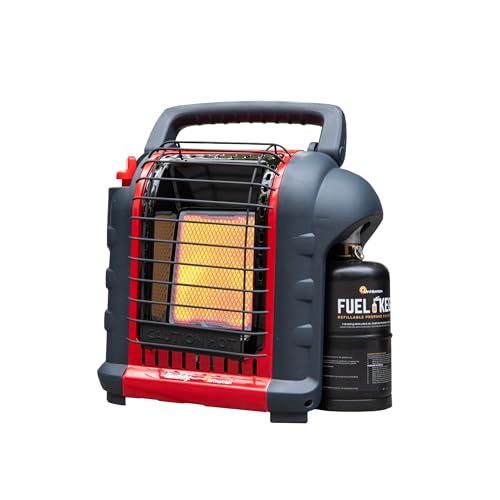
Mr. Heater MH9BX Buddy Portable Propane Heater
Two heat settings deliver 4,000 or 9,000 BTU, enough for roughly 225 square feet in a workshop or tent. An oxygen depletion sensor cuts the gas if oxygen falls, and a tip over switch shuts it down if knocked. It runs on a 1 pound cylinder, or a 20 pound tank through a hose and filter.
Pros
- Indoor use approval backed by an oxygen sensor
- Fold down handle and swivel regulator for storage
- Runs several hours on one small cylinder
Cons
- Shuts off automatically above about 7,000 feet elevation
- Hose use requires an extra fuel filter
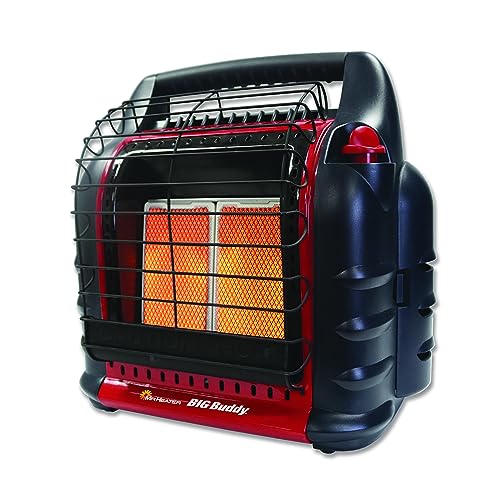
Mr. Heater MH18B Big Buddy Portable Heater
Three settings run 4,000, 9,000 or 18,000 BTU, covering roughly 450 square feet. Two 1 pound cylinders mount on the sides, or a hose feeds it from a 20 pound tank for longer sessions. An internal fan spreads heat further than radiant alone.
Pros
- Fan pushes warm air across a two car garage
- Dual cylinder mounts extend unattended run time
- Same indoor safety systems as the smaller Buddy
Cons
- Fan needs D cell batteries unless you add the adapter
- Heavier and bulkier to carry than the MH9BX

Dyna-Glo 18,000 BTU Liquid Propane Cabinet Heater
A 20 pound tank hides inside the cabinet, removing any external hose or cylinder to trip over. Three ceramic plaques deliver 6,000, 12,000 or 18,000 BTU across roughly 700 square feet. Casters let you roll it between rooms without disconnecting the tank.
Pros
- Tank stays hidden inside with nothing to trip over
- Casters make repositioning simple
- Highest coverage among the indoor rated units here
Cons
- Too bulky to carry to a campsite
- Piezo ignition needs firm pressure to light

Mr. Heater F215100 MH4B Little Buddy
This heater screws straight onto a 1 pound cylinder and radiates 3,800 BTU across roughly 95 square feet. A 45 degree heating angle aims warmth at a person rather than a whole room. Run time reaches about 5.5 hours on a single cylinder.
Pros
- Compact size fits a tent or ice shelter
- Long run time from one small cylinder
- Automatic shutoff triggers if it tips over
Cons
- Only one heat setting with no adjustment
- No hose port for a larger 20 lb tank

Camco Olympian Wave-3 Catalytic Safety Heater
Catalytic combustion produces no open flame, which is why RVs, vans and boat cabins commonly use this design. Output adjusts between 1,600 and 3,000 BTU, heating around 130 square feet without a fan or electricity. It mounts on a wall bracket or sits on optional legs.
Pros
- Silent, flameless operation with no fan noise
- Very low fuel use suits overnight running
- Needs no power, ideal for off grid vans
Cons
- Requires a permanent propane line to install properly
- Takes several minutes to warm up from cold

DeWalt DXH70CFAV 70,000 BTU Forced Air Propane Heater
A blower fires hot air down a steel barrel, warming open construction spaces up to about 1,750 square feet. Output varies from 30,000 to 70,000 BTU, letting you throttle down once a space warms. It needs a mains outlet for the fan plus a 20 pound or larger tank.
Pros
- Warms a large open shell faster than radiant models
- Variable output saves fuel once the space warms
- Steel housing withstands job site knocks
Cons
- Loud blower makes conversation difficult nearby
- Unsuitable for enclosed living spaces without ventilation
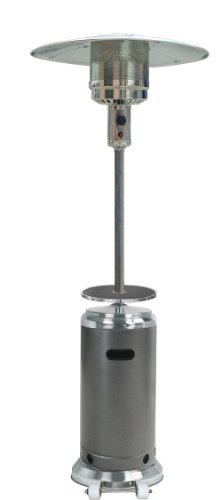
AZ Patio Heaters Hiland HLDS01-GTHG Patio Heater
A 48,000 BTU burner under a reflector hood pushes warmth outward across a patio seating area. The base holds a 20 pound tank, and wheels let one person reposition it against a wall. Powder coated steel construction handles rain better than plain steel.
Pros
- Heats a whole seating area, not just one person
- Wheels make repositioning simple for one person
- Anti tilt valve cuts gas if it starts falling
Cons
- Strictly outdoor use with no indoor approval
- Wind reduces its effective heat output significantly
How they compare
| # | Model | Output | Best for | Score | Price |
|---|---|---|---|---|---|
| 1 | Mr. Heater MH9BX Buddy Portable Propane Heater | 4,000 and 9,000 BTU settings | Best overall | 9.4 | Check price |
| 2 | Mr. Heater MH18B Big Buddy Portable Heater | 4,000, 9,000 and 18,000 BTU | Best for large garages | 9.2 | Check price |
| 3 | Dyna-Glo 18,000 BTU Liquid Propane Cabinet Heater | 6,000, 12,000 and 18,000 BTU | Best for a fixed room | 9.0 | Check price |
| 4 | Mr. Heater F215100 MH4B Little Buddy | 3,800 BTU, single setting | Best portable | 8.8 | Check price |
| 5 | Camco Olympian Wave-3 Catalytic Safety Heater | 1,600 to 3,000 BTU adjustable | Best for RVs and boats | 8.6 | Check price |
| 6 | DeWalt DXH70CFAV 70,000 BTU Forced Air Propane Heater | 30,000 to 70,000 BTU variable | Best for job sites | 8.3 | Check price |
| 7 | AZ Patio Heaters Hiland HLDS01-GTHG Patio Heater | About 48,000 BTU | Best for patios | 8.0 | Check price |
Questions worth asking
Can you use a propane heater indoors safely?
Only models rated for indoor use, such as the Mr. Heater Buddy series, Dyna-Glo cabinet heaters and catalytic units. They need an oxygen depletion sensor, fresh air, and a carbon monoxide alarm in the room.
How many BTU does a two car garage need?
Roughly 18,000 BTU suits an insulated two car garage around 450 square feet, which is exactly what the Mr. Heater MH18B Big Buddy delivers on high. Uninsulated garages need considerably more output or a forced air unit.
How long does a 1 pound propane cylinder last?
About two hours at 9,000 BTU, three hours at 4,000 BTU, and roughly 5.5 hours on the 3,800 BTU Little Buddy. Cold ambient temperatures shorten all of these figures.
What is an oxygen depletion sensor, and do I need one?
It is a safety device that shuts the gas valve when room oxygen falls below a safe level. Any heater used inside a tent, cabin, garage or ice house should include one. Outdoor patio and forced air heaters generally skip this feature.
Is a propane heater cheaper to run than an electric heater?
Usually yes for spot heating, since propane delivers more heat per unit without needing wiring. Electric heaters stay simpler and safer indoors but are capped by a 15 amp circuit, limiting output near 5,100 BTU equivalent.
Can you connect a Buddy heater to a 20 lb propane tank?
Yes, using a propane hose and, importantly, a fuel filter. Standard hoses leach plasticizer that clogs the heater’s orifice, which is why Mr. Heater sells a dedicated filter for this exact purpose.
Why does my propane heater shut off at high altitude?
Indoor rated heaters with oxygen depletion sensors read thinner mountain air as low oxygen. Many Buddy series units cut out above roughly 7,000 feet. Higher altitude use generally calls for a different heater type entirely.
What is the best propane heater for tent camping?
The Mr. Heater MH4B Little Buddy at 3,800 BTU is the usual pick, since it stays small, includes an oxygen sensor and tip over switch, and runs 5.5 hours per cylinder. Keep a vent cracked and never sleep with it running.
Propane heater vs electric heater: which suits a garage better?
Propane heaters like the MH18B Big Buddy heat larger uninsulated garages faster and cost less to run per BTU. Electric heaters need no fuel storage and carry no carbon monoxide risk, but a standard outlet limits their output substantially.
Final word
Mr. Heater’s MH9BX Buddy remains the propane heater to buy first, since indoor approval plus two output settings covers workshops, ice houses and tents. Larger spaces justify the MH18B Big Buddy and its fan, while a room heated every winter suits a Dyna-Glo cabinet unit better. Size by square footage and insulation, then confirm any model carries an oxygen depletion sensor before using it inside.