Pry Bars That Make Demolition and Prying Jobs Easier
Estwing HB-12 Handy Bar leads for trim and finish work, since its thin heel slides behind moulding without crushing it. Vaughan B215 Superbar suits general demolition as the better all-purpose flat bar. Mayhew 61361 Dominator set handles mechanical prying, with four rolling head lengths for bushings, seals and suspension parts.
Estwing HB-12 Handy Bar tops this comparison for trim work, since its thin wide heel lifts moulding without leaving a crescent dent in drywall. Vaughan B215 Superbar works better across general demolition tasks. Mechanics pulling bearings and seals need a different head shape, which is where the Mayhew Dominator set fits.
Picking one is confusing because the category spans finish trim tools and 36 inch wrecking bars under a single name. Blade thickness, steel grade and heel geometry decide whether a bar slides under a baseboard or crushes it. We compared lengths, steel types, blade profiles and strike cap designs, then weighed owner feedback on bars that bent under load or chipped at the tip.
What to look for
What should you look for in a pry bar? Three factors decide performance. Blade thickness sets what the bar can enter, so a thin ground heel gets behind trim while a thick chisel needs a gap to start in. Steel matters next, since forged one piece bars and spring steel flat bars return straight after flexing, whereas cheap stamped bars take a permanent bend. A strike cap on the head also matters, because hammering an unhardened top mushrooms the steel and ruins the tool.
How long a pry bar do you actually need? Leverage scales with length, and so does the damage a bar can cause. Twelve to fifteen inch bars like the Estwing HB-12 and Vaughan B215 give control for trim, flooring and cabinets. Eighteen inches suits pallets and light framing work. Thirty six inch wrecking bars generate enough force to lift joists, which also means enough force to snap what you were trying to save, so pick the shortest bar that does the job.
Which pry bars work best for trim, flooring and salvage? Saving the material changes the tool choice completely. A wide thin heel spreads pressure across a larger area, so drywall does not dent and moulding does not split. Slide a scrap of wood behind the bar as a fulcrum, then work along the length in small lifts instead of levering hard at one point. Pulling nails through from the back of trim avoids blowing out the visible face.
When is a flat bar the wrong tool for mechanical prying? Automotive work needs a different head shape entirely. Rolling head bars such as the Mayhew Dominator keep contact with a component as the bar rotates, which stops the tip skating off a seal or bushing. Indexing sets add adjustable angles for blind joints that a straight bar cannot reach. Never use a screwdriver as a pry bar, and never extend a bar with a pipe, since forged tools are heat treated for a specific load and can fail suddenly.
What we recommend

Estwing HB-12 Handy Bar Nail Puller
Twelve inches of forged steel with a thin, wide heel makes this the pick for lifting baseboard, casing and floorboards. Nail slots sit at both ends, and the wide bearing surface spreads pressure so drywall does not dimple. Estwing forges it from one piece, leaving no weld to fail under leverage.
Pros
- Thin heel slides behind moulding without splitting it
- Wide bearing face avoids denting drywall
- One piece forging with nothing to break
Cons
- Twelve inches limits leverage on framing work
- No strike cap for hammering the tip in

Vaughan B215 Superbar
Vaughan grinds both ends to a fine bevel, so the bar starts into a tight joint instead of skating off it. Fifteen inches balances leverage against working inside a stud bay. Spring steel construction lets the bar flex under load and return straight rather than taking a set.
Pros
- Fine bevels start into tight seams
- Flexes and returns straight rather than bending
- Good balance of leverage and manoeuvrability
Cons
- Thin blade can chip if struck at an angle
- Painted finish wears off quickly in use

Stanley FatMax 55-515 Bar
Stanley adds a strike cap to the top, so a hammer can drive the blade into a joint without mushrooming the steel. Twelve inches with a ground chisel end covers general demolition and stubborn nails. Its beveled nail slot grips shanks that other bars slip off.
Pros
- Strike cap lets you hammer the bar into place
- Widely stocked at a low cost
- Nail slot holds shanks securely
Cons
- Thicker blade than dedicated trim bars
- Finish chips after moderate use

DEAD ON Tools Annihilator Wrecking Bar
One head combines a nail puller, a board grabber, a bottle opener and a hex hole for turning lag bolts. Weight concentrates behind the head, which helps when driving the claw into sheathing. According to the listing it can substitute for a hammer when knocking apart framing, though not for precision trim work.
Pros
- Multiple prying and grabbing features in one head
- Hex hole turns lag bolts without a wrench
- Heavy enough to swing like a small wrecking tool
Cons
- Too aggressive for finish carpentry
- Bulky head does not fit narrow gaps

Mayhew 61361 Dominator Pry Bar Set
Four bars from about 8 to 25 inches use a curved rolling head that keeps contact as the bar rotates through its stroke. Strike caps let you hammer them into a seized joint. Screwdriver style grips give control when separating bushings, seals or suspension components.
Pros
- Rolling head maintains contact through the stroke
- Strike caps handle hammer blows without splitting
- Four lengths cover engine bay to suspension work
Cons
- Not designed for nail pulling or trim
- Grips get slippery with oil on the hands
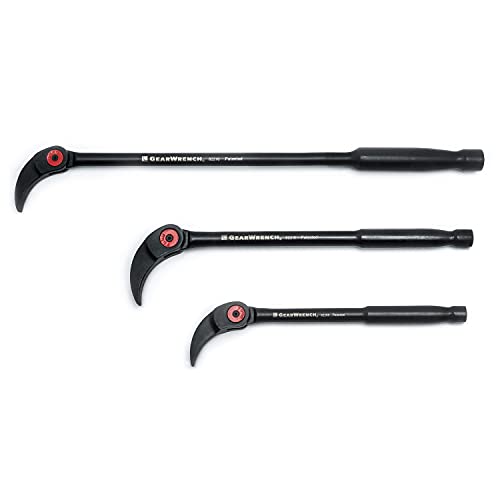
Gearwrench 82304 Indexing Pry Bar Set
Each bar head indexes through multiple locked angles, so the blade can be set to match a joint that cannot be reached straight on. Chrome vanadium steel with a black oxide finish resists corrosion in a damp shop. Four lengths let you match leverage to the space available.
Pros
- Head angles adjust for blind or tight joints
- Chrome vanadium resists corrosion in a damp shop
- Cushion grips reduce hand fatigue
Cons
- Indexing mechanism adds a potential failure point
- Locked head has less strength than a solid bar
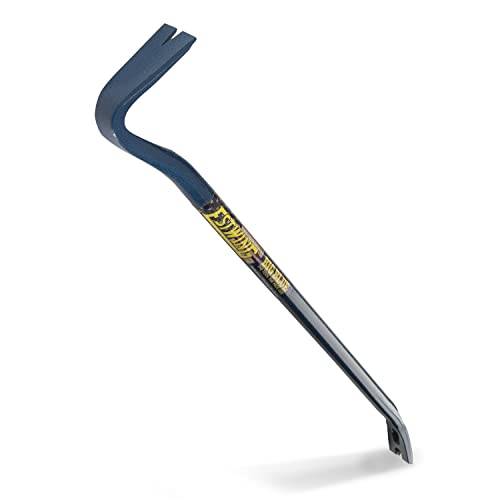
Estwing E3-36 Gooseneck Wrecking Bar 36 inch
Three feet of forged steel turns modest hand force into enough leverage to lift joists and pull framing nails. A gooseneck claw sits at one end and a chisel blade at the other. Owners report treating it as a two hand demolition tool rather than something for a tool belt, given the weight.
Pros
- Longest leverage in this group by a wide margin
- One piece forging handles extreme load
- Gooseneck pulls large framing nails cleanly
Cons
- Heavy and awkward to carry on a belt
- Far too much bar for interior trim work
The lineup, side by side
| # | Model | Length | Best for | Score | Price |
|---|---|---|---|---|---|
| 1 | Estwing HB-12 Handy Bar Nail Puller | 12 inches | Best overall | 9.4 | Check price |
| 2 | Vaughan B215 Superbar | 15 inches | Best flat bar for demolition | 9.2 | Check price |
| 3 | Stanley FatMax 55-515 Bar | 12 inches | Best value | 9.0 | Check price |
| 4 | DEAD ON Tools Annihilator Wrecking Bar | 18 inches | Best for heavy demolition | 8.8 | Check price |
| 5 | Mayhew 61361 Dominator Pry Bar Set | Four bars, roughly 8 to 25 inches | Best for mechanics and automotive work | 8.6 | Check price |
| 6 | Gearwrench 82304 Indexing Pry Bar Set | Four indexing bars | Best for tight or blind joints | 8.3 | Check price |
| 7 | Estwing E3-36 Gooseneck Wrecking Bar 36 inch | 36 inches | Best long bar for maximum leverage | 8.0 | Check price |
Good to know
What is the difference between a pry bar and a crowbar?
The terms overlap in everyday use, but a crowbar usually refers to a heavier, longer demolition bar, while a pry bar covers the wider family including thin flat bars, wrecking bars and mechanical prying sets.
Which pry bar is best for removing baseboard without damage?
The Estwing HB-12 Handy Bar, because its thin wide heel spreads pressure and slips behind moulding. Put a scrap of wood between the bar and the wall, then lift in small increments along the length.
Can you hit a pry bar with a hammer?
Only if it has a strike cap, like the Stanley FatMax 55-515 or the Mayhew Dominator bars. Striking the top of a bar not designed for it mushrooms the steel and can throw fragments.
What size pry bar should you buy first?
A 12 to 15 inch flat bar covers the widest range of household work. The Vaughan B215 Superbar at 15 inches handles demolition, nail pulling and light trim, which is why it is the usual first purchase.
Are rolling head pry bars worth it for automotive work?
Yes, if you separate bushings, seals or suspension parts regularly. The curved head stays in contact as the bar rotates, so the tip does not slip off and gouge the component, unlike a flat carpentry bar.
Will a pry bar bend under heavy load?
Good spring steel bars flex and return straight. Forged one piece bars such as the Estwing models resist bending entirely. Cheap stamped bars take a permanent set, after which they never seat properly in a joint again.
How do you pull nails that are bent over?
Use the beveled nail slot on a flat bar and roll the bar over its heel rather than pulling straight up. If the head has snapped off, drive the claw of a gooseneck bar under the shank and lever from there.
Is an indexing pry bar set better than fixed bars?
Indexing sets like the Gearwrench 82304 help when a joint cannot be approached straight on. Fixed one piece bars stay stronger under extreme load, so many owners keep both and reach for the solid bar during heavy prying.
How many pry bars does a typical homeowner actually need?
Two usually cover most jobs: a 12 to 15 inch flat bar for trim and general prying, plus a longer wrecking bar for occasional framing or joist work. Mechanical rolling head sets only make sense once automotive repair enters the picture.
Our pick
Estwing HB-12 Handy Bar is the pry bar to reach for most often, since finish carpentry punishes any tool that dents or splits what it touches. Broader demolition work is better served by the Vaughan B215 Superbar, which flexes and springs back rather than taking a set. Mechanics should look past both and choose the Mayhew Dominator set, where a rolling head keeps the tip on the part instead of skating off it.