How to Pick a Battery Tester for AA Cells or a Car Battery
OPUS BT-C3100 delivers the most accurate per-cell capacity data for AA and AAA NiMH batteries. La Crosse Technology BC1000 charges eight cells at once and moonlights as a power bank. Drivers checking a car battery should reach for ANCEL BST500, which prints CCA results from a built-in thermal printer.
OPUS BT-C3100 fits hobbyists who cycle AA or AAA NiMH cells often, since each of its four slots tracks capacity and resistance independently. It skips C and D sizes entirely, so a mixed battery drawer still needs a second charger.
Battery testers split into two unrelated jobs: reading small rechargeable cells and load-testing a 12V car battery. We compared slot counts, CCA ranges, display types and owner feedback on reading accuracy to match each pick to its real use case.
Our top picks
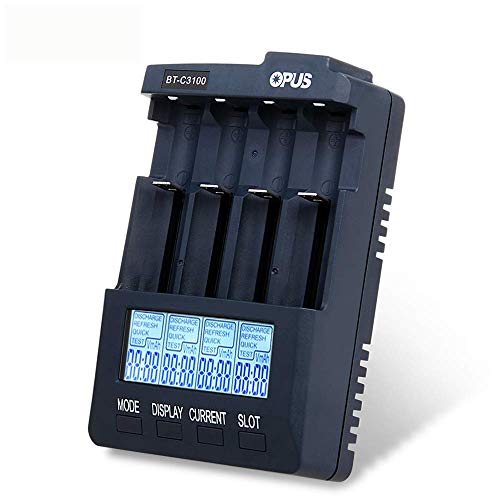
OPUS BT-C3100 V2.2
Four independent slots on the OPUS BT-C3100 V2.2 run AA or AAA cells through separate charge, discharge and capacity cycles. Each LCD segment shows live voltage, current and milliamp-hour capacity per cell. Break-in and cycle modes can revive NiMH batteries that sat unused for months, though C and D sizes never fit its bays.
Pros
- Four slots test and report independently, with no shared readout
- Live voltage, current and resistance display updates per cell
- Break-in mode can restore capacity on tired NiMH batteries
Cons
- Only accepts AA and AAA sizes, never C or D
- A full discharge-then-charge cycle can run several hours
La Crosse Technology BC1000 Alpha Power
Eight bays on the La Crosse BC1000 Alpha Power charge AA or AAA Ni-MH cells at once, each with its own backlit LCD for status and estimated capacity. A refresh and discharge cycle recalibrates batteries that no longer hold a full charge. Its USB output can also top off a phone from spare cells, useful when outlets are scarce.
Pros
- Eight bays cost less per slot than most 4-bay analyzers
- Refresh and discharge cycle brings back capacity on tired cells
- USB output doubles as a small power bank
Cons
- Capacity readout is less precise than dedicated analyzers
- Supports Ni-MH only, not Ni-Cd or other chemistries

EBL 906 Smart Battery Charger
Eight slots on the EBL 906 accept AA, AAA, C, D and 9V Ni-MH or Ni-Cd batteries, though only four channels get independent LCD tracking. A discharge function refreshes cells before long-term storage instead of leaving them half charged. Capacity shows as a simple percentage rather than an exact milliamp-hour figure, a tradeoff for covering five formats at this price.
Pros
- Handles five battery formats including 9V in one charger
- Discharge and refresh cycle suits pre-storage maintenance
- Slot count is high for the price
Cons
- Only 4 of 8 slots show independent LCD readouts
- Capacity displays as a percentage, not exact mAh
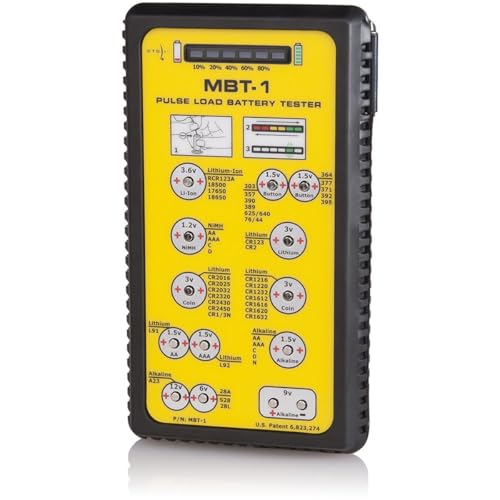
ZTS MBT-1 Multi Battery Tester
A pulse-load test on the ZTS MBT-1 reads NiMH, NiCd, alkaline, lithium coin and Li-ion cells without asking which chemistry is loaded. Photographers and electronics technicians use it to sort mixed battery drawers in seconds per cell. It checks one battery at a time, so bulk overnight charging is not its job.
Pros
- One tool tests both rechargeable and disposable chemistries
- Pulse-load reading takes seconds per battery
- No chemistry dial to set before testing
Cons
- Tests a single cell at a time, with no charging function
- Costs more than most AA/AAA analyzer chargers

ANCEL BST500
Clamps from the ANCEL BST500 read cold cranking amps from 100 to 2000 CCA on 12V or 24V lead-acid batteries. Cranking and charging systems get checked in the same sequence, then results print from a built-in thermal printer. Shops that hand customers a receipt benefit most, though small NiMH or NiCd cells stay outside its scope.
Pros
- Built-in thermal printer outputs results without a phone or app
- Covers both 12V and 24V battery systems
- Tests cranking and charging systems, not just the battery
Cons
- Cannot read AA/AAA rechargeable cells
- Printer paper is a consumable that needs restocking
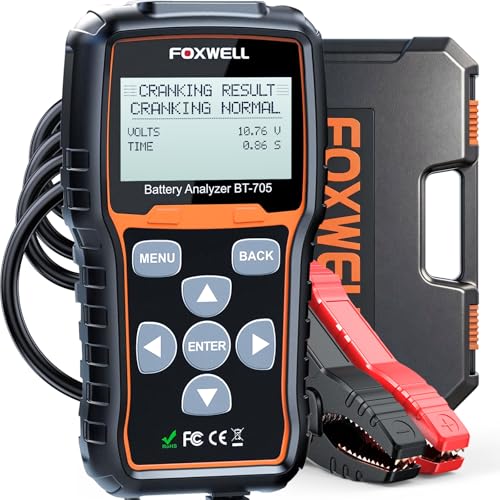
FOXWELL BT705
A color TFT screen on the FOXWELL BT705 displays battery health, cranking performance and charging output for 12V and 24V lead-acid batteries. Results transfer over USB and format into printable reports through Foxwell’s companion app. Shops and serious DIYers who need a paper trail on alternator health gain the most from this setup.
Pros
- Color screen makes multi-step results easier to read
- Charging system test flags failing alternators separately from the battery
- USB reporting supports customer paperwork
Cons
- No support for small rechargeable cell formats
- App setup adds a step compared with standalone testers

TOPDON BT100
A tricolor backlit screen on the TOPDON BT100 shifts color to flag cranking or charging problems on 12V lead-acid batteries between 100 and 2000 CCA. Setup means clamping two leads onto the terminals, with no printer or app pairing required. Trucks running 24V systems and small rechargeable cells fall outside what it can test.
Pros
- Tricolor screen gives an at-a-glance health read
- Two-clamp setup skips any app pairing
- Compact size fits easily in a glove box
Cons
- No 24V support for larger trucks
- No printer or app for saving test history
Side by side
| # | Model | Battery sizes | Best for | Score | Price |
|---|---|---|---|---|---|
| 1 | OPUS BT-C3100 V2.2 | AA and AAA Ni-MH/Ni-Cd | Best overall | 9.4 | Check price |
| 2 | La Crosse Technology BC1000 Alpha Power | AA and AAA Ni-MH | Best value | 9.1 | Check price |
| 3 | EBL 906 Smart Battery Charger | AA, AAA, C, D and 9V Ni-MH/Ni-Cd | Best budget | 8.8 | Check price |
| 4 | ZTS MBT-1 Multi Battery Tester | NiMH, NiCd, alkaline, lithium coin and Li-ion | Best for multi-chemistry testing | 8.5 | Check price |
| 5 | ANCEL BST500 | 12V and 24V lead-acid | Best for 12V car batteries | 8.3 | Check price |
| 6 | FOXWELL BT705 | 12V and 24V lead-acid | Best for charging system diagnostics | 8.1 | Check price |
| 7 | TOPDON BT100 | 12V lead-acid | Best for quick handheld checks | 8.0 | Check price |
How to pick the right one
Battery Tester vs Battery Charger: What Sets Them Apart Many chargers claim to test batteries, yet most just report pass or fail after one quick pulse. Real analyzers such as the OPUS BT-C3100 or EBL 906 run full charge and discharge cycles, then calculate capacity in milliamp hours. Vehicle testers work differently: they load a 12V battery and compare voltage drop against its rated CCA. Buying the wrong category means paying for a charger when a load tester was the actual need.
How to Read Capacity, Internal Resistance and CCA Milliamp-hour capacity shows how much charge a AA or AAA cell holds against its printed rating. Internal resistance rises as a cell ages, so a climbing number on the OPUS display often predicts failure before capacity drops. Cold cranking amps measure something unrelated: the current a 12V battery delivers at low temperature during engine starts. Mixing up the two readings leads to a wasted CCA search on a AAA-only tester.
Handheld Tester or Multi-Slot Analyzer: Which Fits Your Routine Anyone managing a drawer of mixed AA and AAA cells benefits from a multi-slot analyzer that charges and tests several batteries overnight unattended. Photographers, technicians and anyone sorting loose batteries often prefer a handheld unit like the ZTS MBT-1, since it reads one cell in seconds regardless of chemistry. Bulk charging suits routine maintenance, while a handheld unit suits triage: deciding which of twenty mystery batteries are worth keeping. Budget shoppers who only own AA and AAA cells can skip the ZTS MBT-1 and save money with the EBL 906 instead.
Testing a 12V Car or Deep-Cycle Battery Without a Multimeter Voltage alone never reveals whether a car battery can still deliver strong cranking current, which is why load testers like the ANCEL BST500, FOXWELL BT705 and TOPDON BT100 simulate a load instead of a static check. Shops needing printed proof for customers lean toward the BST500’s built-in printer. Home garages often prefer the BT100’s simpler two-clamp setup and lower cost. Deep-cycle and marine batteries follow the same CCA logic, provided the tester’s voltage range covers 12V or 24V systems.
Questions worth asking
How do I know if a rechargeable battery is still good?
Check its capacity against the printed rating with an analyzer like the OPUS BT-C3100 or EBL 906. A NiMH cell reading below about 70 percent of its rated mAh after a full charge cycle is usually near the end of its life.
Which battery tester works best for AA and AAA rechargeables?
OPUS BT-C3100 gives the most detailed per-cell readout among analyzer chargers, while La Crosse BC1000 covers more batteries at once across its eight bays.
Can a car battery tester also check AA or AAA batteries?
No. Testers like the ANCEL BST500 and FOXWELL BT705 are built for 12V and 24V lead-acid batteries and cannot read small NiMH or NiCd cells. A separate AA/AAA analyzer handles those formats.
What is the difference between CCA and battery health percentage?
CCA measures the actual current a 12V battery delivers at low temperature. Health percentage compares that reading against the battery’s rated CCA, so a battery can show a high percentage yet still fail in cold weather if its rated CCA was already low.
Is the OPUS BT-C3100 worth it over a regular smart charger?
It goes further than a standard charger by running discharge, refresh and capacity-test cycles on each slot independently. A regular charger only replenishes voltage without reporting how much real capacity the cell retains.
What is the best tester for mixed battery chemistries?
ZTS MBT-1 handles NiMH, NiCd, alkaline, lithium coin cells and Li-ion with one pulse-load test, without needing to select the chemistry beforehand.
How often should rechargeable batteries get tested for capacity loss?
Testing every few months suits cells in regular rotation, and batteries pulled from long-term storage are worth testing before use. Owners report NiMH cells losing noticeable capacity after 300 to 500 charge cycles.
Do battery testers work on lithium-ion batteries?
Multi-chemistry handheld testers like the ZTS MBT-1 support Li-ion, but dedicated NiMH analyzers such as the OPUS BT-C3100 and EBL 906 are built specifically for Ni-MH and Ni-Cd chemistries, not Li-ion cells.
Which tester is cheaper for someone who only owns AA and AAA cells?
EBL 906 costs less than the ZTS MBT-1 and charges five battery formats at once, though it skips per-cell mAh readouts in favor of a percentage display.
The verdict
OPUS BT-C3100 remains the strongest pick for anyone cycling AA or AAA rechargeable batteries often, thanks to independent per-slot capacity and resistance readings. Drivers checking a car battery should reach for the ANCEL BST500 instead, since its CCA range and built-in printer suit that job better than any AA/AAA analyzer. Owners juggling mixed chemistries in one drawer get more mileage from the ZTS MBT-1’s single-cell pulse test, while budget-focused AA/AAA users can settle for the EBL 906.


