Which Reciprocating Saw Blade Cuts What You Need?
Diablo Steel Demon carbide tipped blades are the strongest all round choice, holding an edge through nail embedded timber and metal. The Milwaukee TORCH with carbide teeth is the pick for thick metal, while the DEWALT 2X Life bi-metal set covers general use at a sensible outlay.
Diablo Steel Demon carbide tipped blades are the ones to keep in the case, because they survive nails, screws and mixed demolition debris that would strip a standard blade in a single cut. For heavy metal work the Milwaukee TORCH with carbide teeth lasts longer again, and the DEWALT 2X Life bi-metal set is the practical everyday choice for wood and light metal.
Reciprocating blades are tricky to buy because packaging language rarely explains the important part, which is that tooth material and teeth per inch matter far more than brand loyalty. We compared published tooth construction, TPI ranges, blade thickness and length, universal shank compatibility and the materials each maker rates the blade for, then cross checked that against what owners report about tooth loss and blade bending in real demolition work.
What we recommend
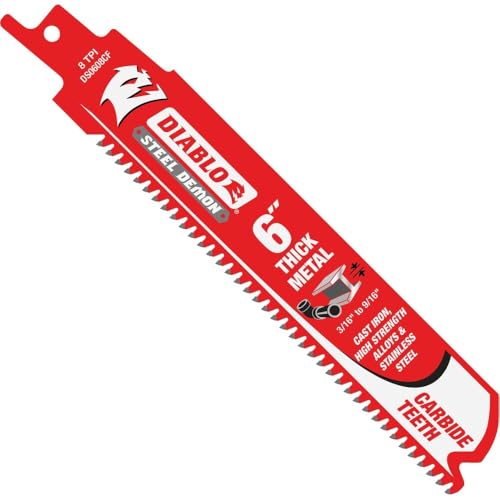
Diablo Steel Demon Carbide Tipped Reciprocating Blades
Diablo brazes carbide teeth onto a stiff steel body, which is why these blades keep cutting long after bi-metal teeth have rounded off. They handle stainless, cast iron and thick mild steel without the burn and stall that plague cheaper blades. Owners report a single blade outlasting a whole pack of standard ones on hard metal work.
Pros
- Carbide teeth last far longer than bi-metal
- Cuts hardened and stainless stock cleanly
- Thick body resists bending in deep cuts
Cons
- Considerably more outlay per blade
- Overkill for plain softwood cutting

Milwaukee TORCH with Carbide Teeth Reciprocating Blade
The TORCH range is built for cutting steel where heat kills ordinary teeth, using carbide tips and a wider body to shed vibration. It suits cast iron pipe, rebar and heavy angle iron more than framing timber. Trades report it is the blade they reach for when a bi-metal blade has already failed on a job.
Pros
- Handles rebar and cast iron reliably
- Wide body reduces flex and wander
- Long service life in hot cutting
Cons
- Aggressive tooth pitch tears softwood
- Premium outlay per blade

DEWALT DW4856 Metal and Woodcutting Reciprocating Blade Set
This set mixes coarse wood blades with fine tooth metal blades so one pack covers most household and site tasks. The bi-metal construction bends rather than snapping when a cut binds, which is forgiving for occasional users. It is the sensible starting point for anyone who has just bought their first reciprocating saw.
Pros
- Covers wood and metal in one purchase
- Bi-metal bodies flex instead of snapping
- Good spread of TPI options
Cons
- Teeth dull quickly on nail embedded timber
- No carbide blade included

LENOX Gold Reciprocating Saw Blades
LENOX applies a titanium nitride coating over bi-metal teeth, which reduces friction and slows heat build up in metal cuts. That coating buys noticeably more life than an uncoated bi-metal blade without moving into carbide pricing. It is a good middle ground for tradespeople working through mixed materials all day.
Pros
- Coating extends life over plain bi-metal
- Runs cooler in sustained metal cuts
- Reasonable cost between bi-metal and carbide
Cons
- Still no match for carbide on cast iron
- Coating wears off after heavy use

Bosch RAP9V Pruning Reciprocating Saw Blade
Pruning blades use very coarse, widely spaced teeth so sap and wet fibre clear instead of clogging the gullets. That makes the RAP9V far quicker through live branches than any general purpose blade. Keep it strictly for the garden, since those teeth are unsuited to anything containing a nail.
Pros
- Clears wet sawdust without clogging
- Very fast through live limbs
- Inexpensive to replace
Cons
- Destroyed instantly by hidden nails
- Rough finish, unsuitable for joinery
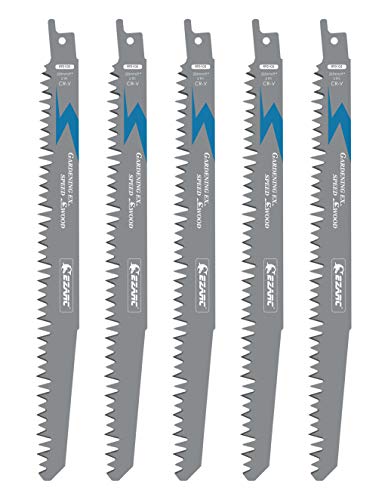
EZARC Wood Pruning Reciprocating Saw Blades
EZARC sells multi packs of long wood blades at a fraction of the outlay of the big tool brands, which suits high volume garden and demolition cutting where blades are consumable. The Japanese style teeth cut aggressively on the pull stroke. Owners report the finish is rough but the cutting speed is genuinely competitive.
Pros
- Very low cost per blade in multi packs
- Long blades reach through thick limbs
- Cuts quickly in clean timber
Cons
- Carbon steel dulls fast on anything hard
- Thin bodies can bend under side load

Milwaukee AX with Carbide Teeth Nail Embedded Wood Blade
Demolition means cutting through timber that hides nails, screws and plate steel, and standard wood teeth simply do not survive that. The AX carbide version keeps a coarse wood pitch but tips the teeth in carbide so hidden fasteners do not end the blade. It is a specialist purchase that pays off on strip out work.
Pros
- Survives hidden nails and screws
- Coarse pitch still cuts timber fast
- Thick body handles plunge cuts
Cons
- Expensive for occasional home use
- Too coarse for tidy finish cuts
How to pick the right one
Match teeth per inch to the material TPI is the single most useful number on the pack. Low counts of five to eight rip through timber quickly because the deep gullets clear big chips, while counts of fourteen to twenty four are needed for metal so that at least three teeth stay in contact with the wall of the stock at all times. Using a coarse wood blade on thin steel strips teeth almost immediately, and using a fine metal blade on framing timber simply burns.
Tooth material decides how long a blade lasts High carbon steel is cheapest and fine for clean softwood and garden work. Bi-metal blades weld a hardened tooth strip to a flexible spring steel body, which resists both dulling and snapping, and this is the sensible default. Carbide tipped teeth cost far more per blade but cut hardened steel, cast iron and nail embedded timber where the alternatives fail within a cut or two, so the cost per cut often works out lower.
Length and thickness affect control, not just reach A longer blade reaches through thicker stock but flexes more and can wander off line or slap the workpiece. Choose a blade only slightly longer than the material is thick for controlled cuts, and reserve nine and twelve inch blades for branches, joists and deep demolition. Thicker blade bodies of around 0.05 inch resist bending during plunge cuts, which matters when cutting into a wall or floor.
Get the technique right and blades last longer Most premature blade failure comes down to heat and side load. Let the shoe rest against the workpiece so the saw pulls itself in rather than bouncing, run metal cuts at a lower speed setting, and use cutting fluid on thick steel. If the blade turns blue, the temper is already gone. Keeping a small selection of pitches on hand is cheaper than forcing one blade through everything.
How they stack up
| # | Model | Tooth material | Best for | Score | Price |
|---|---|---|---|---|---|
| 1 | Diablo Steel Demon Carbide Tipped Reciprocating Blades | Carbide tipped | Best overall | 9.4 | Check price |
| 2 | Milwaukee TORCH with Carbide Teeth Reciprocating Blade | Carbide teeth | Best for thick metal | 9.2 | Check price |
| 3 | DEWALT DW4856 Metal and Woodcutting Reciprocating Blade Set | Bi-metal | Best value | 9.0 | Check price |
| 4 | LENOX Gold Reciprocating Saw Blades | Bi-metal with TiN coating | Best for long life bi-metal | 8.8 | Check price |
| 5 | Bosch RAP9V Pruning Reciprocating Saw Blade | High carbon steel | Best for green wood | 8.6 | Check price |
| 6 | EZARC Wood Pruning Reciprocating Saw Blades | SK5 carbon steel | Best budget | 8.3 | Check price |
| 7 | Milwaukee AX with Carbide Teeth Nail Embedded Wood Blade | Carbide tipped | Best for demolition | 8.0 | Check price |
Questions worth asking
What TPI should I use for cutting metal?
Aim for a blade where at least three teeth are in contact with the material at all times. That generally means 14 to 18 TPI for sheet metal and thin wall pipe, and 10 to 14 TPI for thicker steel sections. Too few teeth in contact causes snagging and tooth loss.
Are reciprocating saw blades universal?
Almost all modern blades use a universal half inch tang shank that fits any standard reciprocating saw or sabre saw, regardless of brand. Very old tools and a few compact models may use a proprietary fitting, so check your saw’s chuck before ordering.
Is a carbide blade worth the extra money?
For clean timber, no, a bi-metal blade is fine. For demolition, nail embedded wood, cast iron pipe or stainless, carbide is usually cheaper overall because one blade replaces several bi-metal blades that would each fail partway through the job.
Why does my blade keep bending?
Bending usually comes from side loading, using a blade far longer than the cut requires, or forcing the saw rather than letting the teeth work. Pressing the shoe firmly against the workpiece steadies the blade and stops the saw bouncing, which is the main cause of flex.
Can I cut tree branches with a reciprocating saw?
Yes, and a dedicated pruning blade with around five TPI does it well because the wide gullets clear damp fibre. Standard wood blades clog quickly in green timber. Never use a pruning blade on reclaimed wood that might contain fasteners.
How do I know when a blade is finished?
Look for rounded tooth tips, missing teeth, blue discolouration from overheating, or a sudden need to push harder for the same cut. A blade that has lost its temper will not recover, and pushing it harder only stresses the saw.
Can these blades cut through nails and screws?
Only blades specifically rated for nail embedded wood, which are usually carbide tipped or heavy duty bi-metal demolition blades. A standard wood blade loses teeth the moment it meets a nail, so match the blade to what is hidden in the material.
What length blade should I buy?
Choose a blade that extends roughly an inch beyond the thickness of the material at full stroke. Six inch blades handle most framing and pipe, nine inch blades suit branches and joists, and twelve inch blades are for deep demolition where control matters less than reach.
Final word
Diablo Steel Demon carbide tipped blades earn the top spot because they cut the widest range of materials without giving up teeth, which is exactly what a mixed demolition job demands. Buyers working mainly in metal should choose the Milwaukee TORCH carbide range, while the DEWALT DW4856 set remains the sensible pack for general home and site cutting.