Reptile Thermometers Built for Monitors, Snakes and Tortoises
Zoo Med’s ReptiTemp RT-600 infrared gun leads for scanning basking spots on large monitors and tortoises without reaching into the enclosure. The Exo Terra Digital Thermometer Hygrometer suits owners who want one continuous probe reading. Anyone tracking two zones at once should choose the REPTIZOO dual probe gauge instead.
Large reptiles need temperature checks from a distance more than small ones do, and the Zoo Med ReptiTemp RT-600 handles that with a laser guided infrared reading from across a tortoise table or monitor enclosure. It reads surface temperature only, not ambient air, so keepers tracking humidity need a second tool alongside it. Owners who want one continuous fixed reading instead should look at the Exo Terra Digital Thermometer Hygrometer.
A six foot iguana enclosure or a large tortoise table has a basking zone and a cool zone that can differ by twenty degrees or more, so a single reading rarely tells the full story. Infrared guns solve reach and safety around defensive animals, while probe gauges give continuous readings a keeper can check without walking over. We compared probe cable length, scanning distance, accuracy range and dual zone capability, then checked owner reports of probe failure and laser reliability over time.
What we recommend

Zoo Med ReptiTemp RT-600 Infrared Temperature Gun
A laser guided infrared sensor reads surface temperature from several feet away, useful for scanning a basking rock without disturbing a large monitor or iguana. Readings return in about half a second, fast enough to check multiple spots during one feeding visit. Surface temperature is all it measures, not ambient air.
Pros
- Checks basking spots without reaching into the enclosure
- Fast readings suit scanning multiple zones quickly
- Safe working distance for defensive or large reptiles
Cons
- Measures surface temperature only, not air
- Needs a steady hand for consistent spot readings

Exo Terra Digital Thermometer Hygrometer
One probe reads both temperature and humidity, mounted inside the enclosure with a suction cup for a continuous readout on the external display. Its cable runs long enough for most large tortoise tables and terrariums. Exo Terra’s housing matches the brand’s own enclosure line, though it works with any setup.
Pros
- One probe covers temperature and humidity together
- Continuous reading without a manual scan
- Suction mount holds through daily handling
Cons
- Single probe cannot track two zones at once
- Suction cup needs occasional repositioning

REPTIZOO Reptile Thermometer Humidity Gauge
Two probes track a hot end and a cool end at the same time, useful in a long enclosure housing a large snake or monitor. The digital display cycles between both readings on demand. Each probe’s cable reaches across enclosures several feet wide.
Pros
- Tracks basking and cool zones without moving the unit
- Long probe cables suit wide enclosures
- Digital display reads easily at a glance
Cons
- Probes need occasional recalibration checks
- Housing runs bulkier than single probe gauges
Zoo Med Digital Infrared Thermometer
This handheld gun covers the same basic job as pricier infrared thermometers, reading surface temperature from a safe distance. It skips the laser guide found on the ReptiTemp, so aiming takes more care at longer range. Spot checking a basking area a few times a day is where it works best.
Pros
- Affordable entry into infrared spot checking
- Quick readings without touching the enclosure
- Compact enough to keep near the reptile room
Cons
- No laser guide, so aiming is less precise
- Accuracy drops at longer distances

Etekcity Lasergrip 774 Infrared Thermometer
Built as a general purpose infrared thermometer, this gun works well for reptile basking checks despite not being marketed for the hobby. A laser guide helps aim at a specific rock or branch from across a large enclosure. Owners report it holding calibration well over months of regular use.
Pros
- Laser guide aids precise spot targeting
- Doubles as a general household thermometer
- Holds calibration well over months of use
Cons
- Not marketed or packaged for reptile keeping specifically
- No enclosure mounting option, handheld only
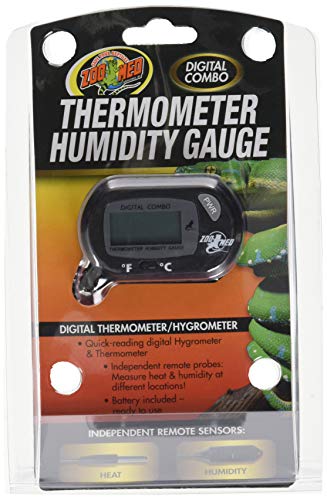
Fluker’s Digital Thermometer Humidity Gauge
A single mounted unit reads both temperature and humidity on one small display, an inexpensive way to monitor a large tortoise table’s ambient conditions. It has no second probe for tracking a separate basking zone. Suction mounting keeps it fixed to the glass or enclosure wall.
Pros
- Low cost way to add digital monitoring
- Combined display saves enclosure space
- Simple suction mount installs quickly
Cons
- Single zone reading only
- Suction mount can loosen in humid enclosures
Zilla Digital Thermometer Humidity Gauge
A longer probe cable than most combo gauges lets this unit reach across a wide enclosure to a distant basking spot. Temperature and humidity display together on one screen mounted outside the glass. Only one location reads at a time, so placement matters more than with a dual probe design.
Pros
- Long cable reaches distant basking spots
- Combined temperature and humidity display
- Easy to read from outside the enclosure
Cons
- Only monitors one location at a time
- Probe placement affects accuracy significantly
The lineup, side by side
| # | Model | Type | Best for | Score | Price |
|---|---|---|---|---|---|
| 1 | Zoo Med ReptiTemp RT-600 Infrared Temperature Gun | Infrared, laser guided | Best overall | 9.4 | Check price |
| 2 | Exo Terra Digital Thermometer Hygrometer | Digital probe, temp and humidity | Best digital probe combo | 9.1 | Check price |
| 3 | REPTIZOO Reptile Thermometer Humidity Gauge | Digital, dual probe | Best dual zone monitoring | 8.9 | Check price |
| 4 | Zoo Med Digital Infrared Thermometer | Infrared, handheld | Best value infrared | 8.6 | Check price |
| 5 | Etekcity Lasergrip 774 Infrared Thermometer | Infrared, laser guided | Best budget infrared | 8.3 | Check price |
| 6 | Fluker’s Digital Thermometer Humidity Gauge | Digital, single probe | Best budget dual gauge | 8.1 | Check price |
| 7 | Zilla Digital Thermometer Humidity Gauge | Digital, single long probe | Best for wide enclosures | 8.0 | Check price |
How to pick the right one
Why large reptile enclosures need more than one reading A large enclosure built for a monitor, big snake or tortoise usually spans a basking zone, a cool retreat and everything between. One thermometer placed in a single spot says nothing about the other end, and that gap is where cold stress or overheating starts. Dual probe gauges or a quick infrared scan across the enclosure close that gap without guesswork.
Infrared guns vs probe gauges Infrared thermometers read surface temperature instantly from a distance, suited to checking a basking rock without disturbing a defensive or fast moving reptile. Probe gauges give a continuous reading, but only from wherever the probe sits, and moving it means climbing into the enclosure. Many experienced keepers use both: a probe for baseline monitoring and a gun for quick spot checks.
What accuracy range actually matters Most reptile thermometers claim accuracy within two to three degrees Fahrenheit, close enough for daily care but not for critical incubation work. That range suits basking spots and ambient zones fine. Egg incubation calls for a dedicated high accuracy thermometer kept separate from general enclosure monitoring.
Placing a probe cable in a large tank A short probe cable forces compromises on placement in anything larger than a standard glass terrarium, often landing the probe somewhere convenient rather than somewhere useful. Extended cables reach a distant basking branch or the far corner of a tortoise table. Route the cable away from heat sources directly, since a probe touching a heat mat or bulb reads that surface, not the air.
Frequently asked questions
What is the best way to check basking spot temperature for large reptiles?
An infrared thermometer with laser guidance, since it reads the exact surface temperature from a safe distance without disturbing the animal.
Do I need two thermometers for one enclosure?
For anything larger than a standard terrarium, yes. A basking zone and a cool zone typically differ by twenty degrees or more, so one reading misses half the picture.
How accurate do reptile thermometers need to be?
Within two to three degrees Fahrenheit is standard and sufficient for daily care. Incubation work calls for a more precise, dedicated thermometer.
Can infrared thermometers measure air temperature?
No. Infrared guns read surface temperature only, so pair one with a probe gauge if ambient air temperature also needs tracking.
Why does my reptile thermometer read differently than my thermostat?
Thermostats often read from a probe near the heat source itself, while a handheld thermometer reads the actual basking surface, which can differ by several degrees.
How long do probe thermometers last in a reptile enclosure?
Most digital probe units last one to three years before displays fade or probes drift out of calibration, based on typical owner reports.
Is a laser guide necessary on an infrared thermometer?
It is not required, but it makes aiming at a specific spot far more reliable in a large enclosure, especially from several feet away.
Where should a temperature probe sit in a large tortoise table?
Near the basking area but not touching the heat source directly, ideally paired with a second probe at the cool end for a full picture.
Infrared gun vs probe gauge: which is better for a large snake enclosure?
Neither replaces the other. A probe gauge tracks baseline temperature continuously, while an infrared gun checks specific basking spots in seconds without entering the enclosure.
Final word
For scanning basking spots across a large enclosure without disturbing the animal, the Zoo Med ReptiTemp RT-600 is the strongest pick, thanks to its laser guide and fast response time. Owners who want a continuous fixed reading should choose the Exo Terra Digital Thermometer Hygrometer instead. Anyone housing a reptile that needs both a hot and cool zone tracked at once should skip single probe units and get the REPTIZOO dual probe gauge.


