Running Watches Compared: GPS, Battery and Data
The Garmin Forerunner 265 is our top pick for its bright AMOLED screen paired with proper training analysis. The Garmin Forerunner 165 covers most runners for considerably less, and the COROS PACE 3 is the battery life champion for anyone training long.
The Garmin Forerunner 265 leads this roundup because it pairs a bright AMOLED display with the training load and recovery analysis that actually changes how people train, without the size and outlay of a flagship. The Garmin Forerunner 165 covers what most runners genuinely use for noticeably less, and the COROS PACE 3 is the pick if battery life and weight matter more than ecosystem polish, since it runs for days of GPS tracking on a single charge.
Running watches are trickier to choose than the feature lists imply, because almost all of them record pace and distance accurately enough, and the differences show up in things that are harder to compare, namely how usable the training data is, how long the battery lasts once you turn the screen brightness up, and whether wrist heart rate holds up during intervals. We compared GPS band support, stated battery life in GPS mode, screen technology, training and recovery metrics, heart rate sensing and mapping, then weighed those against what owners report about strap comfort, watch face responsiveness and how much of the software they use after the first month.
The best picks, ranked

Garmin Forerunner 265 GPS Running Watch
This is the point where Garmin’s bright AMOLED screen meets the training analysis that makes the ecosystem worth buying into, including training readiness, load focus and recovery guidance. Multi band GPS holds position well in cities and under tree cover. The bright display costs battery compared with the memory in pixel screens Garmin uses elsewhere, which is the trade for a screen you can read at a glance.
Pros
- Bright screen readable at a glance mid run
- Training readiness genuinely guides sessions
- Multi band GPS handles cities and trees
Cons
- Shorter battery life than transflective rivals
- No full mapping, unlike the higher models

Garmin Forerunner 165 GPS Running Watch
For most runners this covers everything they actually use, namely accurate pace and distance, structured workouts, sleep tracking and daily suggested sessions, on the same AMOLED screen as pricier models. It drops multi band GPS and the deeper training metrics. If you run road routes and follow a plan rather than analysing load balance, the money saved buys a lot of running shoes.
Pros
- Same bright screen as the pricier model
- Covers the features most runners use
- Light and comfortable for sleep tracking
Cons
- Single band GPS drifts more in cities
- Fewer advanced training metrics

COROS PACE 3 GPS Sport Watch
Coros built this around endurance, delivering GPS tracking measured in days rather than hours in a watch light enough to forget you are wearing. Dual frequency GPS is included at a price where rivals omit it. The software is less polished than Garmin’s and the ecosystem is smaller, so it suits people who want data and battery over app features.
Pros
- Outstanding battery life for the size
- Dual frequency GPS at this level
- Extremely light on the wrist
Cons
- Software less refined than Garmin’s
- Smaller third party app ecosystem

Garmin Forerunner 965 GPS Running Watch
The 965 adds full colour onboard maps, which is the feature that matters when you are on unfamiliar trails and need to know whether the path ahead loops back. The titanium bezel and larger AMOLED screen make it a nicer object, and the full metrics suite is here. It is large on smaller wrists and represents a substantial step up in outlay over the 265.
Pros
- Onboard maps for unfamiliar routes
- Complete training metrics suite
- Premium build with a large clear screen
Cons
- Large case on smaller wrists
- Considerably more expensive than the 265
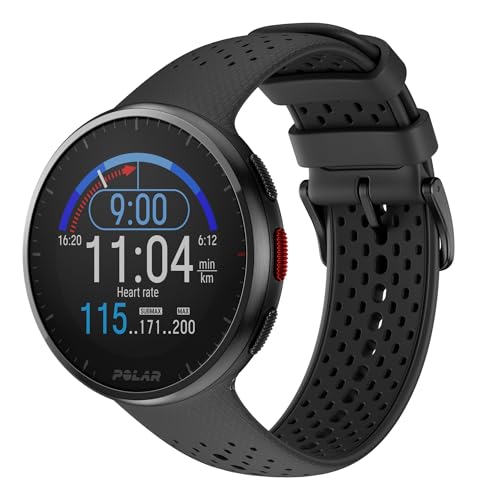
Polar Pacer Pro GPS Running Watch
Polar has always leaned toward physiology, and this watch is built around guided training with running power from the wrist, recovery tracking and a running programme feature that builds a plan for a target race. It is light and comfortable for daily wear. The screen is a conventional memory in pixel type rather than AMOLED, which suits battery life more than kerb appeal.
Pros
- Structured guidance toward a target race
- Running power without a foot pod
- Light and comfortable for all day wear
Cons
- Screen looks dull next to AMOLED rivals
- Smaller ecosystem than Garmin

Suunto Race S GPS Sports Watch
Suunto packs a bright AMOLED display, dual band GPS and offline maps into a compact case that suits smaller wrists better than most feature packed watches. Battery life is respectable for a bright screen. The training analysis is less developed than Garmin’s or Polar’s, so it appeals more to runners who want good tracking and maps than to those chasing load metrics.
Pros
- Bright screen and maps in a compact case
- Dual band GPS for accuracy in cities
- Suits smaller wrists
Cons
- Training analysis less developed than rivals
- Fewer structured workout options

Apple Watch Series 10
If you want one watch for messages, payments and running, this is the most polished option, with accurate GPS, a superb screen and a huge selection of third party training apps that fill the gaps in the built in software. The catch is battery life, which means charging daily and planning ahead for a long race. Dedicated running watches simply outlast it.
Pros
- Best smartwatch features by a distance
- Excellent screen and app selection
- Accurate GPS for road running
Cons
- Battery life requires daily charging
- Not practical for ultra distance events
How to pick the right one
Battery life is measured in different modes A watch advertised with weeks of battery means weeks in smartwatch mode with the screen mostly off, not weeks of GPS tracking. The figure to compare is hours of continuous GPS with the settings you will actually use, since always on displays and multi band tracking both cut it substantially. Work out your longest planned session, add a wide margin, and check the watch clears it comfortably.
Multi band GPS matters in specific places Dual or multi band positioning improves accuracy where signals bounce off buildings or get blocked by tree cover, which is why city runners and trail runners notice it most. On open roads and parks, single band tracking is accurate enough that you would struggle to tell the difference. Pay for it if your regular routes involve tall buildings or dense woodland, and save the money if they do not.
Wrist heart rate has known limits Optical sensors are reliable for steady efforts and daily tracking, and they struggle during intervals where heart rate changes faster than the sensor can follow, and in cold weather when blood flow to the wrist drops. If you train by heart rate zones, a chest strap paired to the watch is far more accurate. Wear the watch snug and a finger’s width above the wrist bone to get the best from the built in sensor.
Buy the data you will actually use Training readiness scores, load balance and recovery advice are genuinely useful if you follow a structured plan and adjust sessions based on them. If you run three times a week for enjoyment, they become numbers you scroll past. Be honest about which category you are in, because that decision separates a mid range watch that fits your running from a flagship whose best features go unused.
Side by side
| # | Model | Display | Best for | Score | Price |
|---|---|---|---|---|---|
| 1 | Garmin Forerunner 265 GPS Running Watch | AMOLED touchscreen | Best overall | 9.4 | Check price |
| 2 | Garmin Forerunner 165 GPS Running Watch | AMOLED touchscreen | Best value | 9.2 | Check price |
| 3 | COROS PACE 3 GPS Sport Watch | Transflective memory in pixel | Best battery life | 9.0 | Check price |
| 4 | Garmin Forerunner 965 GPS Running Watch | Large AMOLED touchscreen | Best for trail and racing | 8.8 | Check price |
| 5 | Polar Pacer Pro GPS Running Watch | Memory in pixel colour screen | Best for training guidance | 8.6 | Check price |
| 6 | Suunto Race S GPS Sports Watch | AMOLED touchscreen | Best screen for the money | 8.3 | Check price |
| 7 | Apple Watch Series 10 | Large always on display | Best smartwatch for runners | 8.0 | Check price |
Good to know
Do I need multi band GPS?
Only if you regularly run among tall buildings or under heavy tree cover, where signal reflection causes drift. On open roads, single band accuracy is close enough that most runners would not notice the difference in their pace data.
Is wrist heart rate accurate enough for training?
For steady runs and general tracking, yes. For intervals and precise zone training, a chest strap is more accurate because optical sensors lag during rapid changes. Most running watches pair with a strap when you want the extra accuracy.
How long should a running watch battery last?
Look for GPS battery life that comfortably exceeds your longest run with margin to spare. Many mid range watches manage 20 to 40 hours of GPS tracking, while smartwatch style models need charging roughly daily.
AMOLED or memory in pixel screen?
AMOLED is brighter and far easier to read in low light, and it uses more power. Memory in pixel screens look duller but are excellent in direct sunlight and stretch battery life considerably. Choose based on whether you run in the dark or in the heat of the day.
Can I use a smartwatch instead of a running watch?
Yes for shorter runs, since GPS accuracy on modern smartwatches is good. The limits are battery life over long distances and training analysis depth. Runners training for a marathon usually end up with a dedicated watch.
Are running watches waterproof?
Most are rated for swimming, commonly to 5 ATM, meaning showers and pool sessions are fine. Check the specific rating before diving or using in hot tubs, where pressure and heat exceed the rating.
Do I need onboard maps?
Only for trail running or exploring unfamiliar routes, where knowing what is ahead has real value. For road running on known routes, breadcrumb navigation showing a track line is sufficient and much cheaper.
How accurate is treadmill distance on a running watch?
Less accurate than outdoor GPS, since it estimates from wrist movement. Calibrating after a few treadmill sessions improves it, and pairing a foot pod is the most accurate approach if you do most of your running indoors.
Our pick
The Garmin Forerunner 265 is the best balance available, combining a screen you can actually read mid run with training data that changes how you plan sessions. Runners who mainly want accurate pace, distance and workouts will be just as happy with the Garmin Forerunner 165. For long training days and races where charging is inconvenient, the COROS PACE 3 outlasts everything else here.


