Matching Generator Wattage to Your RV’s Rooftop AC
Honda EU2200i delivers the cleanest power here, ideal for a CPAP machine or laptop but short of starting a rooftop air conditioner alone. Westinghouse iGen4500 clears that startup surge for larger rigs running rooftop AC. Champion 100692 switches to propane, a solid budget pick when gasoline runs scarce at a campsite.
Honda EU2200i tops this comparison because its inverter output stays clean enough for a CPAP machine or a sensitive laptop charger. Smaller rigs and tent campers benefit most, more than a large travel trailer running rooftop air conditioning. Its 1800 running watts fall short of what a 13500 BTU AC unit demands on startup, so bigger rigs need more headroom elsewhere.
Matching running watts to a rooftop air conditioner trips up most first-time buyers, since a compressor’s starting surge can hit three times its running draw. We compared rated running and starting watts, fuel type, noise in decibels at partial load, and weight against output, then checked owner reports on soft start kits and parallel port compatibility.
Before you buy
How running watts and starting watts differ Running watts describe the continuous output a generator sustains once equipment is already on. Starting watts cover the brief surge a compressor or motor draws at power-on, often two to three times its running draw. A rooftop air conditioner rated at 1500 running watts can spike past 3500 watts for a second on startup. Undersized generators stall right at that moment, not during steady operation afterward. Checking the surge rating on an AC unit before buying avoids that mismatch.
Sizing a generator for a rooftop air conditioner A single 13500 BTU rooftop unit typically needs 3000 to 3600 running watts once startup surge headroom gets included. That rules out both the Honda EU2200i and the Pulsar PG2000iS from running one alone. Westinghouse’s iGen4500 and the DuroMax XP4400EH clear that number with room left for a fridge or lights. Soft start kits lower an AC’s surge draw, letting smaller generators handle units they otherwise could not start.
Inverter generators versus conventional generators Inverter generators, like the Honda and Westinghouse, convert power through electronics that smooth output into a clean sine wave. Laptops, phones, and medical equipment such as a CPAP machine depend on that clean power to avoid voltage spikes. Conventional generators, including the DuroMax here, spin an alternator directly and produce a rougher waveform. A fridge or lights run fine on that rougher power, but sensitive electronics risk damage without an added surge protector.
Noise limits, propane, and campground rules Many campgrounds cap generator noise near 60 decibels and enforce quiet hours overnight. Every inverter model on this list stays near or under that limit at partial load, while the conventional DuroMax runs louder. Dual fuel models like the Champion and DuroMax switch to propane, useful where gasoline sits far from a campsite or fire restrictions limit gasoline storage. Propane burns cleaner but delivers slightly less runtime than gasoline from the same tank size.
The shortlist, ranked

Honda EU2200i
Honda’s EU2200i produces 1800 running watts and 2200 starting watts from a 121cc engine, enough for lights, a CPAP machine, and a laptop, though not a rooftop air conditioner alone. Total harmonic distortion stays under 3 percent, the threshold sensitive electronics need. A parallel port links two units when a bigger rig needs more power later.
Pros
- Clean inverter power protects sensitive electronics
- Runs about 8 hours on 0.95 gallons at quarter load
- Parallel port adds a second unit later
Cons
- 1800 running watts will not start most rooftop AC units alone
- Gasoline only, with no propane option

Westinghouse iGen4500
Westinghouse clears the surge most 13500 BTU rooftop air conditioners draw on startup, a point where smaller inverters stall. A TT-30R twist-lock outlet plugs straight into a 30 amp RV cord without an adapter. Remote start and a fuel gauge suit anyone who fires it up from inside the rig.
Pros
- 3700 running watts covers a rooftop AC plus a fridge
- TT-30R outlet skips the adapter most RVers carry
- Remote start works from a key fob
Cons
- 98 lbs needs the included wheel kit to move
- Louder than the smaller Honda at full load

Champion 100692 2000-Watt Dual Fuel Inverter
Champion’s dual fuel inverter switches to propane when gasoline is hard to find at a campsite. 1700 running watts covers lighting, a mini fridge, and device charging, not a rooftop air conditioner. Quiet Technology keeps noise below most campground quiet hour limits, and Economy Mode stretches runtime on either fuel.
Pros
- Switches between gasoline and propane on site
- Lighter and cheaper than the larger iGen4500
- Economy Mode extends runtime under partial load
Cons
- 1700 running watts will not start a rooftop AC
- Propane runtime runs shorter than gasoline at the same load
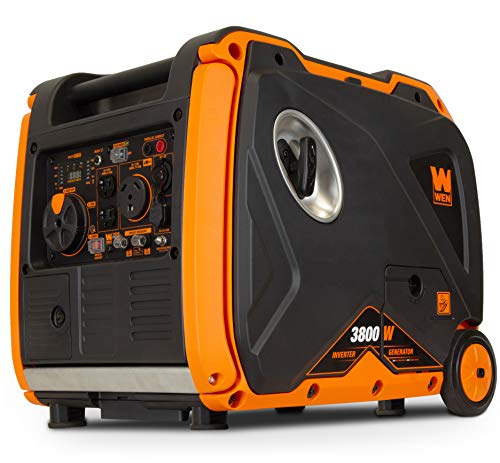
WEN 56380i 3800-Watt Inverter Generator
WEN’s 56380i lands between the Champion and the Westinghouse on power, enough for a smaller rooftop AC paired with a fridge. Two 56380i units link through a parallel port for a larger rig later on. An included wheel kit matters at this weight, since nothing here is a one-hand lift.
Pros
- 3400 running watts handles a smaller rooftop AC with headroom
- Parallel port pairs two units for more power
- Digital display tracks voltage, frequency, and runtime
Cons
- Nearly 100 lbs, awkward without the wheel kit
- No propane option unlike the Champion

DuroMax XP4400EH Dual Fuel Generator
This conventional generator carries more waveform distortion than the Honda or Westinghouse, since it is not an inverter design. Basic loads and a rooftop AC run fine on it, though sensitive electronics still need a separate surge protector. Electric start and dual fuel offset the extra weight for anyone parked long term at a site.
Pros
- 3500 running watts and dual fuel cover most campsite loads
- Electric start beats pulling a cord in cold weather
- Costs less per running watt than the inverter models here
Cons
- Conventional design lacks the clean power inverters supply
- Louder than any inverter model on this list

Jackery Explorer 2000 Plus Portable Power Station
Battery capacity replaces fuel in the Explorer 2000 Plus, so it runs silent inside a campground with generator curfews. 2200W output covers a fridge, lights, and device charging, but a rooftop air conditioner drains it in under an hour. Solar panels recharge it at a site with no shore power available.
Pros
- Silent operation suits quiet campgrounds and generator curfews
- No fuel, oil changes, or exhaust to manage
- Expandable battery packs add capacity later
Cons
- A rooftop air conditioner drains the battery within an hour
- Recharging from solar takes far longer than refueling gasoline

Pulsar PG2000iS Portable Inverter Generator
Pulsar’s PG2000iS undercuts the Honda on cost while covering the same basic loads: lights, a fan, and phone charging. 1600 running watts leaves no headroom for a rooftop AC or a large fridge. Weekend trips and backup power suit it better than full time RV living.
Pros
- Lighter and cheaper than the Honda EU2200i
- Clean inverter power safe for electronics
- Compact enough to store in an outside compartment
Cons
- 1600 running watts is the lowest output on this list
- No parallel port to add a second unit
How they compare
| # | Model | Output | Best for | Score | Price |
|---|---|---|---|---|---|
| 1 | Honda EU2200i | 1800W running / 2200W starting | Best overall | 9.4 | Check price |
| 2 | Westinghouse iGen4500 | 3700W running / 4500W starting | Best for rooftop air conditioners | 9.2 | Check price |
| 3 | Champion 100692 2000-Watt Dual Fuel Inverter | 1700W running / 2000W starting | Best dual fuel value | 9.0 | Check price |
| 4 | WEN 56380i 3800-Watt Inverter Generator | 3400W running / 3800W starting | Best for pairing two units | 8.7 | Check price |
| 5 | DuroMax XP4400EH Dual Fuel Generator | 3500W running / 4400W starting | Best heavy-duty conventional output | 8.5 | Check price |
| 6 | Jackery Explorer 2000 Plus Portable Power Station | 2042Wh battery, 2200W output | Best fuel-free and quiet option | 8.2 | Check price |
| 7 | Pulsar PG2000iS Portable Inverter Generator | 1600W running / 2000W starting | Best budget entry | 8.0 | Check price |
Questions worth asking
How many watts does an RV generator need to run an air conditioner?
Most 13500 BTU rooftop units need roughly 1500 running watts and a startup surge near 3500 watts. Add a few hundred watts more for a fridge and lights running at the same time. A generator rated near 3500 to 4500 running watts, like the Westinghouse iGen4500, covers that with room to spare.
What is the difference between running watts and starting watts?
Running watts are the continuous output a generator sustains once equipment is already on. Starting watts cover the brief surge a motor or compressor draws at power-on, often far higher than its running number. A generator meeting running watts but not starting watts will stall the moment a compressor kicks on.
Can a regular generator work instead of an RV-specific one?
Any generator with enough running and starting watts works, since RV-specific marketing mostly refers to the TT-30R outlet some models include. An adapter converts a standard household plug to the RV’s 30 amp cord without that outlet. Noise level and clean power still matter more than the RV label itself.
Is a dual fuel generator better than gasoline only for RV use?
Dual fuel models like the Champion 100692 or DuroMax XP4400EH switch to propane when gasoline is scarce or restricted at a site. Propane stores longer without going stale, useful for infrequent use between trips. Gasoline-only models run lighter and cheaper for the same output, a fair trade for frequent users who refuel easily.
How loud can a generator be at an RV campground?
Many campgrounds set an informal or posted limit near 60 decibels and enforce quiet hours overnight. Inverter generators like the Honda EU2200i and Westinghouse iGen4500 run near or under that limit at partial load. Conventional generators, including the DuroMax here, typically run louder at the same output.
Do inverter generators work for a CPAP machine?
Yes, inverter generators produce clean sine wave power with low harmonic distortion, the standard most CPAP machines and other medical electronics require. Conventional generators produce a rougher waveform that risks damaging sensitive electronics without an added surge protector. Checking a specific CPAP’s power requirements first avoids relying on the wrong generator overnight.
Can two small generators link together to power a rooftop AC?
Yes, if both units include a parallel port, like the Honda EU2200i or WEN 56380i. Linking two inverters roughly doubles running watts, which can clear a smaller rooftop AC’s surge. Checking parallel kit compatibility before buying matters, since not every brand links to another.
Is a portable power station a replacement for a gas generator?
For lights, a fridge, and device charging, yes, and it runs silently with no fuel or exhaust to manage. A rooftop air conditioner will drain most battery stations, including the Jackery Explorer 2000 Plus, within an hour. Solar panels recharge a power station at a site with no shore power, though slower than refueling gasoline.
Which RV generator works best for boondocking without gasoline nearby?
Dual fuel models like the Champion 100692 switch to propane, which stores longer than gasoline between trips. The Jackery Explorer 2000 Plus skips fuel entirely, running on battery power recharged by solar panels. Either suits boondocking better than a gasoline-only model that needs refueling from a can.
Final word
Choose the Honda EU2200i when a CPAP machine, a laptop, or other sensitive electronics matter more than air conditioning, since its clean power protects them best. RVers running a rooftop air conditioner should spend up on the Westinghouse iGen4500, the only inverter here with enough running watts for that surge. Anyone camping where gasoline runs short should look at the Champion 100692, which switches to propane without extra equipment.