Saute Pans With Enough Depth for Real Cooking
The All-Clad D3 Stainless 3-Quart Saute Pan is the best long term choice, with fully clad construction that browns evenly and lasts decades. The Tramontina Tri-Ply Clad 4-Quart pan delivers similar performance for far less, and the Calphalon Premier 5-Quart pan suits nonstick cooking for larger families.
The All-Clad D3 3-Quart Saute Pan is the one to buy if you want a pan for life, with the Tramontina Tri-Ply Clad 4-Quart as the value equivalent and the Calphalon Premier 5-Quart for nonstick family cooking.
Saute pans are confusing to shop for because the name is used loosely and the specification that matters most, how the metal layers are constructed, is often buried in the description. We compared cladding type, base and wall thickness, capacity against surface area, handle comfort and oven safe temperatures, then weighed those specifications against what owners report about warping, sticking and how each pan behaves on induction.
The shortlist, ranked

All-Clad D3 Stainless 3-Quart Saute Pan
The D3 uses three bonded layers running up the walls rather than just across the base, so the sides heat as evenly as the bottom and food does not scorch where the pan curves. That construction is what makes it brown a chicken thigh evenly and build a fond worth deglazing. Owners report these pans stay flat and usable for decades, which is the real argument for the price.
Pros
- Even heating up the walls, not just the base
- Extremely durable and dishwasher safe
- Lid and helper handle included
Cons
- Handle stays cool but is not the most comfortable
- Requires proper preheating to avoid sticking
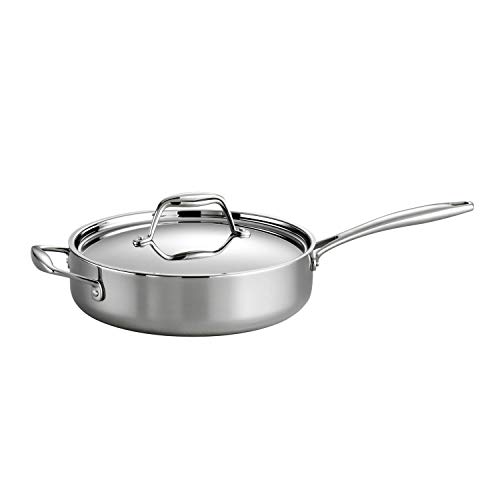
Tramontina Tri-Ply Clad 4-Quart Saute Pan
Tramontina builds this pan with the same fully clad tri ply approach as premium brands at a fraction of the outlay, which is why it turns up in so many working kitchens. The extra quart of capacity makes it more useful for braising a family sized portion. Based on specifications the gap to the most expensive pans is smaller than the price difference suggests.
Pros
- Fully clad construction at a moderate price
- Larger capacity suits braising
- Works on induction without adapters
Cons
- Slightly thinner than premium clad pans
- Handle rivets need attention when scrubbing
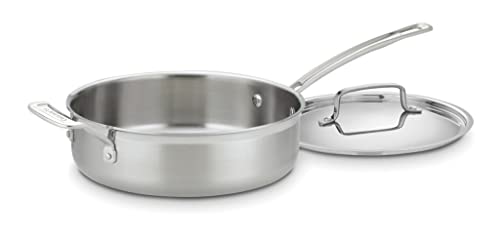
Cuisinart MultiClad Pro MCP33-24H 3.5-Quart Saute Pan
The MultiClad Pro sits at a practical 3.5 quarts with a brushed exterior that hides marks better than mirror polished pans. Its tri ply build handles searing and simmering equally well and the tight fitting lid holds moisture for braises. Owners report it is the pan they reach for most often once it lives on the hob.
Pros
- Very even heating for the price
- Brushed exterior hides everyday marks
- Tight lid seal for braising
Cons
- Handle can feel angular in the hand
- Interior discolours with high heat over time

Calphalon Premier Space-Saving Hard-Anodized 5-Quart Saute Pan
This pan combines a hard anodised body with a durable nonstick interior and a design that stacks neatly with other pans in the range. Five quarts is generous, making it a good fit for one pan dinners that feed four or more. Nonstick surfaces have a finite life, so treat this as a decade of easy cooking rather than a lifetime pan.
Pros
- Very easy release for eggs and delicate fish
- Large capacity for family meals
- Stacks neatly to save cupboard space
Cons
- Nonstick coating wears out eventually
- Does not build fond like bare stainless

Le Creuset Signature Enameled Cast Iron 3.5-Quart Deep Saute Pan
Cast iron under enamel holds heat like nothing else here, so the pan barely drops temperature when cold ingredients hit it and holds a low steady simmer for hours. That makes it excellent for braises and anything that starts on the hob and finishes in the oven. It is also by far the heaviest pan in the group, which is a genuine consideration for anyone with wrist trouble.
Pros
- Outstanding heat retention for searing and braising
- Enamel needs no seasoning and resists acids
- Moves from hob to oven to table
Cons
- Very heavy when full
- Enamel chips if knocked or thermally shocked

GreenPan Valencia Pro 3.5-Quart Saute Pan
GreenPan uses a ceramic based nonstick coating over a hard anodised body for cooks who prefer to avoid traditional nonstick chemistry. Release is excellent when new and the pan tolerates higher oven temperatures than most nonstick. Owners report ceramic coatings reward gentle handling and lower heat far more than conventional nonstick does.
Pros
- Ceramic coating free of traditional nonstick chemistry
- High oven safe temperature for nonstick
- Good release when new and properly cared for
Cons
- Coating performance fades faster with high heat
- Needs low to medium heat to preserve the surface

T-fal Ultimate Hard Anodized 5-Quart Saute Pan
T-fal covers the basics with a light hard anodised pan, a reliable nonstick interior and the familiar heat indicator in the centre that tells you when to add food. It is the pan for a first kitchen or a rental where a lifetime purchase makes no sense. It heats faster and less evenly than the clad pans above, so keep the flame moderate.
Pros
- Light and easy to handle
- Heat indicator helps with preheating
- Lowest cost entry with a lid included
Cons
- Thinner base gives less even heating
- Lower oven safe temperature than clad pans
How to choose
A saute pan is not a frying pan The defining feature is straight vertical sides and a wide flat base, which gives more cooking surface than a skillet of the same diameter and enough wall height to hold liquid. That combination is what lets one pan sear, then deglaze, then braise with a lid on. A skillet with sloped sides is better for tossing and flipping, so most kitchens genuinely benefit from owning both rather than choosing between them.
Fully clad beats a disc bottom Cheaper stainless pans bond a thick aluminium disc to the base only, leaving thin single layer walls that heat unevenly and scorch sauces at the edge. Fully clad pans run the aluminium core all the way up the sides, so heat spreads evenly across the whole cooking surface. This is the single specification most worth paying for, and it is usually described as tri ply, five ply or fully clad in the listing.
Match capacity to your usual portions A 3 quart pan suits one or two people and browns better because ingredients are not crowded. Four to five quarts handles a family sized braise or a one pan dinner but takes longer to heat and is heavier to lift when full. Look at base diameter as well as quart rating, since a tall narrow pan holds the same volume with much less searing surface.
Care that keeps a pan performing Preheat stainless properly before adding fat and food, since most sticking is a temperature problem rather than a pan problem. Avoid thermal shock by letting a hot pan cool before it meets cold water, which is what warps thin bases and chips enamel. For nonstick and ceramic, stay below high heat, use wooden or silicone tools and hand wash even when the pan is labelled dishwasher safe, since detergents shorten coating life.
How they stack up
| # | Model | Construction | Best for | Score | Price |
|---|---|---|---|---|---|
| 1 | All-Clad D3 Stainless 3-Quart Saute Pan | Three ply bonded, stainless and aluminium | Best overall | 9.4 | Check price |
| 2 | Tramontina Tri-Ply Clad 4-Quart Saute Pan | Tri ply clad stainless and aluminium | Best value | 9.2 | Check price |
| 3 | Cuisinart MultiClad Pro MCP33-24H 3.5-Quart Saute Pan | Tri ply stainless with aluminium core | Best for everyday use | 9.0 | Check price |
| 4 | Calphalon Premier Space-Saving Hard-Anodized 5-Quart Saute Pan | Hard anodised aluminium | Best nonstick option | 8.8 | Check price |
| 5 | Le Creuset Signature Enameled Cast Iron 3.5-Quart Deep Saute Pan | Enamelled cast iron | Best for braising | 8.6 | Check price |
| 6 | GreenPan Valencia Pro 3.5-Quart Saute Pan | Hard anodised body with ceramic nonstick | Best ceramic nonstick | 8.3 | Check price |
| 7 | T-fal Ultimate Hard Anodized 5-Quart Saute Pan | Hard anodised aluminium | Best budget | 8.0 | Check price |
Good to know
What is the difference between a saute pan and a skillet?
A saute pan has straight vertical sides and a lid, giving more flat cooking surface and the ability to hold liquid for braising. A skillet has sloped sides that make tossing and flipping easier but hold less liquid. Many cooks use both for different jobs.
What size saute pan should I buy?
Three quarts suits one or two people and browns well without crowding. Three and a half to four quarts is the most versatile size for a family, and five quarts makes sense if you regularly cook one pan meals for four or more. Check base diameter as well as volume.
Is stainless steel or nonstick better for a saute pan?
Stainless browns better, builds fond for pan sauces and lasts indefinitely, but requires proper preheating technique. Nonstick releases eggs and delicate fish effortlessly and cleans easily, but the coating wears out and it will not develop the browned bits that make a sauce. Choose based on what you cook most.
Why does food stick to my stainless saute pan?
Almost always because the pan was not hot enough when the food went in, or the food was moved too early before a crust formed. Heat the dry pan first, add fat, wait for it to shimmer, then add food and leave it alone until it releases naturally.
Are these pans induction compatible?
The clad stainless and cast iron pans work on induction directly. Hard anodised aluminium pans need a bonded magnetic base to work, which the listings state explicitly, so check before buying if you have an induction hob.
Can a saute pan go in the oven?
Most can, but the safe temperature varies from about 400 degrees for basic nonstick to 600 degrees for fully clad stainless. Lids and handles often have lower limits than the pan body, particularly glass lids and silicone handle covers.
How do I clean discoloured stainless steel?
Rainbow tinting and white spots are cosmetic. A paste of bar keepers friend or a simmer of water and vinegar removes both without damaging the pan. Avoid steel wool, which scratches the polished interior and makes future sticking worse.
How long does nonstick coating last?
With careful use, generally three to five years of regular cooking before release noticeably degrades. High heat, metal tools and dishwasher detergent all shorten that considerably, which is why a clad stainless pan is the better long term buy if you only want to purchase once.
Final word
The All-Clad D3 3-Quart Saute Pan is the pan worth buying once and keeping, with fully clad construction that heats evenly and survives decades of use. The Tramontina Tri-Ply Clad 4-Quart pan gets you most of the way for far less, and the Calphalon Premier 5-Quart is the pick if you want easy release and family sized capacity.


