Sheet Pans That Bake Evenly and Refuse to Warp
The Nordic Ware Naturals Half Sheet Pan is the best sheet pan for most kitchens, with heavy aluminium construction that browns evenly and resists warping. The USA Pan half sheet adds a textured surface for easier release, and the Amazon Basics aluminium half sheet covers batch cooking cheaply.
The Nordic Ware Naturals Half Sheet Pan is the sheet pan worth owning several of, with the USA Pan half sheet for easier release and the Amazon Basics aluminium half sheet when you need cheap trays in quantity.
Sheet pans look like the simplest thing in a kitchen and yet the differences between them are the reason one tray browns potatoes beautifully while another buckles with a bang halfway through roasting. We compared metal gauge, aluminium against steel, rim rolling and reinforcement, and surface coatings, then weighed those specifications against what owners report about warping, staining and how each pan releases food after months of use.
The shortlist, ranked

Nordic Ware Naturals Half Sheet Pan
This is the pan professional kitchens use, made from heavy uncoated aluminium with a rolled steel rim that stops the tray flexing under heat. Aluminium conducts heat quickly and evenly, which is why vegetables brown across the whole surface rather than only in the middle. Owners report these pans last for decades, darkening with use in a way that does not affect performance.
Pros
- Very even browning across the pan
- Reinforced rim resists warping
- Durable enough for daily use for years
Cons
- Uncoated aluminium reacts with acidic foods
- Discolours over time, though harmlessly

USA Pan Bakeware Half Sheet Pan
USA Pan uses aluminised steel with a corrugated surface that lifts food slightly off the base, improving airflow and making release noticeably easier than a flat pan. The silicone based coating is nonstick without the fragility of a conventional coating. Based on specifications it is the pan to choose if sticking is your recurring frustration.
Pros
- Corrugated surface releases food easily
- Strong steel construction resists warping
- Coating tolerates normal oven temperatures well
Cons
- Ridges are harder to scrub clean
- Coating rules out abrasive cleaning

Chicago Metallic Commercial II Non-Stick Cookie and Jelly Roll Pan
Chicago Metallic builds this pan from heavy gauge aluminised steel with a nonstick coating that suits cookies, sticky bakes and anything with sugar in it. The reinforced rim keeps it flat through repeated heating cycles. It is aimed more at baking than at high heat roasting, where uncoated aluminium still has the edge.
Pros
- Excellent release for sugary bakes
- Heavy gauge stays flat
- Cleans quickly after cookies
Cons
- Coating limits maximum useful oven temperature
- Browns slightly less aggressively than bare aluminium

Amazon Basics Aluminum Half Sheet Baking Pan
For batch roasting and meal prep you want more than one tray, and this is the pan that makes owning four affordable. Aluminium construction with a rolled rim covers the fundamentals, at a lighter gauge than the commercial pans above. Expect slightly more flex at high heat and a shorter life under heavy daily use.
Pros
- Cheap enough to own several
- Standard half sheet size fits home ovens
- Even heating for the price
Cons
- Lighter gauge is more prone to warping
- Not as durable as commercial pans

Wilton Recipe Right Non-Stick Baking Sheet
Wilton aims squarely at home bakers with a nonstick pan sized for standard ovens and cookie sheets rather than commercial racks. Release is reliable for biscuits and traybakes and clean up is quick. The lighter construction means it is best kept for baking rather than high heat roasting.
Pros
- Reliable release for cookies
- Sizes suited to smaller home ovens
- Very easy to clean
Cons
- Lighter gauge warps at high roasting heat
- Coating wears with metal utensils

Caraway Non-Stick Ceramic Baking Sheet
Caraway uses a ceramic based nonstick coating for cooks who prefer to avoid traditional nonstick chemistry, over an aluminised steel core. Release is excellent when new and the pan looks smart enough to bring to the table. Ceramic coatings reward gentle handling and moderate heat far more than conventional nonstick does.
Pros
- Ceramic coating avoids traditional nonstick chemistry
- Very good release when new
- Attractive finish for serving
Cons
- Coating performance fades with high heat use
- Costs more than most half sheet pans
Calphalon Nonstick Bakeware Baking Sheet
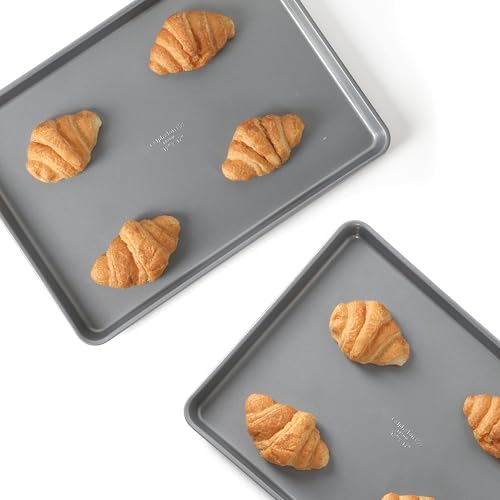
Calphalon combines a heavy gauge steel core with an interlocking nonstick surface pattern that promotes airflow underneath food. It handles weeknight roasting and baking with equal competence and cleans easily. It is a solid mid range pan without the commercial durability of the top picks here.
Pros
- Good airflow pattern under food
- Sturdy enough for regular roasting
- Simple to clean
Cons
- Lower maximum oven temperature than bare aluminium
- Nonstick surface wears eventually
Compared at a glance
| # | Model | Material | Best for | Score | Price |
|---|---|---|---|---|---|
| 1 | Nordic Ware Naturals Half Sheet Pan | Uncoated pure aluminium | Best overall | 9.4 | Check price |
| 2 | USA Pan Bakeware Half Sheet Pan | Aluminised steel | Best for easy release | 9.2 | Check price |
| 3 | Chicago Metallic Commercial II Non-Stick Cookie and Jelly Roll Pan | Heavy gauge aluminised steel | Best for baking | 9.0 | Check price |
| 4 | Amazon Basics Aluminum Half Sheet Baking Pan | Aluminium | Best budget | 8.8 | Check price |
| 5 | Wilton Recipe Right Non-Stick Baking Sheet | Steel with nonstick coating | Best for cookies | 8.6 | Check price |
| 6 | Caraway Non-Stick Ceramic Baking Sheet | Aluminised steel with ceramic coating | Best ceramic coated | 8.3 | Check price |
| 7 | Calphalon Nonstick Bakeware Baking Sheet | Heavy gauge steel | Best for everyday roasting | 8.0 | Check price |
Before you buy
Gauge and rim are what stop warping That alarming bang halfway through roasting is a thin pan expanding unevenly and snapping into a new shape. Heavier gauge metal resists it, and a rolled rim with a steel wire encased inside stiffens the whole tray. Commercial half sheet pans use both, which is why they stay flat in professional kitchens running them at high heat all day. If you roast at high temperatures regularly, gauge is the specification worth paying for.
Aluminium and aluminised steel behave differently Bare aluminium conducts heat fastest and browns most evenly, which makes it the choice for roasting vegetables and getting crisp edges. It is reactive, so acidic foods like tomatoes and lemon can pit the surface and pick up a metallic note over long cooking. Aluminised steel is stiffer and takes a coating well, giving easier release at the cost of slightly less aggressive browning.
Half sheet is the size that fits home ovens A half sheet measures roughly 18 by 13 inches and fits almost every domestic oven with room for air to circulate. Full sheets are a commercial size and will not fit most home ovens at all. Quarter sheets suit small batches and toaster ovens. Owning two or three half sheets is far more useful than owning one of each size, since batch roasting and meal prep both depend on not crowding the pan.
Care that keeps a sheet pan flat and clean Never put a hot pan straight into cold water, since that thermal shock is what warps trays permanently. Let baked on residue soak rather than attacking it with steel wool on a coated pan, and use baking parchment or a silicone mat for sticky bakes to reduce scrubbing entirely. Darkening on bare aluminium is normal and does not affect performance, though a very dark pan browns a little faster so check bakes slightly early.
Common questions
What size sheet pan should I buy?
A half sheet at roughly 18 by 13 inches fits most home ovens and is the most versatile size. Quarter sheets suit small batches and toaster ovens, and full sheets are a commercial size that will not fit a standard domestic oven.
Why does my sheet pan warp in the oven?
Thin metal expands unevenly when one area heats faster than another, and the pan buckles to relieve the stress. Heavier gauge pans with reinforced rims resist this. Preheating gradually and avoiding cold liquid on a hot pan both reduce the chance.
Is aluminium or steel better for a sheet pan?
Bare aluminium conducts heat best and browns most evenly, making it the choice for roasting. Aluminised steel is stiffer and holds nonstick coatings well, giving easier release. Many kitchens keep both for different jobs.
Do I need a nonstick sheet pan?
Not necessarily. Baking parchment or a silicone mat gives release on any pan without the coating wearing out, and uncoated pans tolerate higher heat and metal utensils. Nonstick is convenient for sticky bakes if you accept a finite lifespan.
Can sheet pans go in the dishwasher?
Coated pans generally should be hand washed, since detergents degrade the coating. Bare aluminium can go in but will discolour and dull, which is cosmetic rather than harmful. Hand washing extends the life of every pan here.
Why has my aluminium pan gone dark?
Oxidation from heat and oil, which is entirely normal and does not affect food safety. A dark pan absorbs heat slightly faster, so check bakes a couple of minutes early once a pan has darkened significantly.
How many sheet pans should I own?
At least two, ideally three. Crowding a single pan steams food instead of roasting it, and having a second means you can rotate batches through the oven without waiting for one to cool and be washed.
Can I use parchment paper on any sheet pan?
Yes, and it is the simplest way to protect a coating and cut cleaning time. Check the parchment’s own temperature limit, usually around 425 degrees Fahrenheit, and use a silicone mat or bare pan above that.
Final word
The Nordic Ware Naturals Half Sheet Pan is the one to buy first and probably buy twice, with commercial gauge aluminium and a reinforced rim that keeps it flat for years. Choose the USA Pan half sheet if easy release matters most to you, or the Amazon Basics aluminium half sheet when you simply need several trays for batch cooking.