Slam Balls Compared by Shell, Fill and Bounce Resistance
Yes4All Slam Ball stays the most consistent no-bounce option across every weight size offered. ProsourceFit Slam Ball nearly matches that durability at a lower price per pound. Amazon Basics Slam Ball suits casual users who want a dependable budget option without extra features.
Yes4All Slam Ball leads this group with a thick rubber shell that dead-stops on impact instead of skidding back. ProsourceFit Slam Ball nearly matches that durability at a friendlier price per pound. Amazon Basics Slam Ball rounds out the top three as the simplest budget pick for occasional use.
Fill density, not shell color or branding, separates a slam ball from a medicine ball built to bounce. Shell material determines how many concrete or turf slams a ball survives before splitting at the seam. We compared shell thickness, fill density, grip texture and available weight range, then weighed owner reports of seam durability after months of regular use.
The shortlist, ranked

Yes4All Slam Ball
A thick rubber shell absorbs impact and drops dead on the floor instead of bouncing back toward the user. Textured ridges across the surface hold grip through sweaty hands better than a smooth shell. Sizes span a wide weight range, so a household can share one brand across skill levels.
Pros
- Dead-drop design avoids a dangerous bounce back
- Textured surface holds grip through sweaty hands
- Wide weight range suits shared household use
Cons
- Heavier weights cost more per pound
- New units carry a noticeable rubber smell

ProsourceFit Slam Ball
This shell survives repeated concrete slams nearly as well as premium rivals, at a lower price per pound. Double-layer stitching along the seam resists the splitting that ends cheaper balls early. Grip texture runs slightly less aggressive than Yes4All’s, noticeable mainly in humid conditions.
Pros
- Double-stitched seam resists early splitting
- Costs less per pound than the top pick
- Minimal bounce holds up on concrete or turf
Cons
- Grip texture softens somewhat in humidity
- Weight range tops out lower than Yes4All

Amazon Basics Slam Ball
A straightforward rubber shell and sand fill cover casual training needs without extra features. It handles occasional gym-floor use well, though owners report faster wear under daily heavy slams than premium brands. Pricing undercuts most name-brand competitors at comparable weights.
Pros
- Priced lowest among comparable weight options
- Adequate for casual, occasional training sessions
- Spans a decent range of stocked weights
Cons
- Wears faster under daily heavy use
- Shows slightly more bounce than premium shells
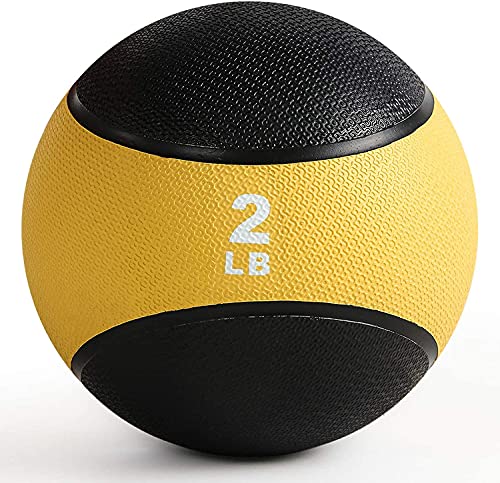
RitFit Slam Ball
A more aggressive surface pattern than most rivals improves grip during chalk-free, sweaty training sessions. Concrete and turf slams do not crack this shell the way some budget balls show after a few months. It runs slightly heavier per stated weight, which owners notice when switching brands.
Pros
- Aggressive texture improves grip when sweaty
- Resists cracking on concrete or turf surfaces
- Delivers consistent no-bounce performance
Cons
- Runs slightly heavy versus its stated weight
- Offers a smaller weight range than top picks

Titan Fitness Slam Ball
Titan builds this for garage gym use, with a shell thick enough to survive regular contact with bare concrete. Heavier top-end weights beat several competitors, useful for advanced lifters progressing loads. A firmer feel is the trade-off, which some users find less comfortable on the rebound-free drop.
Pros
- Survives bare concrete without a mat underneath
- Offers heavier top-end weights than most rivals
- Suits advanced lifters progressing their loads
Cons
- Firmer shell feels less forgiving to catch
- Skips lightweight options useful for beginners

Signature Fitness Slam Ball
Signature Fitness stocks lighter increments than most competitors, useful for beginners building slam technique before adding weight. Moderate use does not trouble this shell, though it is not rated for the heaviest daily gym traffic. Grip texture stays modest but sufficient for controlled, lower-intensity training.
Pros
- Lighter increments suit beginners learning form
- Comfortable for practicing proper slam technique
- Priced reasonably for entry-level buyers
Cons
- Top weight range runs too light for advanced lifters
- Shell wears faster under heavy daily slams

Retrospec Core Slam Ball
A reinforced shell tolerates asphalt, gravel-adjacent turf and other rough outdoor surfaces better than balls built mainly for gym flooring. It stays firm through temperature swings, useful for outdoor bootcamp classes. Weight range runs narrower than dedicated gym-focused competitors.
Pros
- Tolerates rough outdoor surfaces well
- Stays firm through outdoor temperature swings
- Suits outdoor bootcamp-style training sessions
Cons
- Weight range runs narrower than gym-focused brands
- Feels less cushioned on indoor flooring
What to look for
What separates a slam ball from a medicine ball A medicine ball is built to bounce or be caught, filled to a moderate density that keeps some spring. Denser sand-based fill packs into a slam ball instead, so it drops dead on impact rather than rebounding toward the user. That difference matters most during slam and throw exercises, where a bouncing ball back at your shins is a real hazard.
Shell material and seam durability over time Rubber shells dominate this category because they absorb repeated concrete or turf impact without splitting quickly. Thicker shells, like Titan Fitness and Retrospec’s reinforced designs, survive bare concrete floors better than thinner budget shells. Seam construction matters too, since a weak stitch line is usually where a slam ball fails first.
Choosing a weight range for your training level Beginners benefit from lighter balls in the 6 to 15 pound range, building proper slam technique before adding load. Intermediate and advanced lifters typically progress into the 20 to 40 pound range for conditioning and power work. Few users need the 50 pound top end some brands offer, so buy for your current level rather than a hypothetical future one.
Indoor gym floors versus outdoor training surfaces Standard rubber-shell slam balls handle rubber gym flooring and turf without issue. Wear accelerates on asphalt or gravel-adjacent surfaces, which is where reinforced designs like Retrospec’s earn their keep outdoors. Temperature swings outdoors can also stiffen or soften a shell, changing how it feels on impact.
Compared at a glance
| # | Model | Weight range | Best for | Score | Price |
|---|---|---|---|---|---|
| 1 | Yes4All Slam Ball | 10 to 50 lb | Best overall | 9.3 | Check price |
| 2 | ProsourceFit Slam Ball | 10 to 30 lb | Best value | 9.0 | Check price |
| 3 | Amazon Basics Slam Ball | 10 to 40 lb | Best budget | 8.7 | Check price |
| 4 | RitFit Slam Ball | 10 to 30 lb | Best textured grip | 8.4 | Check price |
| 5 | Titan Fitness Slam Ball | 20 to 50 lb | Best for garage gyms | 8.2 | Check price |
| 6 | Signature Fitness Slam Ball | 6 to 20 lb | Best for beginners | 8.1 | Check price |
| 7 | Retrospec Core Slam Ball | 10 to 25 lb | Best for outdoor and rough surfaces | 8.0 | Check price |
Common questions
What is a slam ball used for?
Explosive conditioning exercises like overhead slams, rotational throws and squat-to-press combos rely on slam balls. Their dead-drop design makes repeated ground contact safer than a bouncing medicine ball.
How is a slam ball different from a wall ball?
A wall ball is built to bounce back off a wall for catch-and-throw exercises, while denser fill makes a slam ball stop dead on the ground. Using a wall ball for slams risks an unpredictable bounce toward the user.
What weight slam ball should a beginner buy?
Most beginners start between 6 and 15 pounds to learn proper hip hinge and overhead slam technique. Adding weight before technique is solid raises injury risk without adding training benefit.
Can slam balls be used on concrete floors?
Yes, though shell durability varies by brand. Heavier-duty shells like Titan Fitness and Retrospec Core are built specifically to tolerate bare concrete without cracking as quickly as thinner shells.
Do slam balls bounce?
Quality slam balls minimize bounce through dense, often sand-based fill. Cheaper balls or those with thinner shells sometimes bounce more than expected, a safety concern during overhead slams.
How much weight should I use for slam ball conditioning?
Conditioning work generally uses lighter to moderate weights, often 10 to 25 pounds, allowing higher repetitions and sustained explosive movement. Heavier balls suit strength-focused, lower-repetition training instead.
Are slam balls good for a home gym?
Yes, assuming the flooring can tolerate repeated impact. A rubber mat under a slam ball protects both the floor and the ball’s shell, extending its service life indoors.
How long do slam balls typically last?
With regular use, a quality slam ball lasts one to several years depending on shell thickness and training frequency. Seam splitting is the most common failure point, usually appearing after heavy daily use on hard surfaces.
Slam ball vs medicine ball, which should I buy first?
A slam ball suits anyone doing ground-based slam or throw work, since it will not bounce back unpredictably. A medicine ball fits catch-and-throw drills against a wall or partner where controlled rebound is the point.
Our pick
Yes4All Slam Ball holds up best across a wide weight range for regular training. ProsourceFit Slam Ball delivers nearly identical durability for a lower price per pound. Beginners building technique should start with Signature Fitness Slam Ball’s lighter increments rather than jumping straight to a heavier shell.


