Which Smart Smoke Detectors Send an Alert Before the Horn
Google Nest Protect leads for splitting flaming fires from slow smoldering smoke and alerting your phone first. First Alert Onelink Safe & Sound adds a built-in speaker and Alexa for whole-home coverage. Budget-minded buyers should check the Kidde RapidResponse, which puts Wi-Fi on a familiar photoelectric sensor.
Google Nest Protect wins this comparison on sensor sophistication, splitting fast flaming fires from slow smoldering ones before the horn sounds. First Alert Onelink Safe & Sound doubles as a ceiling speaker with Alexa built in, useful when replacing several hallway alarms at once. Kidde RapidResponse keeps the core smart features while staying close to standard alarm pricing.
A phone alert only helps if it actually reaches you, so dead batteries and false alarms defeat the purpose fast. Sealed ten year batteries remove one failure point, while Wi-Fi dropouts create another. We compared sensor type, battery format, app reliability reported by owners, and whether each unit also senses carbon monoxide, since many fires and CO leaks share the same detector housing.
The best picks, ranked

Google Nest Protect (2nd Gen, Battery)
Photoelectric and heat sensors work together here to tell cooking smoke from a real fire, cutting nuisance alarms. A phone alert lands before the horn if smoke builds slowly. Monthly self tests and a ten year sealed battery remove most manual maintenance.
Pros
- Distinguishes steam and cooking smoke from fire
- Voice alert names the room and hazard type
- Sealed battery removes swap out maintenance
Cons
- Costs more than any other unit compared here
- Requires a Nest or Google Home account

First Alert Onelink Safe & Sound
A full speaker and Amazon Alexa hide inside this ceiling mounted smoke and carbon monoxide alarm. Music or a podcast plays through the hallway, then cuts out instantly for an alarm signal. Linking multiple units means one alarm triggers every unit in the house.
Pros
- Doubles as a room speaker with Alexa
- Interlinks wirelessly with other Onelink units
- Voice tells you which room triggered the alert
Cons
- Hardwired install is not a simple swap
- Bulkier than a standard ceiling alarm
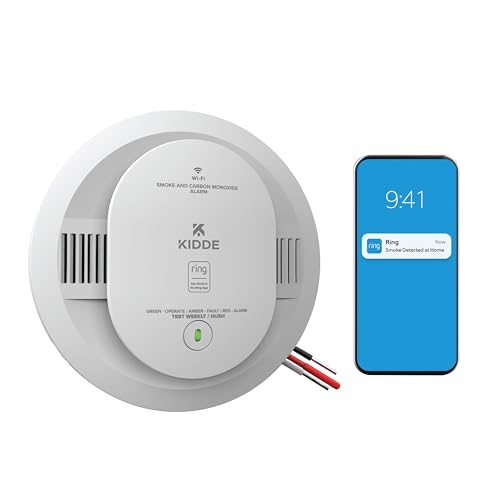
Kidde RapidResponse Smart Smoke and Carbon Monoxide Alarm
Kidde keeps this alarm close to a standard hardwired unit, then layers Wi-Fi and app alerts on top. Replacement batteries are common AA cells rather than a sealed pack. Long term cost stays down for households already running other Kidde hardware.
Pros
- Uses replaceable AA batteries, not a sealed pack
- Priced close to non smart alarms
- Works alongside existing Kidde hardware
Cons
- App has drawn setup complaints from some owners
- Ionization sensor reacts slower to smoldering smoke

X-Sense SC07-WX Smart Smoke and Carbon Monoxide Alarm
A ten year lithium battery seals inside this unit, so nothing needs replacing before the alarm ages out. Photoelectric smoke sensing pairs with carbon monoxide detection in one housing. The companion app sends phone alerts and lets several units share test and hush commands.
Pros
- Sealed battery lasts the alarm’s full rated life
- App hush avoids climbing a ladder for cooking smoke
- Photoelectric sensor suits smoldering fires well
Cons
- App ecosystem is smaller than Nest or Onelink
- Battery cannot be swapped if the Wi-Fi module fails early

First Alert Onelink Smoke + Carbon Monoxide Alarm (Battery)
Battery only power replaces the speaker and Alexa found on the Safe & Sound model here. Phone alerts still push through, and the unit interlinks wirelessly with other Onelink alarms. A single room or a rental where hardwiring is not an option gets the basics covered.
Pros
- Battery only install suits rentals
- Interlinks with pricier Onelink models
- Phone alerts work without a separate hub
Cons
- No speaker or Alexa integration
- AA batteries need periodic replacement
Roost Smart Battery (RSB-04)
Wi-Fi builds into a 9V battery here, meant to slot into an existing smoke alarm you already trust. A phone alert fires when the host alarm sounds, and the battery reports its own remaining charge. Anyone wanting alerts without replacing hardwired alarms fits this use case.
Pros
- No new alarm hardware to mount
- Works with hardwired alarms via the backup slot
- Reports remaining battery life in the app
Cons
- Only relays the host alarm, adds no sensor of its own
- Five year rated life is shorter than a sealed ten year unit
Ecolink Firefighter Z-Wave Smoke/CO Listener
This listener sits near an existing smoke alarm and recognizes its specific alert tone, then relays that to a Z-Wave hub like SmartThings or Hubitat. No siren of its own means it depends entirely on the alarm it monitors. Placement during setup becomes critical for that reason.
Pros
- Bridges any dumb alarm into a Z-Wave system
- Can trigger lights or locks through hub automations
- No monthly fee or cloud account required
Cons
- Needs a Z-Wave hub to do anything useful
- Listens for a tone, so misplacement causes missed alerts
Before you buy
What actually makes a smoke detector smart A Wi-Fi or Z-Wave radio paired with a phone alert forms the baseline, but sensor quality still decides how useful an alarm is. Photoelectric sensors catch smoldering fires earlier than ionization sensors do. Carbon monoxide detection built into the same housing covers a second hazard without a separate unit. App alerts and voice location announcements only add value once the underlying sensor performs well.
Hardwired versus battery smart alarms Hardwired alarms interlink instantly across a house and rarely run flat, though installation means working with existing wiring or hiring an electrician. Battery models install in minutes and suit renters, though even a sealed ten year battery eventually needs full unit replacement. Households already wired for interconnected alarms should stay hardwired rather than mix formats.
Retrofitting an old alarm versus buying a new one A smart 9V battery like Roost adds alerts to alarms you already trust, without new mounting holes or a fresh install. A Z-Wave listener does something similar for homes already running a smart hub. Full replacement units like Nest Protect or Onelink cost more but add better sensors, not just a smarter alert path.
Cutting false alarms and missed alerts Owners report that photoelectric sensors trigger far less often from cooking steam than ionization sensors do. Placing alarms away from bathroom doors and kitchen exhaust paths cuts nuisance trips further. App based hush features let you silence a cooking related alarm from a phone instead of fanning it with a towel.
Compared at a glance
| # | Model | Sensors | Best for | Score | Price |
|---|---|---|---|---|---|
| 1 | Google Nest Protect (2nd Gen, Battery) | Photoelectric smoke, heat, carbon monoxide | Best overall | 9.4 | Check price |
| 2 | First Alert Onelink Safe & Sound | Photoelectric smoke, carbon monoxide | Best for whole home audio | 9.1 | Check price |
| 3 | Kidde RapidResponse Smart Smoke and Carbon Monoxide Alarm | Ionization smoke, carbon monoxide | Best value | 8.8 | Check price |
| 4 | X-Sense SC07-WX Smart Smoke and Carbon Monoxide Alarm | Photoelectric smoke, carbon monoxide | Best sealed ten year battery | 8.6 | Check price |
| 5 | First Alert Onelink Smoke + Carbon Monoxide Alarm (Battery) | Photoelectric smoke, carbon monoxide | Best budget standalone | 8.3 | Check price |
| 6 | Roost Smart Battery (RSB-04) | Any standard 9V smoke or CO alarm | Best retrofit for existing alarms | 8.1 | Check price |
| 7 | Ecolink Firefighter Z-Wave Smoke/CO Listener | Z-Wave Plus hubs | Best for existing smart home hubs | 8.0 | Check price |
Common questions
Do smart smoke detectors need Wi-Fi to work as alarms?
No. Smoke and heat sensors function on battery or hardwired power regardless of connectivity. Wi-Fi only adds the phone alert and remote testing, so the alarm still sounds locally if the network drops.
Can a smart smoke detector replace a carbon monoxide alarm?
Only if it lists CO detection specifically, which several models here do. A smoke only alarm will not sense carbon monoxide, so check the sensor list before assuming one device covers both hazards.
How long do smart smoke detector batteries last?
Sealed units like Nest Protect and X-Sense rate their batteries for ten years, matching the alarm’s full service life. Models using AA or 9V batteries need replacement every one to two years depending on alert frequency.
Is a smart smoke detector worth it over a standard one?
It is worth it for anyone who travels, owns a rental property, or wants an alert while away from home. A single owner occupied bedroom covers most needs with a standard alarm and fresh batteries.
Which smart smoke detector works without a hub?
Nest Protect, both First Alert Onelink models, Kidde RapidResponse, and X-Sense all connect straight to home Wi-Fi and their own app. Only the Ecolink listener requires a separate Z-Wave hub to function.
Retrofit battery or full alarm replacement, which is better?
A retrofit battery like Roost works well if your current alarms are recent and functioning properly. Full replacement makes more sense once alarms approach ten years old, since the sensor itself degrades over that span.
Do smart smoke detectors send false alerts to your phone?
Owners report occasional false pushes tied to Wi-Fi hiccups rather than the sensor itself. Photoelectric models generally report fewer false positives than ionization based ones during normal cooking.
Can you mix brands of smart smoke detectors in one house?
Yes, since each connects to its own app rather than a shared ecosystem. Wireless interlinking, where one alarm triggers all others, only works within the same brand and often the same product line.
Our pick
Pick the Google Nest Protect for the most reliable sensor if you are already in the Google ecosystem, since its dual sensor design cuts false alarms other units cannot match. Choose the First Alert Onelink Safe & Sound instead for a ceiling speaker you will use daily. Anyone retrofitting alarms they already trust should skip full replacement and add a Roost Smart Battery.