NVMe or SATA? Picking the Right SSD for Your PC
The Samsung 990 PRO is our overall pick for peak PCIe 4.0 speed and strong endurance ratings. The WD_BLACK SN850X is the better match for gaming rigs and PlayStation 5 expansion, while the Crucial P3 Plus covers everyday upgrades without fuss.
If you want the fastest mainstream drive for a modern desktop or laptop, the Samsung 990 PRO is the one to buy, with the WD_BLACK SN850X the stronger option for gaming and console expansion and the Crucial P3 Plus the sensible choice for a straightforward capacity upgrade.
SSDs are confusing because the advertised sequential figure is the number a drive hits under ideal conditions with an empty cache, and almost nothing you do daily looks like that. We compared interface generation, DRAM cache presence, published endurance ratings and form factor compatibility to rank the seven below.
What matters most
Work out which slot your machine actually has This is the step people skip and then regret. A modern desktop board usually has one or more M.2 slots wired for PCIe 4.0 or 5.0, an older one may have M.2 wired only for PCIe 3.0, and some machines have no M.2 slot at all and need a 2.5 inch SATA drive. Laptops add a further constraint because many only accept a single sided M.2 module. Check the manual or the manufacturer support page for your exact model before choosing.
DRAM cache matters more than the headline number Drives split into those with on board DRAM and those that borrow system memory through host memory buffer. For browsing, office work and gaming, the difference is small. For copying very large folders, editing video or running virtual machines, a DRAM drive holds its speed while a DRAM less one slows to a fraction of its advertised figure once the fast write cache is used up. If your workload involves sustained writes, pay for the DRAM.
Sequential speed is the least useful specification The large sequential figures on the box describe one long uninterrupted transfer. Booting an operating system, launching applications and loading a game are mostly small random reads, which is a different measurement entirely. Two drives with a large gap in sequential rating can feel identical in daily use. Look at random read performance and at the endurance rating in terabytes written if you want numbers that predict how the drive will behave and how long it will last.
Plan for heat in tight spaces PCIe 4.0 and 5.0 drives generate real heat and will throttle to protect themselves if they cannot shed it. A desktop board with a built in M.2 heatsink handles this without help. A console expansion bay requires a heatsink on the drive itself, and a thin laptop relies entirely on whatever thermal pad the chassis provides. If you are installing into a console, buy the heatsink version rather than adding one, since the bay has a fixed height limit.
Our top picks

Samsung 990 PRO NVMe M.2 Internal SSD
Samsung’s flagship PCIe 4.0 drive pairs an in house controller with DRAM cache and high published endurance ratings, which is the combination that keeps performance steady once the drive fills up. It is offered with or without a heatsink so it suits both desktop boards and consoles. Owners report it stays near its rated figures during long transfers rather than collapsing to drive speed early.
Pros
- Holds speed well after the write cache is exhausted
- High published endurance rating for the class
- Heatsink version fits console expansion bays
Cons
- Priced above drives that feel similar in daily use
- Runs warm without adequate airflow or a heatsink

WD_BLACK SN850X NVMe Internal Gaming SSD
Western Digital’s gaming focused PCIe 4.0 drive matches the top tier on random read performance, which is the figure that actually affects level loading. A game mode in the desktop software keeps the drive ready rather than letting it idle down. Owners report it as the straightforward choice for PlayStation 5 storage expansion when bought in the heatsink version.
Pros
- Strong random read performance for game loading
- Heatsink model is sized for console bays
- Good software suite for monitoring and firmware
Cons
- Software is Windows focused
- Non heatsink version needs board cooling in tight builds

Crucial T500 NVMe M.2 Internal SSD
A DRAM equipped PCIe 4.0 drive that sits just under the flagships on paper while behaving very similarly in ordinary desktop workloads. The presence of real DRAM cache is what separates it from cheaper drives once you start moving large folders. Owners report it as the drive to pick when the flagship premium is hard to justify.
Pros
- Real DRAM cache at a mid tier position
- Close to flagship performance in normal use
- Available in laptop friendly single sided capacities
Cons
- Peak figures trail the top two drives
- Heatsink variant availability varies by capacity

Crucial P3 Plus NVMe M.2 Internal SSD
A DRAM less PCIe 4.0 drive aimed at people who mainly want more space rather than the last word in throughput. It uses host memory buffer instead of on board DRAM, which is fine for general use and less ideal for sustained heavy writes. Owners report it as a painless drop in upgrade for laptops and older desktops with a spare M.2 slot.
Pros
- Single sided board fits thin laptops
- Works in PCIe 3.0 slots at reduced speed
- Very simple installation with no extra hardware
Cons
- Sustained write speed drops once the cache fills
- No DRAM cache hurts heavy multitasking

Samsung 870 EVO SATA III 2.5 inch Internal SSD
The long running SATA option for machines that have no M.2 slot at all, which still covers a great many desktops and older laptops. SATA caps sequential speed far below NVMe, but the jump from a mechanical hard drive is still dramatic. Owners report these drives running for years in office machines and home servers without incident.
Pros
- Works in machines with no M.2 slot
- Consistent performance across the whole drive
- Long standing reliability reputation
Cons
- SATA interface limits sequential speed
- Needs a mounting bracket in many desktop bays
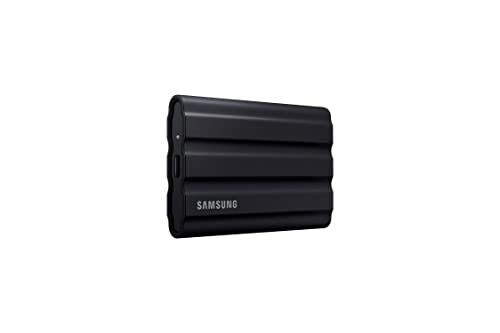
Samsung T7 Shield Portable SSD
A rubberised external SSD with an ingress protection rating, built for people who carry a drive between locations rather than leave it on a desk. It connects over USB 3.2 Gen 2 and works with both computers and many cameras. Owners report the grippy shell survives being dropped into a bag repeatedly, which plain metal enclosures do not.
Pros
- Rugged shell suited to travel
- Ingress rating unusual at this size
- Works across computers, phones and cameras
Cons
- USB interface caps speed below internal NVMe
- Cable is short for desk use
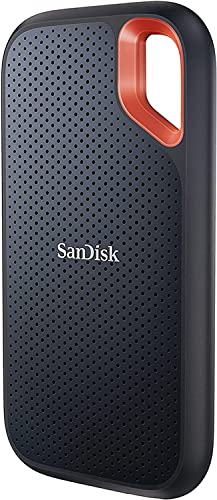
SanDisk Extreme Portable SSD V2
A compact external drive with a moulded carabiner loop, intended for photographers and anyone clipping storage to a bag rather than packing it. It offers hardware encryption and a silicone shell for drop resistance. Owners report it as the most convenient of the portables to carry, with the caveat that it should be backed up rather than trusted as a sole copy.
Pros
- Carabiner loop clips straight to a bag
- Silicone shell absorbs knocks
- Hardware encryption included
Cons
- Should not be your only copy of important files
- Warms noticeably during long transfers
Compared at a glance
| # | Model | Interface | Best for | Score | Price |
|---|---|---|---|---|---|
| 1 | Samsung 990 PRO NVMe M.2 Internal SSD | PCIe 4.0 x4 NVMe | Best overall | 9.4 | Check price |
| 2 | WD_BLACK SN850X NVMe Internal Gaming SSD | PCIe 4.0 x4 NVMe | Best for gaming | 9.2 | Check price |
| 3 | Crucial T500 NVMe M.2 Internal SSD | PCIe 4.0 x4 NVMe | Best value | 9.0 | Check price |
| 4 | Crucial P3 Plus NVMe M.2 Internal SSD | PCIe 4.0 x4 NVMe, backwards compatible | Best for simple capacity upgrades | 8.8 | Check price |
| 5 | Samsung 870 EVO SATA III 2.5 inch Internal SSD | SATA III 6Gb per second | Best for older systems | 8.6 | Check price |
| 6 | Samsung T7 Shield Portable SSD | USB 3.2 Gen 2, Type C | Best portable | 8.3 | Check price |
| 7 | SanDisk Extreme Portable SSD V2 | USB 3.2 Gen 2, Type C | Best budget portable | 8.0 | Check price |
Common questions
Will a PCIe 4.0 drive work in a PCIe 3.0 slot?
Yes. NVMe drives are backwards compatible and will run at the slower interface speed. You lose the peak sequential performance you paid for, but the drive works normally and still feels far faster than any mechanical hard drive. If your board is PCIe 3.0 only and will stay that way, a good PCIe 3.0 drive is the more sensible purchase.
What does the terabytes written figure mean?
It is the manufacturer’s endurance rating, describing how much data can be written to the drive over its life before the warranty coverage lapses. Ordinary home use rarely comes close to these figures, so it matters mainly for video editing, database work and anything writing continuously. Higher is better, but for most people it will never be the limiting factor.
Do I need a heatsink on my SSD?
It depends on where the drive goes. Desktop boards with a built in M.2 heatsink need nothing extra. Console expansion bays require a heatsink and a drive that fits the bay’s height limit. Thin laptops generally cannot accept an aftermarket heatsink at all, which is one reason laptop drives are often specified more conservatively.
Can I clone my old drive rather than reinstalling?
Yes, and most manufacturers offer free cloning software for their own drives. The main constraint is that the destination needs enough capacity for the data being moved, not for the original drive’s size. Cloning preserves your installed applications and settings, though a clean install often leaves a tidier system.
Is SATA still worth buying?
It is, in one specific case: when the machine has no M.2 slot. A SATA SSD in an old desktop or laptop is still a transformative upgrade over a mechanical hard drive, even though its ceiling is far below NVMe. If you have an M.2 slot available, use it instead.
Why does my new drive slow down during big copies?
Most consumer drives keep a portion of their flash in a fast single bit mode as a write cache. While that cache has room, writes are very quick. Once it is full, the drive writes directly to slower flash and the rate drops, sometimes sharply on drives without DRAM. This is normal behaviour and mainly visible on transfers of many gigabytes at once.
How full should I let an SSD get?
Leaving roughly ten to fifteen percent free is a reasonable habit. SSDs need spare blocks to manage wear levelling and garbage collection efficiently, and a drive filled to the last gigabyte will both slow down and work harder. Modern drives reserve some capacity internally, but a little user side headroom still helps.
Are portable SSDs reliable enough for backups?
They are reliable enough to be one copy, not the only copy. Any single drive can fail, and portable drives face drops, cable strain and heat that internal drives do not. Follow the usual rule of keeping important data in more than one place, ideally with one copy somewhere other than your desk.
Final word
The Samsung 990 PRO is the drive to buy if you want peak PCIe 4.0 performance that holds up under sustained load, and the WD_BLACK SN850X is the equal choice for gaming and console expansion. For a straightforward capacity upgrade where the workload is browsing, office work and media, the Crucial P3 Plus does the job for considerably less, and the Samsung 870 EVO remains the answer for any machine without an M.2 slot.


