Which Sublimation Printer Suits Your Craft Setup?
The Sawgrass SG500 is the most straightforward dedicated choice, shipping with sublimation ink and colour management built in. The Epson SureColor F170 is the compact alternative with lower running costs, while the Epson EcoTank ET-2800 remains the flexible starting point for crafters converting a printer themselves.
For a ready to run setup the Sawgrass SG500 is the pick, with the Epson SureColor F170 close behind on running cost and the Epson EcoTank ET-2800 covering budget conversions.
Sublimation is confusing because two very different routes exist, a purpose built dye sub printer or a standard EcoTank converted with sublimation ink, and each carries different warranty and colour accuracy implications. We compared print widths, ink delivery systems, bundled colour profiles and reported material compatibility so you can match the machine to the products you plan to make.
The top picks, ranked

Sawgrass SG500
The SG500 arrives as a sublimation printer rather than a conversion, with SubliJet ink cartridges and Sawgrass colour management included. That combination removes the guesswork from getting a red to print as a red on polyester. Owners report the bundled print utility is the main reason they stayed with Sawgrass rather than converting a cheaper machine.
Pros
- No conversion or ink flushing required
- Bundled colour management saves trial prints
- Warranty covers sublimation use
Cons
- Cartridge ink costs more per millilitre than bottles
- Limited to letter width output

Epson SureColor F170
Epson designed the F170 specifically for dye sublimation and pairs it with refillable ink tanks rather than cartridges, which brings running costs down considerably. The footprint is small enough for a craft desk rather than a workshop bench. Based on specifications it is the most economical dedicated machine here for regular output.
Pros
- Low ink cost per print
- Purpose built, so no warranty grey area
- Compact enough for a craft room
Cons
- Letter width only
- Software is less polished than Sawgrass
Epson EcoTank ET-2800
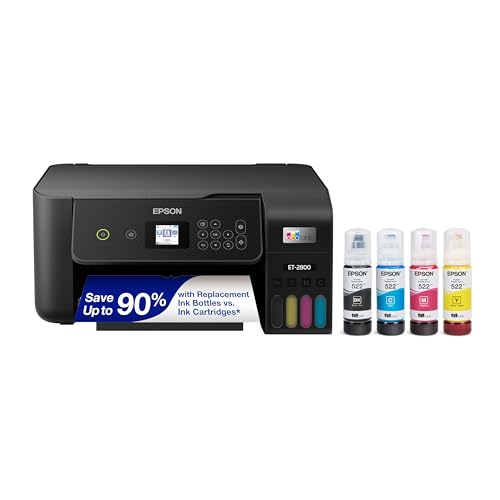
The ET-2800 is the model most crafters convert, because its refillable tanks accept third party sublimation ink from new without a cartridge chip to defeat. It prints letter width transfers cleanly once profiled. Owners consistently note that converting a brand new unit, never having run pigment ink through it, is essential to avoid clogs.
Pros
- Lowest entry cost of any route here
- Tanks fill directly with sublimation ink
- Doubles as a scanner and copier
Cons
- Sublimation ink voids the Epson warranty
- Colour accuracy needs manual profiling

Sawgrass SG1000
The SG1000 extends the Sawgrass approach to 11 by 17 inch prints with a bypass tray that pushes usable transfer length further still. That opens up full front shirt graphics and large panels that a letter width machine has to tile. It is a substantially bigger unit, so measure the bench before committing.
Pros
- Handles full front shirt graphics
- Long bypass tray for banners and panels
- Same colour management as the SG500
Cons
- Large footprint and heavy
- Cartridge running costs add up

Epson SureColor F570
The F570 moves into roll fed territory with a 24 inch width, which is the practical threshold for cut and sew work, banners and large soft signage. It combines a roll feeder with a sheet path, so short runs do not force you onto a roll. This is a production tool rather than a craft desk printer.
Pros
- Roll feed suits repeat production runs
- Wide enough for cut and sew panels
- Bottle ink keeps cost per print low
Cons
- Needs dedicated floor space
- Significant step up in complexity

Epson EcoTank ET-15000
For crafters who want larger transfers without moving to Sawgrass pricing, the ET-15000 converts the same way as smaller EcoTanks but prints up to 13 by 19 inches. That covers most tumbler wraps, large mouse mats and shirt front graphics. Owners report the wider carriage benefits from a slower print speed setting for even ink laydown.
Pros
- Large format at conversion pricing
- Wide scanner bed is genuinely useful
- Ethernet option for shared workshops
Cons
- Conversion voids the warranty
- Bulky for a home craft space

Epson EcoTank ET-4800
If the printer has to earn its keep as an office machine between craft sessions, the ET-4800 adds an automatic document feeder and fax to the familiar EcoTank tank system. Converted to sublimation ink it prints letter width transfers like its smaller sibling. The trade off is that once converted it can no longer do ordinary document printing well.
Pros
- Document feeder and copier built in
- Same simple tank conversion route
- Ethernet and Wi-Fi both supported
Cons
- Cannot serve both roles after conversion
- Warranty grey area applies
Before you buy
Dedicated printer or converted EcoTank A dedicated machine like the Sawgrass SG500 or Epson SureColor F170 ships with sublimation ink, a supported warranty and colour profiles that match the ink. A converted EcoTank costs far less up front but you take on the profiling yourself and the manufacturer warranty no longer applies once third party ink enters the tanks. Neither route is wrong, but decide before you buy rather than after.
Print width sets your product range Letter width, roughly 8.5 inches, covers mugs, coasters, keyrings, small signs and youth shirt graphics. Moving to 11 by 17 or 13 by 19 inches opens full adult shirt fronts and larger panels without tiling. A 24 inch roll printer is really a small production line and only pays back if you sell volume.
Ink, paper and substrate all have to agree Sublimation only bonds to polyester or a polymer coated surface, so cotton shirts and uncoated ceramics will not hold the image. Pair the printer with dedicated sublimation transfer paper rather than copy paper, since the release coating is what pushes the dye into the substrate rather than letting it soak into the sheet.
Colour management is where most frustration lives Sublimation ink shifts dramatically between the printed sheet and the pressed product, so what looks dull on paper often presses vivid. Bundled software such as Sawgrass Print Manager handles that shift automatically. If you convert an EcoTank, budget time for a colour swatch test on your actual substrate before you promise a customer a specific shade.
How they stack up
| # | Model | Max print width | Best for | Score | Price |
|---|---|---|---|---|---|
| 1 | Sawgrass SG500 | 8.5 inches | Best overall | 9.4 | Check price |
| 2 | Epson SureColor F170 | 8.5 inches | Best dedicated compact | 9.2 | Check price |
| 3 | Epson EcoTank ET-2800 | 8.5 inches | Best value | 9.0 | Check price |
| 4 | Sawgrass SG1000 | 11 by 17 inches | Best for large transfers | 8.8 | Check price |
| 5 | Epson SureColor F570 | 24 inches | Best for wide format | 8.6 | Check price |
| 6 | Epson EcoTank ET-15000 | 13 by 19 inches | Best for tabloid conversions | 8.3 | Check price |
| 7 | Epson EcoTank ET-4800 | 8.5 inches | Best all in one | 8.0 | Check price |
Questions worth asking
Can I use a regular inkjet printer for sublimation?
Only certain models, and only refillable tank printers in practice. Cartridge based printers with chipped cartridges resist third party ink, and printers that have already run pigment ink will clog when sublimation ink is introduced. A brand new EcoTank is the standard conversion route.
Does converting an Epson EcoTank void the warranty?
Yes. Filling the tanks with third party sublimation ink means Epson will not cover ink system faults. Many crafters accept that trade, but it is the main reason people choose the SureColor F170 instead.
What fabrics does sublimation actually work on?
Polyester and high polyester blends give the strongest result. Anything below roughly 65 percent polyester produces a visibly faded, vintage look, and pure cotton will not hold the dye at all without a specialist coating.
Do I need special paper?
Yes. Sublimation transfer paper has a coating that holds the ink on the surface and releases it under heat. Plain copy paper absorbs the ink and transfers a weak, blotchy image.
Why do my prints look dull before pressing?
That is normal. Sublimation ink only develops its full colour when heat converts it to gas and it bonds with the polymer. Judge colour on the pressed product, never on the printed sheet.
How often should the printer be used?
Print something at least weekly. Sublimation ink dries in the print head faster than standard ink, and idle machines are the most common cause of clogged nozzles reported by owners.
Can I print white?
No. Sublimation has no white ink, so any area meant to be white simply stays the colour of the substrate. This is why sublimation blanks are almost always white or very light coloured.
Is a wide format printer worth it for a hobby?
Rarely. The Epson SureColor F570 and similar roll printers make sense when you are selling repeat runs of larger items. For occasional shirts and mugs, a letter or tabloid width machine is the better value and takes far less space.
The bottom line
The Sawgrass SG500 remains the cleanest answer for anyone who wants to print rather than troubleshoot, since colour management and supported ink come in the box. The Epson SureColor F170 is the smarter long term pick if you print often and want bottle ink economics, and the Epson EcoTank ET-2800 is still the sensible way to find out whether sublimation suits you at all.