Temperature Sensors That Actually Hold Calibration
The SensorPush HT.w leads on accuracy and long term logging, making it the strongest all round choice. The Govee WiFi Thermometer Hygrometer H5179 gives you remote alerts without a hub for far less outlay, and the SwitchBot Meter Plus is the easiest pick for anyone already running a smart home routine.
If you want a sensor that stays accurate over years rather than months, the SensorPush HT.w is the pick, with the Govee H5179 close behind for hub free remote alerts and the SwitchBot Meter Plus best for smart home automation.
Temperature sensors are tricky to shop for because almost every listing quotes an accuracy figure, yet very few explain the conditions behind it or how far the humidity element drifts over time. We compared published accuracy tolerances, radio range, on device memory, export options and battery type, then weighed those against what owners report about long term drift, app reliability and alert delivery.
The shortlist, ranked
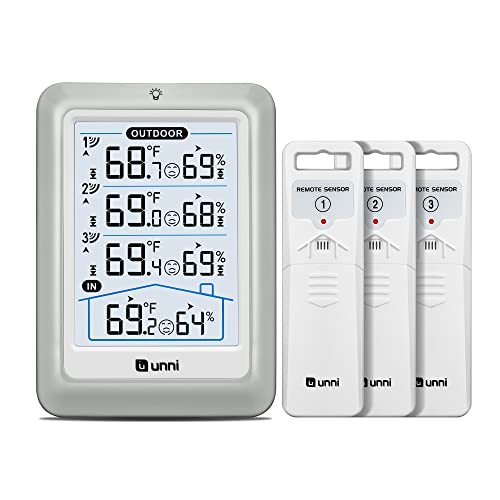
SensorPush HT.w Wireless Thermometer Hygrometer
SensorPush built the HT.w around a Swiss made sensing element with a tight published tolerance, and it stores twenty days of readings on the device itself so nothing is lost if your phone wanders out of range. Data exports cleanly to CSV, which matters if you are documenting a wine cellar, a reptile enclosure or a server closet. Owners report it is the sensor they stop double checking after the first month.
Pros
- Tight published accuracy tolerance on both temperature and humidity
- Stores readings locally so gaps do not appear in the log
- Straightforward CSV export for record keeping
Cons
- Remote access needs the separate WiFi gateway
- App design is functional rather than polished

Govee WiFi Thermometer Hygrometer H5179
The H5179 joins your home WiFi directly, so you get push alerts from anywhere without buying a bridge first. The front panel display is large enough to read across a room, and the Govee app keeps two years of history you can export. It is the sensible choice for a second home, a garage or a nursery you want to watch remotely.
Pros
- Direct WiFi means remote alerts out of the box
- Clear on unit display for at a glance checks
- Generous history retention in the app
Cons
- Will not join 5GHz networks
- Alerts depend on the Govee cloud staying reachable

SwitchBot Meter Plus
SwitchBot designed the Meter Plus to trigger things rather than just report them, so a humidity threshold can switch on a dehumidifier through a SwitchBot plug. The e ink style panel is easy to read and the trend arrow tells you which way conditions are heading. Pair it with the SwitchBot Hub if you want alerts while you are away.
Pros
- Acts as a trigger for humidifiers, fans and heaters
- Very legible display with trend direction
- Works with Alexa and Google through the hub
Cons
- Needs a hub for anything beyond local Bluetooth
- Automations are limited to the SwitchBot ecosystem

ThermoPro TP357 Bluetooth Hygrometer Thermometer
The TP357 keeps things deliberately basic, pairing over Bluetooth with a claimed range of around 260 feet in open space. There is no cloud account to set up and no hub to buy, which suits anyone who just wants to watch a bedroom or greenhouse from inside the house. Owners report the display is bright and the battery lasts a long stretch on a single set.
Pros
- Very low barrier to entry with no account required
- Long claimed Bluetooth range for the class
- Readable display with comfort level indicator
Cons
- No remote access once you leave the house
- Accuracy tolerance is looser than premium sensors

Aqara Temperature and Humidity Sensor
This Zigbee sensor is tiny, cheap enough to scatter through the house and reports temperature, humidity and barometric pressure back to an Aqara hub. Once bridged it shows up natively in Apple Home, Alexa and Google, so automations live wherever you already build them. Battery life is measured in years rather than months because Zigbee radios sip power.
Pros
- Small and inexpensive enough to deploy in every room
- Native platform integration once bridged
- Excellent battery life on the Zigbee radio
Cons
- Useless without an Aqara or compatible Zigbee hub
- No display on the sensor itself

Inkbird IBS-TH2 Plus Bluetooth Thermometer
The IBS-TH2 Plus ships with an external probe, which means you can leave the body outside a fridge, incubator or fermenting vessel and read what is happening inside. It logs to internal memory and syncs when your phone comes back in range, so the record stays continuous. Brewers and reptile keepers gravitate to it for exactly that reason.
Pros
- External probe reaches inside sealed spaces
- Logs offline and backfills the app later
- Adjustable calibration offset in the app
Cons
- Bluetooth only unless you add an Inkbird gateway
- App interface takes some learning

Ecowitt WH31 Multi Channel Thermo Hygrometer Sensor
The WH31 is designed to be bought several at a time, with up to eight channels reporting into a single Ecowitt console or gateway. That makes it the cheapest sensible way to instrument a whole house or a set of grow tents without eight separate apps. You do need an Ecowitt receiver, so treat it as part of a system rather than a standalone buy.
Pros
- Cheapest route to many rooms on one dashboard
- Long radio range through interior walls
- Data can be pushed to third party weather services
Cons
- Requires an Ecowitt gateway or console to work
- Setup is more involved than a consumer WiFi sensor
Side by side
| # | Model | Sensing element | Best for | Score | Price |
|---|---|---|---|---|---|
| 1 | SensorPush HT.w Wireless Thermometer Hygrometer | Swiss made digital temperature and humidity | Best overall | 9.4 | Check price |
| 2 | Govee WiFi Thermometer Hygrometer H5179 | 2.4GHz WiFi, no hub required | Best value | 9.2 | Check price |
| 3 | SwitchBot Meter Plus | Bluetooth, hub for remote and voice | Best for smart home automation | 9.0 | Check price |
| 4 | ThermoPro TP357 Bluetooth Hygrometer Thermometer | Bluetooth, roughly 260ft open range | Best budget | 8.7 | Check price |
| 5 | Aqara Temperature and Humidity Sensor | Zigbee, requires Aqara hub | Best for Apple Home users | 8.5 | Check price |
| 6 | Inkbird IBS-TH2 Plus Bluetooth Thermometer | Bluetooth with offline logging | Best for external probe use | 8.3 | Check price |
| 7 | Ecowitt WH31 Multi Channel Thermo Hygrometer Sensor | 915MHz radio to Ecowitt gateway | Best for multi room monitoring | 8.0 | Check price |
What to look for
Accuracy claims deserve a closer look Almost every sensor lists a tolerance figure, but that number usually applies only near room temperature and mid range humidity. Accuracy typically degrades at the extremes, which is exactly where a freezer, greenhouse or crawlspace lives. Look for a stated range alongside the tolerance, and treat sensors that quote a tolerance without a range with some caution.
Bluetooth, WiFi or Zigbee changes what you can do Bluetooth sensors are cheap and battery friendly but only reach you while you are in the building. WiFi models alert you anywhere at the cost of shorter battery life and dependence on a cloud service. Zigbee sensors need a hub, yet they last for years and integrate cleanly with wider home automation. Choose the radio around whether you need alerts while away.
Local logging prevents gaps in the record If you are monitoring anything you may need to prove later, such as a wine store or a medication fridge, on device memory matters more than app polish. Sensors that log locally and backfill when they reconnect give you an unbroken record. Sensors that only stream live data leave holes every time the connection drops.
Placement affects readings more than the sensor does A sensor in direct sunlight, above a radiator or tight against an exterior wall will read several degrees off no matter how good the element is. Mount at roughly chest height, away from vents and windows, and give it airflow on all sides. If you are comparing two rooms, use identical placement in both so the difference you see is real.
Questions worth asking
How accurate are consumer temperature sensors?
Most quality consumer sensors land within a few tenths of a degree for temperature and a few percent for relative humidity under normal room conditions. Humidity is the harder measurement and drifts more over time. Premium sensors state tighter tolerances and use better sensing elements, which is where much of the price difference sits.
Do I need a hub for a wireless temperature sensor?
It depends on the radio. WiFi sensors like the Govee H5179 connect straight to your router. Bluetooth sensors work phone to sensor with no hub but only within range. Zigbee models such as the Aqara sensor always need a compatible hub, and SensorPush needs its gateway only if you want remote access.
Can these sensors monitor a freezer or fridge?
Many can, though check the stated operating range first, as some consumer sensors are only rated down to around minus twenty degrees Celsius. A model with an external probe, like the Inkbird IBS-TH2 Plus, is usually better because the radio stays outside the metal box where the signal can escape.
How long do the batteries last?
Zigbee and Bluetooth sensors commonly run one to two years on a coin cell or AAA set. WiFi sensors work harder and typically want fresh batteries every several months to a year, depending on how often they report. Cold environments shorten battery life noticeably, so budget for more frequent changes in a freezer or outdoors.
Will a sensor work through walls?
Usually yes, but every wall costs range. Bluetooth is the most easily blocked, sub gigahertz radios like the Ecowitt system pass through interior walls best, and WiFi depends entirely on your existing coverage. If the sensor sits in a basement or detached garage, favour a longer range radio or place a gateway closer to it.
Can I calibrate a temperature sensor at home?
Some apps, including Inkbird and Ecowitt, let you enter an offset. A common approach is the salt test for humidity, where a sealed container of damp salt should read close to seventy five percent, and an ice bath check for temperature at zero degrees Celsius. Apply any offset you find in the app rather than doing mental maths later.
What humidity range should a home sit in?
Between roughly forty and sixty percent relative humidity is the usual comfort and health target. Below that, wood shrinks and static builds. Above it, condensation and mould risk climb quickly. Setting alerts at those two boundaries is more useful than watching the number all day.
Are cheap sensors worth buying for casual use?
For general comfort monitoring, yes. A budget sensor like the ThermoPro TP357 will tell you reliably whether a room is warmer or damper than another. Spend more only when the reading has consequences, such as stored goods, livestock, instruments or anything you may need to document.
Our pick
For most people the SensorPush HT.w justifies its position at the top through accuracy that holds up and logging you can actually rely on. If remote alerts matter more than precision, the Govee H5179 does the job without a hub, and the SwitchBot Meter Plus is the one to pick if you want the reading to trigger something rather than just inform you.