Tempered Glass Screen Protectors That Stay Clear
The Spigen GlasTR EZ Fit takes the top spot thanks to its auto align tray, which removes most of the guesswork from installation. The Whitestone Dome Glass is the pick for curved displays because the liquid adhesive bonds edge to edge, and the amFilm OneTouch is the sensible multi pack choice.
The Spigen GlasTR EZ Fit leads this roundup because the included alignment tray makes a bubble free, centred install repeatable even on a first attempt. The Whitestone Dome Glass is the better answer for curved edge phones, where a liquid adhesive bonds the whole surface instead of only the flat middle, and the amFilm OneTouch is the pick when you want spare panels in the drawer for the inevitable second install.
Tempered glass is tricky to shop for because the marketing numbers are the least useful part. Almost every listing claims 9H hardness, yet what separates a good panel from a bad one is edge coverage, whether the cutouts clear your camera and proximity sensor, how thick the glass sits under a case lip and whether the oleophobic coating survives a few months of thumbs. We compared stated thickness, coverage style, install hardware and sensor cutouts, then weighed those against what owners report about lifting corners, halo gaps and fingerprint sensor reliability.
What we recommend
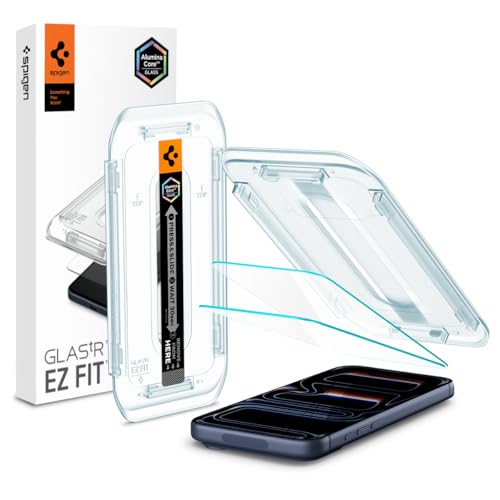
Spigen GlasTR EZ Fit Screen Protector
The auto align tray is the reason this one keeps winning roundups, since it drops the glass into position without you touching the adhesive face. The glass itself is standard thickness with a clean oleophobic layer, so swipes stay smooth rather than dragging. Cutouts are cut tightly enough that face unlock and proximity sensing behave normally.
Pros
- Alignment tray makes a straight install easy
- Coating keeps fingerprints from smearing
- Sits low enough for most cases
Cons
- Flat design leaves curved edges uncovered
- Tray is model specific, so it cannot be reused

Whitestone Dome Glass Screen Protector
Instead of a pre applied sticky layer, this kit spreads liquid optical adhesive under the glass and cures it with UV light. The result bonds right into the curve of an edge display, which is where cheaper panels lift and form a rainbow halo. It is the fussiest install here and the least forgiving of mistakes.
Pros
- Only real fix for curved edge lifting
- Bonded surface keeps touch response even
- Fills micro scratches on the display glass
Cons
- Install is slow and unforgiving
- Adhesive can seep if you overapply it

amFilm OneTouch Glass Screen Protector
amFilm packs an applicator frame with several panels, so a botched install costs you nothing but time. Clarity and touch feel are close enough to the premium names that most owners cannot tell them apart in daily use. The trade off is a slightly softer coating that picks up fingerprints sooner.
Pros
- Spare panels remove install anxiety
- Frame keeps the glass square to the screen
- Thin enough for slim cases
Cons
- Oleophobic layer wears faster than premium glass
- Edge coverage stops short of the bezel

ZAGG InvisibleShield Glass Elite
ZAGG treats its glass with an ion exchange process that targets impact strength rather than headline hardness numbers. Owners report it survives corner drops that shatter thinner panels, though it is noticeably thicker under a fingertip. The registration program that comes with it is a nice touch if you break panels often.
Pros
- Holds up well to corner and edge impacts
- Tray install is quick and repeatable
- Brand support if the panel cracks
Cons
- Thicker feel than budget panels
- Single panel per box
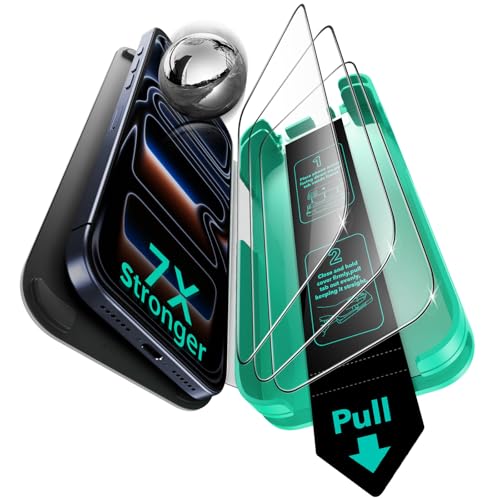
ESR Armorite Screen Protector
ESR builds the Armorite around a harder surface treatment aimed at keys and grit rather than drops. Pocket scratching is genuinely rare on these, and the included frame keeps dust out during application. Touch sensitivity stays accurate at the corners, which is where cheaper glass sometimes goes dead.
Pros
- Resists pocket and key scratching well
- Frame keeps dust from getting trapped
- Consistent touch response to the corners
Cons
- Slightly more reflective than plain glass
- Edges can chip if the case squeezes them

Ailun Glass Screen Protector
Ailun sells three panels in a box with a basic guide frame, which makes it the default choice for a phone that already has scars. Clarity is fine and the glass shatters into the film rather than spraying, as tempered glass should. Coatings dull faster here, so plan on swapping panels once or twice a year.
Pros
- Lowest cost per panel in this group
- Three panels cover repeated mistakes
- Clarity is close to premium options
Cons
- Coating dulls within months of heavy use
- Frame is less precise than tray systems

Belkin ScreenForce TemperedGlass
Belkin sells the ScreenForce line in clear, privacy and anti glare versions using the same tray applicator, which is handy if you want a matching finish across a few devices. Build quality is consistent and the tray holds alignment well. The privacy variants dim the display noticeably, as all privacy filters do.
Pros
- Same install system across finishes
- Consistent panel quality between batches
- Privacy option genuinely narrows viewing angle
Cons
- Privacy versions cut screen brightness
- One panel per box with no spare
How they compare
| # | Model | Coverage | Best for | Score | Price |
|---|---|---|---|---|---|
| 1 | Spigen GlasTR EZ Fit Screen Protector | Flat panel with case friendly edge | Best overall | 9.4 | Check price |
| 2 | Whitestone Dome Glass Screen Protector | Full edge to edge including curves | Best for curved screens | 9.2 | Check price |
| 3 | amFilm OneTouch Glass Screen Protector | Flat panel, case friendly | Best value | 9.0 | Check price |
| 4 | ZAGG InvisibleShield Glass Elite | Flat panel with reinforced edges | Best for durability | 8.8 | Check price |
| 5 | ESR Armorite Screen Protector | Flat panel, case compatible | Best for scratch resistance | 8.6 | Check price |
| 6 | Ailun Glass Screen Protector | Flat panel with cut edge | Best budget | 8.3 | Check price |
| 7 | Belkin ScreenForce TemperedGlass | Flat panel, case friendly | Best for privacy and coverage options | 8.0 | Check price |
How to pick the right one
Hardness ratings tell you almost nothing Nearly every listing claims 9H, a figure borrowed from a pencil scratch scale that tops out well below what your keys can do. What actually differs between panels is the thickness of the glass, the quality of the ion strengthening and how the edge is finished. A slightly thicker panel with a polished edge survives drops better than a paper thin one with the same 9H sticker, so read the thickness and edge description rather than the hardness claim.
Flat glass on a curved phone will lift Most tempered glass is cut flat because flat glass is cheap and easy to align. On a phone with curved display edges that leaves a gap where the panel stops short of the bezel, and dust plus adhesive stress eventually shows as a rainbow halo along the sides. If your phone has curved edges, either accept a smaller flat panel that sits inside the curve or move to a liquid adhesive kit that bonds the full surface.
Case compatibility is the quiet dealbreaker A rugged case with a raised lip can press against the outer millimetre of a screen protector every time you set the phone down, and that pressure is what starts corners peeling. Protectors labelled case friendly are cut a little narrower to sit inside the lip. If you use a heavy case, prioritise a case friendly cut over maximum coverage, because a panel that peels protects nothing.
Installation systems matter more than the glass Owners report that far more protectors are ruined by dust and misalignment than by drops. Tray and frame applicators solve this by holding the panel above the screen until you release it, so your fingers never touch the adhesive and the panel cannot land crooked. If you are installing in a dusty room, run a hot shower first to settle airborne particles, use the included dust removal sticker on anything you see, and do not try to reposition a panel once the adhesive has grabbed.
Good to know
Does a tempered glass protector reduce touch sensitivity?
A standard thickness panel makes no practical difference on a modern phone. Very thick protectors, or any panel with trapped air under it, can cause missed taps at the edges. If touch response drops after installing, look for bubbles at the corners rather than blaming the screen.
Will it work with an in display fingerprint sensor?
Only if the listing says so. Sensor compatible panels use thinner or specially treated glass over the reader area, and generic panels often break optical readers. Ultrasonic sensors are fussier still, so check the compatibility note for your exact phone model before buying.
Why did a rainbow pattern appear around the edges?
That halo is a thin air gap where the adhesive has not bonded, usually along a curved edge or over a bit of trapped dust. Pressing firmly from the centre outward within the first day sometimes clears it. If it persists on a curved screen, the panel is simply the wrong shape for that display.
How often should a screen protector be replaced?
Replace it when the oleophobic coating stops repelling fingerprints, when scratches start catching your nail, or immediately after any crack. Budget panels typically lose their coating within a year of heavy use, while premium glass often lasts longer.
Can two protectors be stacked for extra protection?
No. Stacking traps air between the layers, ruins clarity and makes touch response unreliable. Remove the old panel completely, clean off any adhesive residue with the included wipe, and install a single fresh panel.
Is privacy glass worth the trade off?
It works, and it also dims the display and narrows the viewing angle for you as well as everyone else. If you regularly work with sensitive information on a train or in an open office, that is a fair trade. For general use, a clear panel is the better experience.
What is the difference between full coverage and case friendly?
Full coverage panels run to the bezel edge and look seamless, but they can conflict with case lips. Case friendly panels are cut a couple of millimetres narrower, leaving a visible border while avoiding the pressure that lifts corners. Match the choice to your case, not to the photos.
How do I remove trapped dust after installing?
Lift the affected corner slightly with a piece of tape, use the sticker from the kit to pick the particle off the adhesive, then lay the panel back down and press outward from the centre. Do this once at most, since each lift weakens the adhesive.
Our take
For most phones the Spigen GlasTR EZ Fit is the safest pick, because the alignment tray solves the part of this purchase people actually get wrong. Curved edge phones are better served by the Whitestone Dome Glass and its liquid adhesive, while the amFilm OneTouch multi pack is the practical choice if you would rather have spares than a perfect single panel.


