Timing Belt Kits That Last the Full Service Interval
Gates PowerGrip timing belt kits take our top spot for original equipment tooth profiles and complete component packages. Continental ContiTech is the closest alternative on quality, and Aisin is the safest choice on Japanese engines where the water pump is driven by the belt.
Gates PowerGrip timing belt kits are the best choice for most engines, with Continental ContiTech a near equal alternative and Aisin the pick on Japanese engines where the belt also turns the water pump.
A timing belt is a low cost part attached to a very high cost job, and on an interference engine a failure means bent valves rather than a tow home. We compared tooth profile and tensile cord specifications, published temperature ratings, what each kit actually includes in the box and owner reports about tensioners that failed long before the belt did.
What matters most
Buy the kit, not just the belt The belt is the cheapest component in the job and the labour is the same whether you change one part or five. Tensioners and idler pulleys run on bearings that wear at a similar rate to the belt, and a seized idler will shred a new belt. Any kit worth buying includes the tensioner and idlers, and on many engines the water pump too.
Interference engines change the stakes On an interference engine the valves and pistons occupy the same space at different moments, so a snapped belt means bent valves and often a cylinder head rebuild. On a non interference engine the car simply stops. Find out which yours is before deciding whether to stretch the interval, because the consequence of getting it wrong differs enormously.
Replace the water pump when the belt drives it If the timing belt turns the water pump, replacing the pump at the same time is standard practice, because doing it later means paying the same labour a second time. Pumps and belts have broadly similar service lives. This is why the Aisin kits include one, and why Gates and Continental offer kit variants with a pump.
Follow the interval by time as well as mileage Rubber degrades with heat and age, not only with rotations. A low mileage car that is ten years old is still due a belt. Check your manufacturer’s interval in both miles and years, and treat whichever comes first as the deadline. Oil contamination from a leaking cam seal accelerates the failure considerably.
The top picks, ranked

Gates PowerGrip Timing Belt Kit
Gates supplies timing belts to vehicle manufacturers, so a PowerGrip kit is frequently the same belt the engine left the factory with. The kits bundle the belt, tensioner and idler pulleys, which matters because a new belt on an old tensioner is a false economy given the labour involved. Coverage is the broadest of any brand here, and the kit contents are clearly listed per application.
Pros
- Often the same specification as the factory belt
- Kits include the wear parts that fail alongside the belt
- Excellent application coverage and documentation
Cons
- Priced above budget kits
- Kit contents vary by application, so check the list

Continental ContiTech Pro Series Timing Belt Kit
Continental is the other major original equipment belt supplier, and its Pro Series kits are effectively interchangeable in quality with the Gates equivalents. Belt compounds are rated for high underbonnet temperatures and the tooth profiles match factory specifications closely. Which of the two you buy usually comes down to which has better coverage and stock for your specific engine.
Pros
- Original equipment quality construction
- Particularly strong European coverage
- Consistent tooth profile accuracy
Cons
- Coverage on some Asian engines is thinner
- Availability varies more than Gates
Aisin Engine Timing Belt Kit
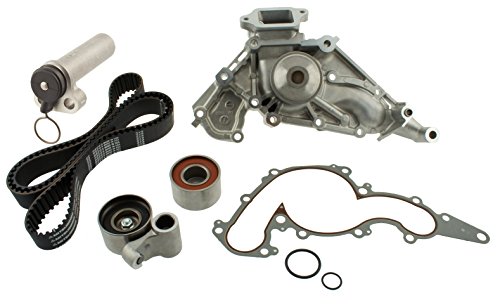
Aisin is an original equipment supplier to several Japanese manufacturers, and its kits typically include the water pump that the belt drives, which is the correct way to do this job on those engines. Buying the Aisin kit means the pump, belt and tensioner are all to factory specification rather than a mix of aftermarket parts with different service lives. Coverage outside Japanese applications is limited.
Pros
- Includes a factory specification water pump
- All components share a matched service life
- Some kits include the seals you should replace anyway
Cons
- Very limited coverage beyond Japanese vehicles
- Costs more than mixed aftermarket kits

Dayco Timing Belt Kit
Dayco sits a step below the two original equipment giants on price while still supplying complete kits rather than bare belts. The belts use modern compounds and the coverage is wide, including some older applications the premium brands have dropped. Owner reports are generally positive, with the occasional note that tensioner pulley bearings are the weaker component in the box.
Pros
- Complete kits at a lower price point
- Covers some discontinued applications
- Good availability
Cons
- Pulley bearing quality is less consistent
- Not the choice for a high mileage keeper

Mitsuboshi Timing Belt
Mitsuboshi supplies belts to Japanese manufacturers and its bare belts are frequently what came off the engine, right down to the tooth count and markings. This is the option when you are replacing a belt on its own, for instance if the tensioner and pump were done recently. On a full service you should still buy a kit rather than a belt alone.
Pros
- Frequently identical to the factory fitted belt
- Printed timing marks simplify installation
- Lower cost when only the belt is needed
Cons
- Sold without tensioner or pulleys
- Coverage concentrated on Japanese engines

Bando Timing Belt
Bando is another Japanese belt manufacturer with original equipment credentials, and its belts are a dependable low cost choice on the applications it covers. Construction uses heat resistant compounds and the tooth profiles are accurate. As with Mitsuboshi, these are usually sold as bare belts, so plan on sourcing tensioner and idler pulleys separately if they need replacing.
Pros
- Original equipment heritage at a low price
- Accurate tooth profiles
- Good coverage on Korean engines too
Cons
- Bare belt only in most listings
- Less documentation than the major kit brands

ACDelco Professional Timing Belt
For General Motors engines that use a belt rather than a chain, ACDelco Professional is the direct factory style replacement without the dealer markup. Fitment is exact and quality control is consistent. Coverage is naturally concentrated on domestic applications, so it is not a general purpose recommendation, but it is the safe pick where it applies.
Pros
- Exact fitment on the engines it covers
- Reliable quality control
- Easy to source through normal channels
Cons
- Narrow application range
- Kits are not offered for every listing
How they stack up
| # | Model | Belt construction | Best for | Score | Price |
|---|---|---|---|---|---|
| 1 | Gates PowerGrip Timing Belt Kit | High modulus tensile cord, HNBR compound | Best overall | 9.4 | Check price |
| 2 | Continental ContiTech Pro Series Timing Belt Kit | HNBR compound with fibreglass cord | Best alternative to Gates | 9.2 | Check price |
| 3 | Aisin Engine Timing Belt Kit | Belt, tensioner, idlers, water pump | Best for Japanese engines | 9.0 | Check price |
| 4 | Dayco Timing Belt Kit | Reinforced synthetic rubber | Best value kit | 8.8 | Check price |
| 5 | Mitsuboshi Timing Belt | Bare timing belt | Best bare belt | 8.6 | Check price |
| 6 | Bando Timing Belt | Bare timing belt | Best budget belt | 8.3 | Check price |
| 7 | ACDelco Professional Timing Belt | Original equipment style | Best for domestic applications | 8.0 | Check price |
Common questions
How often should a timing belt be replaced?
Most manufacturers specify somewhere between sixty thousand and one hundred thousand miles, or a fixed number of years, whichever comes first. Check your handbook for the exact figure, since it varies considerably between engines.
What happens if a timing belt breaks?
On an interference engine, the valves collide with the pistons and the engine suffers serious internal damage. On a non interference engine, the engine simply stops running and can usually be repaired by fitting a new belt and retiming it.
Are there warning signs before a timing belt fails?
Often not, which is why the interval is followed rather than waiting for symptoms. Where warnings do appear they include a ticking noise from the timing cover, rough running, difficulty starting, or visible cracking and oil contamination on the belt during inspection.
Should I replace the water pump with the timing belt?
Yes if the belt drives the pump. The labour to reach the pump is almost entirely shared with the belt job, so doing it separately later effectively doubles the cost. If the pump is driven by the auxiliary belt instead, it can be left alone.
Is a timing chain better than a timing belt?
Chains generally last longer and many are designed for the life of the engine, but they are not maintenance free and chain guides and tensioners do fail. Belts are quieter, lighter and cheaper to replace when the interval comes around.
Can I replace a timing belt myself?
It is one of the more demanding home mechanic jobs, requiring correct engine timing, often special locking tools, and precise tensioner setting. A small error puts the valve timing out and can damage the engine. Many capable DIY mechanics still choose to pay for this one.
Does brand really matter for a timing belt?
It matters more than for most parts, because the consequence of failure is severe and the labour cost dwarfs the part cost. Sticking to original equipment suppliers such as Gates, Continental, Aisin, Mitsuboshi or Bando is cheap insurance.
Why did my new timing belt fail early?
The most common causes are a worn tensioner or idler pulley left in place, incorrect belt tension at installation, or oil leaking onto the belt from a failed cam or crank seal. All three are avoidable by replacing the full kit and fixing leaks during the job.
The verdict
Gates PowerGrip kits are the default recommendation because they combine original equipment specification with the tensioner and idler pulleys that should be replaced at the same time. Continental ContiTech is an equally sound choice where coverage suits your engine better, and on Japanese engines with a belt driven water pump the Aisin kit is the one that gets every component to factory specification.