Which Tire Pressure Monitor Fits Your Vehicle?
The TireMinder A1AS heads our ranking because it monitors up to twenty two tires and includes a signal booster for long rigs. The Tymate M7-3 is the sensible car and truck choice, while the Jansite solar unit is the easiest to install for everyday commuting.
For trailers and long vehicles the TireMinder A1AS is the tire pressure monitor we rank first, thanks to its capacity and included booster. Cars and pickups are well served by the Tymate M7-3, and the Jansite solar unit is the quickest to fit for daily commuting.
Aftermarket tire pressure monitors are confusing because the two designs on sale, cap mounted external sensors and internal sensors fitted inside the wheel, behave very differently in terms of accuracy, theft risk and installation effort. We compared sensor type, stated pressure range, alarm thresholds, display readability in sunlight and how each unit is powered across seven current listings.
What matters most
External versus internal sensors Cap mounted external sensors screw onto the valve stem in minutes and can move between vehicles, which is why every kit here uses them. The trade offs are that they can be unscrewed by a thief, they add a little unsprung weight at the valve, and they need anti theft locking rings on vehicles parked on the street. Internal sensors fitted inside the wheel are tidier and more accurate but require a tire shop to install.
Set targets from the door placard, not the sidewall The pressure printed on the tire sidewall is the maximum the tire can hold, not the pressure your vehicle wants. Use the placard inside the driver door frame, which gives the manufacturer’s cold inflation figures for front and rear. Set your monitor’s alert thresholds a few psi either side of those numbers, since normal driving raises pressure as the tires warm.
Display placement and readability A monitor you cannot read is a monitor you will ignore. Solar displays need light to charge but wash out in direct sun, so a spot that catches daylight without facing straight at it works best. Check that adhesive or suction mounts hold in summer heat, since owners report dashboard mounts letting go on hot days more often than any other failure.
What a monitor can and cannot do Tire pressure monitoring warns you about slow leaks and gradual underinflation, which is where most fuel waste and uneven wear comes from. It is not a substitute for a monthly check with a good gauge, and no consumer system reliably predicts a blowout. Treat it as an early warning layer that buys you time to reach a safe place to stop.
The best picks, ranked

TireMinder A1AS TPMS with Signal Booster
Designed for recreational vehicles and trailers, the A1AS monitors up to twenty two tires and ships with a booster so the signal reaches the back of a long combination. Alerts cover high and low pressure plus rapid leaks and high temperature. Owners report the setup process takes some patience, but once programmed it is dependable.
Pros
- Handles trailers and long vehicles
- Booster keeps rear signals reliable
- Wide pressure range for heavy tires
Cons
- Setup is more involved than car kits
- Display is functional rather than modern

EEZTire TPMS E68 Real Time Monitoring System
EEZTire backs its system with a long warranty and offers user replaceable sensor batteries, which is what keeps a large sensor set economical over years. The display shows all monitored positions at once rather than cycling. It uses external sensors, so anti theft rings are worth fitting on a vehicle left parked outdoors.
Pros
- User replaceable sensor batteries
- Shows many positions simultaneously
- Long warranty period
Cons
- External sensors can be removed by thieves
- Display needs a good mounting spot

Tymate M7-3 Tire Pressure Monitoring System
A colour screen with a large readable layout makes this the easiest of the four sensor kits to interpret at a glance while driving. Solar charging with USB backup means it usually never needs plugging in. Owners report the external sensors add a small amount of weight at the valve, which is not noticeable in normal driving.
Pros
- Easy to read colour display
- Solar keeps it charged
- Six alarm types covered
Cons
- Adds slight weight at the valve
- Screen washes out in direct sun

Jansite Solar Wireless Tire Pressure Monitoring System
Screw four sensors onto the valve stems, sit the solar display on the dash and it works, which is genuinely the whole installation. It suits commuters who want a warning of a slow puncture rather than detailed monitoring. Pressure accuracy is adequate for alerts but should be checked against a good gauge when setting targets.
Pros
- Fastest installation in this ranking
- No wiring required
- Modest outlay
Cons
- Accuracy trails premium systems
- Suction or adhesive mount can loosen in heat

GUTA Solar Wireless TPMS
GUTA covers the essentials of pressure and temperature alerts on four wheels with a compact solar display. Alarm thresholds are adjustable, which many low cost units fix at unhelpful defaults. Based on specifications the sensor batteries are not user replaceable, so plan on replacing sensors after a couple of years.
Pros
- Adjustable alarm thresholds
- Compact dash display
- Low outlay
Cons
- Sensor batteries not replaceable
- Basic display styling

Steelmate TP-79 Tire Pressure Monitoring System
Steelmate’s sensors are among the smallest here, which matters on motorcycle valve stems where a heavy cap sensor can cause imbalance at speed. The display is compact and weather resistant. Two sensor configurations keep it relevant to bikes rather than forcing a four wheel kit.
Pros
- Small light sensors
- Suited to two wheeled vehicles
- Weather resistant display
Cons
- Only covers two wheels
- Small screen is harder to read
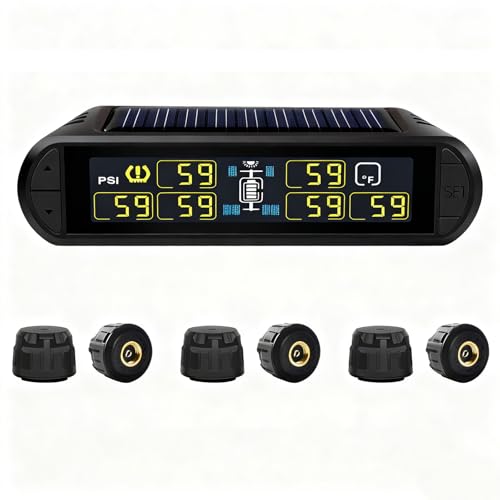
B-Qtech Solar Power TPMS
This is the least expensive way to get a low pressure warning on a vehicle that lacks factory monitoring, with four cap sensors and a small solar display. It covers the core job of telling you a tire is losing air. Refresh rate is slower than premium systems, so it is better at catching slow leaks than sudden blowouts.
Pros
- Lowest outlay in the ranking
- No wiring or tools needed
- Covers the essential alerts
Cons
- Slower update rate
- Limited adjustment options
Compared at a glance
| # | Model | Sensor capacity | Best for | Score | Price |
|---|---|---|---|---|---|
| 1 | TireMinder A1AS TPMS with Signal Booster | Up to 22 tires | Best overall | 9.4 | Check price |
| 2 | EEZTire TPMS E68 Real Time Monitoring System | Up to 26 tires | Best for RVs and trailers | 9.2 | Check price |
| 3 | Tymate M7-3 Tire Pressure Monitoring System | 4 tires | Best for cars and trucks | 9.0 | Check price |
| 4 | Jansite Solar Wireless Tire Pressure Monitoring System | 4 tires | Best for easy installation | 8.8 | Check price |
| 5 | GUTA Solar Wireless TPMS | 4 tires | Best value | 8.6 | Check price |
| 6 | Steelmate TP-79 Tire Pressure Monitoring System | 2 sensors | Best for motorcycles and small vehicles | 8.3 | Check price |
| 7 | B-Qtech Solar Power TPMS | 4 tires | Best budget | 8.0 | Check price |
Common questions
Do I need an aftermarket TPMS if my car already has one?
Usually not for the car itself. Aftermarket systems are most useful for trailers, recreational vehicles, motorcycles and older cars built before monitoring became standard.
Are cap mounted sensors accurate?
They are accurate enough for alerts, typically within a couple of psi. For setting exact target pressures, check with a quality manual gauge and use the monitor for ongoing warnings.
Will external sensors cause valve stem leaks?
Properly fitted sensors with their sealing washers do not, but they do put slightly more load on the stem. Rubber stems in poor condition should be replaced before fitting sensors.
Can someone steal the sensors?
Yes, which is why most kits include anti theft locking rings. Fitting them takes a minute per wheel and is worth doing on any vehicle parked outdoors.
How long do the sensor batteries last?
Typically one to three years depending on the model. Systems with user replaceable batteries are considerably cheaper to keep running over time.
What pressure should I set the alerts to?
Base them on the placard inside the driver door frame, with the low alert around ten to fifteen percent below target and the high alert allowing for normal heat build up on a long drive.
Do solar displays work in winter?
They charge more slowly with short days and low sun, which is why every solar unit here also includes USB charging as a backup. Plugging it in occasionally solves it.
Will a monitor warn me before a blowout?
It can warn of a rapid pressure drop, which sometimes precedes failure, but no consumer system reliably predicts a sudden blowout. Its main value is catching slow leaks early.
Final word
The TireMinder A1AS wins our ranking because trailers and long vehicles are where aftermarket monitoring genuinely earns its place, and the included booster solves the signal problem those setups create. Drivers of cars and pickups will be better served by the Tymate M7-3 and its clearer display. If you simply want a fast fitting warning of a slow puncture, the Jansite solar kit does that job for very little.