Toy Doctor Kits Kids Actually Keep Playing With
Melissa and Doug Get Well Doctor’s Kit Play Set leads on piece quality and its zippered fabric bag. Fisher-Price Medical Kit suits younger toddlers with chunky, chewable safe parts. Learning Resources Pretend and Play Doctor Set adds real function through a working stethoscope.
Melissa and Doug Get Well Doctor’s Kit Play Set is the all round pick for ages three and up. Fisher-Price Medical Kit fits toddlers better. Learning Resources adds a functioning stethoscope.
Sorting these sets is harder than piece counts suggest, because a 20 piece kit full of loose plastic often loses half its parts in a week. Working instruments and a case that closes matter far more. We compared materials, age ratings, storage design, which tools actually function, and what owners report about durability after months of play.
How to pick the right one
What makes a good toy doctor kit? Storage decides whether a kit survives past a month. A zippered bag or latching case keeps the set intact; loose pieces in a toy bin disappear. Look next at material, since wood and thick plastic outlast thin molded parts. Piece count is the least useful number on the box. Ten well made tools beat twenty flimsy ones every time.
Which age is each kit suited to? Most sets carry a three and up rating because of small parts. Toddlers under three need chunky, rounded pieces, which is where the Fisher-Price Medical Kit fits. Preschoolers from three to five respond to realistic detail, so Theo Klein and Learning Resources land well. Older children around six enjoy story props like X ray cards and prescription pads.
Do the instruments need to work? One working tool changes how long a set holds attention. The Learning Resources stethoscope carries a real heartbeat, which children test on parents, pets and stuffed animals repeatedly. Blood pressure cuffs that inflate and syringes with moving plungers create similar cause and effect moments. Purely decorative tools still support role play, though the novelty fades faster.
Wood, plastic or electronic: which holds up? Solid wood, as in the Hape set, resists cracking and avoids plastic altogether, but weighs more. Thick molded plastic is the practical middle ground and wipes clean after sticky hands. Electronic kits like the Kidzlane set need batteries and have more failure points. Choose electronics for engagement, wood for longevity, plastic for everyday balance.
The best picks, ranked

Melissa and Doug Get Well Doctor’s Kit Play Set
Eleven pieces cover the tools children recognize, including a stethoscope, reflex hammer, syringe, thermometer and ear scope. Everything stores in a zippered fabric bag with a shoulder strap, so cleanup is one motion. Wood and sturdy plastic construction survives being dropped on hardwood repeatedly.
Pros
- Zippered bag keeps small pieces together
- Wood handled tools feel substantial in small hands
- Includes an eye chart and patient ID card for role play
Cons
- Stethoscope does not transmit sound
- Fabric bag stains and needs spot cleaning

Learning Resources Pretend and Play Doctor Set
The stethoscope actually carries sound, which turns listening to a heartbeat into a real discovery rather than mime. Nineteen pieces include a blood pressure cuff, otoscope and reflex hammer. A hard sided carry case with a latch keeps the set organized between sessions.
Pros
- Stethoscope transmits real heartbeat sounds
- Hard case protects pieces better than fabric
- Blood pressure cuff adds a less common instrument
Cons
- Nineteen pieces means more to lose
- Case latch can pop open if dropped

Fisher-Price Medical Kit
Seven oversized pieces are shaped for hands that still grip with a whole fist. Rounded edges and thick plastic suit children who mouth toys. The open carry case has no latch to pinch fingers, and pieces drop in without careful arranging.
Pros
- Large pieces are easy for small hands to hold
- No sharp corners or pinch points
- Wipes clean with a damp cloth
Cons
- Fewest pieces of any set here
- No working instruments

Theo Klein Doctor Case
Modeled closely on real medical equipment, including a clicking blood pressure gauge and a syringe with a moving plunger. The rigid case has a proper handle and clasps, giving it the feel of a real doctor’s bag. Made in Germany with stated compliance to EN 71 toy safety standards.
Pros
- Instrument detailing looks convincing to older preschoolers
- Syringe plunger and gauge dial actually move
- Case feels like a real bag rather than a toy box
Cons
- Small parts are easier to misplace
- Costs more than comparable piece counts

Battat Deluxe Doctor Kit
A soft sided bag holds 25 pieces, including bandages, an X ray card and prescription pad extras that stretch the story beyond examinations. Plastic tools are lighter than the Melissa and Doug set but hold up to daily use. Bag opens wide so children can see everything at once.
Pros
- Highest piece count in this comparison
- Story props extend play past simple checkups
- Wide opening bag makes selection easy
Cons
- Lighter plastic than premium sets
- Paper extras wear out quickly
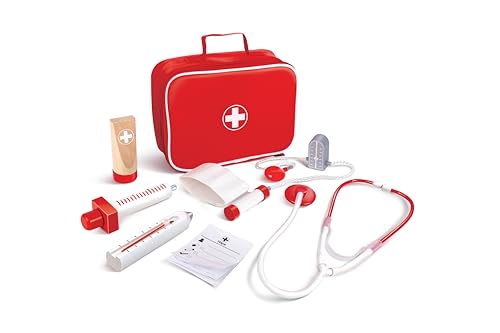
Hape Doctor on Call Play Set
Solid wood tools finished with water based paint suit families avoiding plastic. Pieces are simplified rather than realistic, which keeps them robust and easy for young children to identify. Includes a wooden case that also serves as a display tray during play.
Pros
- Wood construction avoids plastic entirely
- Water based finishes suit families with sensitivities
- Pieces resist cracking when stepped on
Cons
- Simplified shapes look less realistic
- Wooden case is heavier for a child to carry

Kidzlane Doctor Kit for Kids
Twenty pieces with light and sound effects on several tools, which younger children respond to strongly. A hard plastic case with a handle snaps shut for storage. Build quality is basic, so this suits a first kit or a spare for a grandparent’s house.
Pros
- Lights and sounds engage younger children quickly
- Lowest cost per piece in this group
- Case handle sized for a child to carry
Cons
- Requires batteries for the electronic tools
- Thinner plastic than the premium sets
The lineup, side by side
| # | Model | Pieces | Best for | Score | Price |
|---|---|---|---|---|---|
| 1 | Melissa and Doug Get Well Doctor’s Kit Play Set | 11 | Best overall | 9.4 | Check price |
| 2 | Learning Resources Pretend and Play Doctor Set | 19 | Best for realistic play | 9.2 | Check price |
| 3 | Fisher-Price Medical Kit | 7 | Best for toddlers | 9.0 | Check price |
| 4 | Theo Klein Doctor Case | About 12 | Best for detail | 8.8 | Check price |
| 5 | Battat Deluxe Doctor Kit | 25 | Best value | 8.6 | Check price |
| 6 | Hape Doctor on Call Play Set | About 12 | Best wooden set | 8.3 | Check price |
| 7 | Kidzlane Doctor Kit for Kids | 20 | Best budget | 8.0 | Check price |
Questions worth asking
What age is a toy doctor kit best for?
Three to six years is the core range, since pretend play peaks then. Most sets carry a three and up rating due to small parts. Fisher-Price Medical Kit uses larger pieces that suit younger toddlers under supervision.
Which toy doctor kit has a working stethoscope?
Learning Resources Pretend and Play Doctor Set includes a stethoscope that transmits real heartbeat sounds. Most other sets use a decorative version. That single feature is the most common reason owners pick it.
Are wooden doctor kits better than plastic ones?
Wood resists cracking and avoids plastic, which some families prefer. Plastic is lighter and wipes clean more easily after messy play. Hape Doctor on Call covers the wood option; Melissa and Doug mixes both materials.
Do toy doctor kits help children with fear of doctors?
Many parents report that role play reduces anxiety before appointments by making instruments familiar. Acting out a checkup at home lets a child rehearse the sequence. Talk through each tool as it comes out of the bag.
How many pieces should a doctor kit have?
Seven to twelve well made pieces is plenty for most children. Larger sets like the 25 piece Battat kit add story props rather than core instruments. More pieces also mean more to lose and tidy.
Melissa and Doug vs Learning Resources doctor kit: which is better?
Melissa and Doug offers better build quality and a zippered bag that keeps pieces together. Learning Resources counters with a working stethoscope and more instruments. Pick by whether realism or tidiness matters more in your home.
Are toy doctor kits safe for children under three?
Most are rated three and up because of choking sized parts. Fisher-Price Medical Kit uses oversized pieces designed for younger hands. Always check the packaging rating and supervise play with any set containing syringes or small caps.
How do you clean a toy doctor kit?
Wipe plastic tools with mild soapy water and dry fully before storage. Wooden pieces should be damp wiped only, never soaked. Fabric bags usually need spot cleaning rather than a machine wash.
Our take
Melissa and Doug Get Well Doctor’s Kit Play Set is the sensible default because its zippered bag and sturdy tools keep the set usable long after the novelty passes. Children who want realism will get more out of the Learning Resources Pretend and Play Doctor Set and its functioning stethoscope. For toddlers still mouthing toys, the Fisher-Price Medical Kit is the appropriate choice.