Which Ultrawide Monitor Suits Your Desk Setup?
The Dell UltraSharp U3423WE is our top overall ultrawide thanks to its sharp 34 inch panel and built-in dock. The Alienware AW3423DWF wins for gaming contrast, while the LG 34WQ650-W covers everyday productivity needs at the lowest outlay of the group.
If you want one ultrawide that handles spreadsheets, video calls and evening gaming, the Dell UltraSharp U3423WE is the safest pick, with the Alienware AW3423DWF ahead for contrast and the LG 34WQ650-W covering the basics well.
Ultrawides are tricky because two monitors with the same diagonal can feel completely different once curvature, pixel density and refresh rate come into play. We compared published specifications, port layouts and what owners report about text clarity and stand stability to rank the seven below.
What we recommend

Dell UltraSharp U3423WE
A 34 inch curved IPS Black panel that pairs strong contrast for an IPS with a genuinely useful USB-C dock. One cable carries video, data and laptop charging, which clears a lot of desk clutter. Owners report that text stays crisp across the full width thanks to the sensible pixel density.
Pros
- USB-C dock handles video, data and charging on one cable
- IPS Black panel lifts contrast over standard IPS
- Fully adjustable stand with height, tilt, swivel and slide
Cons
- 60 Hz refresh rate limits fast gaming
- Gentle curve may feel too subtle for some users

Alienware AW3423DWF
A QD-OLED ultrawide with per-pixel lighting, so black areas genuinely go black instead of glowing grey. The 165 Hz refresh rate and very low response time suit shooters and racing titles. Owners report that the coating handles reflections better than typical glossy OLED panels.
Pros
- Per-pixel contrast that LCD ultrawides cannot match
- 165 Hz with AMD FreeSync Premium Pro
- Very fast pixel response for competitive play
Cons
- No USB-C video input
- Text fringing is visible to some users on fine fonts

LG 34WQ650-W
A flat 34 inch ultrawide aimed squarely at office work rather than gaming. The flat geometry keeps straight lines straight, which matters if you draft, edit layouts or stare at spreadsheets. USB-C with 65W charging keeps a laptop topped up without a second cable.
Pros
- Flat panel keeps rulers and grids visually true
- USB-C charging at 65W suits most thin laptops
- Height adjustable stand included
Cons
- 1080 vertical resolution looks coarse at this width
- Colour coverage trails the pricier panels here
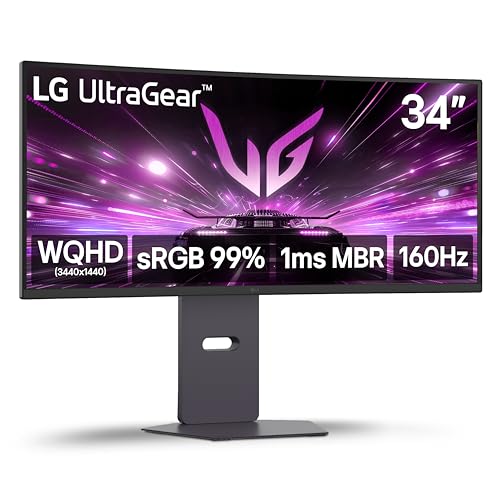
LG UltraGear 34GP83A-B
A Nano IPS ultrawide that pushes 160 Hz with a 1 ms response figure, which is unusual outside VA and OLED panels. It carries G-SYNC compatibility alongside FreeSync, so it works with either graphics card brand. Owners report strong out of box colour with minimal calibration.
Pros
- Fast IPS response without OLED text concerns
- Wide colour gamut suitable for light creative work
- Works well with both major GPU brands
Cons
- IPS glow visible in dark rooms
- No USB-C input for laptop docking

ASUS ProArt PA348CGV
Built for photo and video editors who also want a usable refresh rate, this ProArt ships factory calibrated with a Delta E figure under two. It covers wide sRGB and DCI-P3 ranges and includes a hardware calibration path. The 120 Hz panel keeps general desktop motion smooth.
Pros
- Calibration report included in the box
- USB-C with 90W power delivery
- Colour preset modes switch quickly for different projects
Cons
- Contrast is standard IPS rather than IPS Black
- Chunky bezels compared with gaming rivals

Samsung Odyssey G9 LC49G95T
A 49 inch super ultrawide that replaces a dual monitor setup with a single aggressive 1000R curve. The 5120 x 1440 resolution gives two full 27 inch workspaces side by side. Owners report it demands a deep desk and a capable graphics card to drive properly.
Pros
- Replaces two monitors with one continuous surface
- 240 Hz refresh rate at full resolution
- Strong VA contrast for dark scenes
Cons
- Needs a deep desk and a strong GPU
- Aggressive curve is polarising for document work

Gigabyte M34WQ
A flat 34 inch panel at 3440 x 1440 with a built-in KVM switch, which lets one keyboard and mouse control two connected machines. The 144 Hz refresh rate is generous for the outlay. Owners report the stand is basic but the panel itself punches above its class.
Pros
- KVM switch is rare at this level
- Full 3440 x 1440 resolution at 144 Hz
- Flat panel suits productivity layouts
Cons
- Stand offers limited adjustment
- USB-C power delivery is too low to charge a laptop
How to choose
Resolution matters more than diagonal A 34 inch ultrawide at 3440 x 1440 gives roughly 110 pixels per inch, which keeps small text readable. The same diagonal at 2560 x 1080 drops to around 82 pixels per inch, and letters start to look soft at normal viewing distance. If you spend your day in documents or code, treat 3440 x 1440 as the sensible floor and view the lower resolution panels as budget options rather than equals.
Curvature is a personal preference, not a spec race Curve is quoted as a radius, so 1000R is far more aggressive than 1800R, and flat panels have no curve at all. Tighter curves wrap the image toward you and suit gaming and immersion. Flat and gentle curves keep straight lines honest, which matters for drawing, CAD and layout work. Nobody can tell you which you will prefer, so weigh it against what you actually do at the desk.
Check what the USB-C port really does USB-C on a monitor can mean three different things. Some ports carry video only, some add data for the built-in hub, and the useful ones add power delivery so your laptop charges through the same cable. Power delivery figures range widely, and a 15W port will not keep a working laptop charged. If single cable docking is the goal, confirm the wattage before buying.
Refresh rate should match your graphics card A 165 Hz ultrawide only pays off if your GPU can push frames at 3440 x 1440. Driving a 49 inch panel at 5120 x 1440 is roughly the same load as 4K, so modest cards will fall short. For office work and video, 60 Hz to 100 Hz is perfectly comfortable, and the money is better spent on resolution, colour accuracy or connectivity than on refresh rate you cannot feed.
Side by side
| # | Model | Screen size | Best for | Score | Price |
|---|---|---|---|---|---|
| 1 | Dell UltraSharp U3423WE | 34 inches | Best overall | 9.4 | Check price |
| 2 | Alienware AW3423DWF | 34 inches | Best for gaming | 9.2 | Check price |
| 3 | LG 34WQ650-W | 34 inches | Best value | 9.0 | Check price |
| 4 | LG UltraGear 34GP83A-B | 34 inches | Best for fast IPS response | 8.8 | Check price |
| 5 | ASUS ProArt PA348CGV | 34 inches | Best for colour work | 8.6 | Check price |
| 6 | Samsung Odyssey G9 LC49G95T | 49 inches | Best for maximum width | 8.3 | Check price |
| 7 | Gigabyte M34WQ | 34 inches | Best budget ultrawide | 8.0 | Check price |
Frequently asked questions
Is an ultrawide better than two separate monitors?
It depends on your workflow. An ultrawide gives one continuous surface with no bezel down the middle, which suits timelines, spreadsheets and wide code editors. Two monitors give you independent orientations and easier full screen separation. Many people find one 34 inch ultrawide plus a small vertical secondary display is the sweet spot.
What graphics card do I need for 3440 x 1440?
That resolution is roughly 35 percent more demanding than 1440p and noticeably lighter than 4K. A current mid range card handles most titles comfortably at high settings. For 49 inch panels at 5120 x 1440 you should plan for a card in the same class you would buy for 4K gaming.
Do ultrawide monitors work with laptops?
Yes, though the connection matters. A USB-C port with DisplayPort alt mode carries the full resolution on one cable, and models with power delivery charge the laptop at the same time. Older laptops may need HDMI or DisplayPort, and some HDMI versions cap the refresh rate at the full ultrawide resolution.
Will all games support the 21:9 aspect ratio?
Most modern titles do, and support has improved a lot. Some older games and a few competitive shooters render 21:9 with black bars or an unchanged vertical field of view. Community patches often fill the gaps, but it is worth checking the specific games you play most before committing.
Is OLED risky for office work?
Static elements such as taskbars and toolbars are the main concern for long term image retention. Current QD-OLED panels include pixel refresh routines and logo dimming that mitigate this, and warranties commonly cover burn-in for a set period. If your screen shows the same interface unchanged for eight hours a day, an IPS Black or VA panel is the lower risk choice.
What is a KVM switch and do I need one?
A KVM switch lets a single keyboard and mouse control two computers connected to the same monitor, switching between them from the monitor menu. It is genuinely useful if you run a work laptop and a personal desktop at the same desk. If you only ever use one machine, it adds nothing.
How much desk depth does a 49 inch ultrawide need?
Owners generally report wanting at least 30 inches of depth so the far edges of the panel are not uncomfortably close. Anything shallower forces you to swivel your head rather than your eyes. A monitor arm can buy back some depth by pushing the panel toward the wall and removing the stand base.
Does IPS Black actually improve contrast?
It roughly doubles the contrast ratio of a conventional IPS panel, moving from around 1000:1 to about 2000:1, while keeping IPS viewing angles and colour consistency. That is a visible improvement in dim rooms, though it still does not approach OLED or the better VA panels for true black levels.
The verdict
For most desks the Dell UltraSharp U3423WE is the ultrawide to buy, because the docking, the stand and the panel quality all hold up for a full working day. Gamers who care about contrast should stretch to the Alienware AW3423DWF, and anyone who mainly wants more horizontal room without a large outlay will be satisfied with the LG 34WQ650-W.



