Reptile Tank Thermometers That Survive Frequent Wipe Downs
Zoo Med’s digital thermometer suits most single-species tanks with a wipeable wired probe, though it skips humidity readings. Exo Terra’s combo gauge covers humidity-sensitive species like chameleons, and REPTI ZOO’s wireless model serves keepers running several enclosures. All seven use smooth housings built for frequent cleaning.
Zoo Med’s digital thermometer fits most single-species tanks, using a wired probe that wipes clean during routine maintenance, though it tracks temperature only, not humidity. Chameleons and other humidity-sensitive species do better under the Exo Terra combo gauge, and keepers running several enclosures save time with REPTI ZOO’s wireless receiver.
Terrarium sensors face constant exposure to misting, substrate dust, and shed skin, so wipeable housing matters as much as reading accuracy. We compared probe type, temperature and humidity range, power source, and how each housing holds up to regular cleaning.
Our top picks
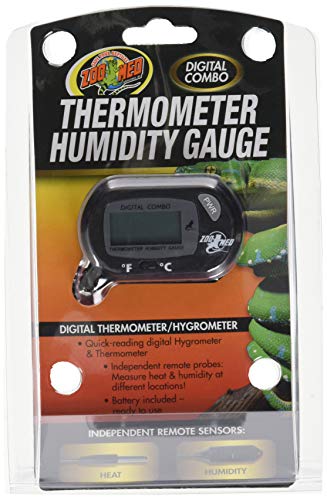
Zoo Med Digital Thermometer
A wired probe suction-cups to glass or mesh, sending readings to an LCD display mounted outside the tank. Wiping down the probe alone keeps the sensor working, no need to touch the display. Its 32 to 122 degree Fahrenheit range covers both desert and tropical setups.
Pros
- Wired probe wipes clean without removing the display
- Range spans desert and tropical species alike
- Suction cup mounts securely to glass or mesh
Cons
- Reads one fixed point, not a full-tank average
- Battery needs periodic replacement

REPTI ZOO Digital Thermometer Hygrometer
One wired probe reports both temperature and humidity on a single LCD panel, useful for species needing tight humidity control. Smooth plastic housing wipes down easily after cleaning the enclosure. Readings update on one screen without switching between modes.
Pros
- Tracks temperature and humidity from a single unit
- Wipeable housing resists moisture buildup
- Costs less than buying separate temp and humidity gauges
Cons
- Humidity readings drift over several months of use
- Small display can be hard to read from a distance

Exo Terra Digital Thermometer/Hygrometer
An internal sensor unit mounts inside the enclosure, built for humidity-sensitive species like tree frogs and chameleons. Smooth casing resists water spotting during regular misting. A backlit display option makes readings visible under dim, naturalistic lighting.
Pros
- Built for high-humidity, frequently misted setups
- Backlit display reads well in dim terrariums
- Compact housing suits small enclosures
Cons
- Fixed internal mount rules out separate probe placement
- Sensor needs wiping down after each misting

Zilla Digital Terrarium Thermometer
A single wired probe and compact external display keep setup simple for one basking or cool zone. Budget-conscious keepers get accurate readings without paying for a combo humidity function. The smooth probe surface wipes clean without disassembling any housing.
Pros
- Costs less than combo temp and humidity units
- Single-probe design is simple to place
- Wipeable probe needs no disassembly
Cons
- No humidity reading included
- Shorter probe cable than some competitors
Fluker’s Digital Thermometer
An extended probe cable reaches a heat lamp zone from an externally mounted display, built for basking spot monitoring. Keepers confirm basking temperatures stay in a safe range without guessing. The probe tip wipes down quickly during routine tank cleaning.
Pros
- Long cable reaches basking zones other probes miss
- Range covers both hot basking spots and cool zones
- Quick-wipe probe tip resists buildup
Cons
- Display housing runs bulkier than minimalist models
- No humidity function included

Zoo Med Analog Thermometer & Humidity Gauge
A dial mechanism reads both temperature and humidity without batteries or electronics. Keepers who’d rather skip tracking battery life get an always-on readout instead. The flat dial face wipes free of condensation with a dry cloth.
Pros
- No batteries to replace or fail
- Always-on readout needs no power switch
- Flat dial wipes clean of condensation easily
Cons
- Less precise than digital probe readings
- No backlight for low-light enclosures
REPTI ZOO Wireless Thermometer Hygrometer
A wireless sensor sits inside the tank while the receiver mounts outside or moves several feet away. Keepers managing multiple tanks can carry one receiver between setups instead of buying separate units per tank. The sensor housing wipes clean without disturbing the wireless connection.
Pros
- Receiver reads from several feet away
- One receiver moves between multiple tanks
- Sensor housing wipes down without losing signal
Cons
- Needs batteries in both sensor and receiver
- Signal weakens through multiple tank walls
What to look for
What to look for in a reptile thermometer Accurate readings keep basking and cool zones inside a species’ safe range. Wired probes place the sensor exactly where an animal spends time, while internal units read from one fixed spot in the enclosure. Smooth, wipeable housings resist the buildup that substrate dust and misting leave behind. Desert species need a higher maximum range than tropical or temperate setups.
Digital vs analog gauges Digital models like Zoo Med’s wired thermometer read to the exact degree and often add a backlight for dim tanks. Zoo Med’s analog gauge skips electronics entirely and never needs a battery swap. Digital units drift less over time but go dark if a battery dies unnoticed. Analog dials read slightly less precisely yet stay functional indefinitely.
Picking a gauge for humidity-sensitive species Tree frogs, chameleons, and other high-humidity species need moisture tracked alongside temperature. Combo units like the Exo Terra and REPTI ZOO models read both from one housing, cutting clutter in smaller tanks. Frequent misting shortens the useful life of any exposed sensor, so wipeable surfaces matter more here than in dry desert setups. Desert keepers can usually skip the humidity function and save on cost.
Placing and cleaning the probe Mounting a probe near the basking spot, not the floor, gives the most useful reading for a thermoregulating reptile. Fluker’s extended cable reaches heat lamp zones that shorter probes can’t. Wiping the probe or dial face during routine tank cleaning stops substrate dust from skewing readings. Wireless sensors need the same wipe-down, just without disturbing their connection to the remote receiver.
How they compare
| # | Model | Display | Best for | Score | Price |
|---|---|---|---|---|---|
| 1 | Zoo Med Digital Thermometer | External digital LCD | Best overall | 9.4 | Check price |
| 2 | REPTI ZOO Digital Thermometer Hygrometer | Digital LCD, temp + humidity | Best value | 9.1 | Check price |
| 3 | Exo Terra Digital Thermometer/Hygrometer | Digital LCD, temp + humidity | Best for humidity-sensitive species | 8.9 | Check price |
| 4 | Zilla Digital Terrarium Thermometer | External digital LCD | Best budget | 8.6 | Check price |
| 5 | Fluker’s Digital Thermometer | External digital LCD | Best for basking spot monitoring | 8.4 | Check price |
| 6 | Zoo Med Analog Thermometer & Humidity Gauge | Analog dial, temp + humidity | Best analog option | 8.2 | Check price |
| 7 | REPTI ZOO Wireless Thermometer Hygrometer | Wireless remote receiver | Best for multiple enclosures | 8.0 | Check price |
Questions worth asking
Why does a reptile thermometer need to be washable?
Substrate dust, shed skin, and misting residue build up on any sensor inside a terrarium. A wipeable housing lets keepers clean the probe during routine tank maintenance without risking the electronics. Non-wipeable models trap grime that skews readings over time.
What is the difference between a probe thermometer and an infrared gun?
A probe thermometer reads continuously from a fixed point, while an infrared gun takes a single instant reading wherever it’s aimed. Infrared guns suit quick spot-checks on a basking rock but miss changes across the day. Probe models like Zoo Med’s wired thermometer stay in place for ongoing monitoring.
Do reptile thermometers need both temperature and humidity readings?
It depends on the species. Desert reptiles like bearded dragons mainly need accurate temperature tracking, while tropical species such as chameleons and tree frogs need humidity watched just as closely. Combo units like the REPTI ZOO or Exo Terra models cover both from one housing.
How often should I clean a reptile enclosure thermometer?
Wiping the probe or dial face during each substrate change, roughly every one to two weeks, keeps readings accurate. Heavily misted enclosures need more frequent wiping since moisture residue builds up faster. A dry cloth usually does the job, since harsh cleaners can damage the sensor housing.
Can I use a regular household thermometer in a reptile tank?
Household thermometers aren’t built for enclosure humidity or the temperature ranges reptiles need, and most lack a mountable probe. Reptile-specific models like Zilla’s or Fluker’s calibrate for a wider range, often down to freezing and past 140°F for basking zones.
Where should a reptile thermometer be placed for the most accurate reading?
Place the probe at the animal’s actual basking or resting height, not on the floor or outside glass. A probe near the heat lamp reads the true basking temperature, while one near the substrate reads the cooler ambient zone. Many keepers run two thermometers to track both zones at once.
Do wireless reptile thermometers work through glass?
Most wireless models, including the REPTI ZOO wireless thermometer, transmit through a single glass or acrylic panel without trouble. Range and reliability drop once the signal has to cross multiple tank walls or a rack of stacked enclosures. Keeping the receiver within a few feet of the sensor gives the steadiest reading.
How long do batteries last in a digital reptile thermometer?
Most digital models run on a single AAA battery lasting several months to a year under normal use. Combo units like the REPTI ZOO wireless model drain faster since both the receiver and sensor need power. A dimming or blank display usually signals a battery due for replacement.
Zoo Med digital vs Zoo Med analog: which reptile thermometer is better?
The digital Zoo Med thermometer reads to the exact degree and covers a wide 32 to 122°F range, while the analog gauge skips batteries entirely for an always-on dial. Choose digital for precision, analog for a setup that never needs a battery swap. Neither adds a backlight, so check tank lighting before deciding.
Final word
Zoo Med’s digital thermometer covers most single-species tanks well, pairing a wipeable wired probe with a range wide enough for tropical and desert setups alike. Keepers with humidity-sensitive species like chameleons should choose the Exo Terra combo gauge instead, and anyone running several enclosures gets more value from REPTI ZOO’s wireless receiver. Skip the analog Zoo Med gauge if degree-by-degree precision matters more than avoiding battery changes.