How to Choose a Whole House Water Filter System
For most municipal water supplies, the SpringWell CF1 Whole House Water Filter System balances flow rate and filter life. Well water with iron or sediment calls for the Home Master HMF3SDGFEC instead. Renters without space for a tank system fit better with the Culligan HF-360.
Well water and city water need different filter media entirely, and the SpringWell CF1 handles most municipal supplies well. Households dealing with iron staining or sulfur odor from a well should choose the Home Master HMF3SDGFEC instead, while renters without space for a tank system fit better with the inline Culligan HF-360.
Filter life claims vary widely, from three months on an inline cartridge to nearly a decade on a tank-style system, which changes the real cost of ownership over time. We compared rated capacity, flow rate and stated media type against the specific contaminants each system targets before ranking these seven.
Our top picks

SpringWell CF1 Whole House Water Filter System
Catalytic carbon and KDF media target chlorine, chloramine and general sediment across city water supplies. Sized models scale flow rate to household size, from one to six bathrooms. Tank-style housing needs floor space near the main water line rather than mounting inline.
Pros
- High rated capacity before filter replacement
- Flow rate scales to household size
- Targets both chlorine and chloramine
Cons
- Tank-style install needs dedicated floor space
- Higher upfront cost than inline filters

Aquasana Rhino EQ-1000 Whole House Water Filter
A rated capacity of one million gallons stretches replacement intervals to roughly a decade for an average household. Optional add-on modules include UV disinfection and a salt-free softener stage sold separately. Professional installation is recommended given the multi-tank setup.
Pros
- Longest rated filter life in this group before replacement
- Modular add-ons for UV and softening
- Targets chlorine, chloramine and sediment
Cons
- Professional installation recommended rather than simple DIY
- Larger footprint than single-tank competitors

iSpring WGB32B 3-Stage Whole House Water Filtration System
A three-stage cartridge design uses standard-size housings, so replacement filters are widely available from multiple brands. A wall-mounted bracket keeps the footprint smaller than tank-style competitors. Cartridges need replacement every 6 to 12 months rather than lasting years.
Pros
- Widely available standard-size replacement cartridges
- Smaller wall-mounted footprint
- High flow rate for a 3-stage system
Cons
- Cartridges need replacing more often than tank-style systems
- No dedicated iron removal media

Culligan HF-360 Whole House Filtration System
An inline design mounts directly to the main water line without a drain hookup or electrical connection, simplifying installation. A single combination cartridge handles sediment and chlorine taste and odor together. Shorter filter life than tank-style systems means more frequent cartridge swaps.
Pros
- Simplest installation with no drain or power needed
- Lowest upfront cost in this group
- Compact inline housing
Cons
- Cartridges need replacing roughly every 3 months
- Lower rated capacity than tank-style systems

Home Master HMF3SDGFEC Whole House Filter
A dedicated iron reduction stage sets it apart from filters built mainly for municipal chlorine removal. Its radial flow carbon design increases the surface area contact time inside each housing. Best suited to well water with iron staining or sulfur odor rather than city supplies.
Pros
- Dedicated iron reduction stage for well water
- Radial flow carbon design increases contact time
- Standard-size replacement housings
Cons
- Not necessary for households on treated city water
- Sediment cartridge still needs replacement every 3 months

Pelican Water PC600 Whole House Filtration System
Built specifically around municipal water treated with chlorine, reducing taste and odor rather than targeting iron or sulfur. Optional pre-filter and UV modules attach for households wanting extra sediment or pathogen protection. NSF-tested claims apply to the carbon media stage, per the listing.
Pros
- Targets chlorine taste and odor specifically for city water
- Optional pre-filter and UV modules available
- NSF-tested carbon media per listing
Cons
- Not designed for well water iron or sulfur issues
- Annual filter replacement needed
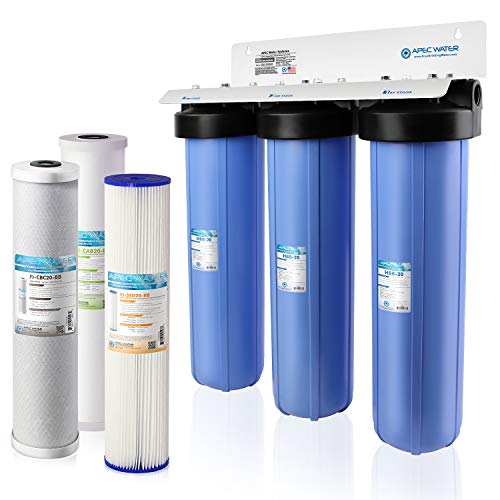
APEC Water Systems Whole House Water Filter CB3-SED-CAB-10
A higher flow rate suits larger households running multiple fixtures simultaneously without pressure drop. A coconut shell carbon stage adds odor and taste reduction beyond the standard carbon block. Standard 10 inch housings accept widely available replacement cartridges from several brands.
Pros
- High flow rate suited to large households and multiple fixtures
- Coconut shell carbon adds extra odor reduction
- Standard housings simplify cartridge sourcing
Cons
- No dedicated iron removal stage for well water
- Sediment cartridge needs frequent replacement
How to pick the right one
How do whole house water filters work? Installed at the point where the main water line enters the home, these systems treat every fixture rather than a single tap. Water passes through one or more media stages, typically sediment, carbon and sometimes a specialty media like iron-reduction resin. Rated capacity, measured in gallons or years, determines how often each stage needs replacing. Flow rate, measured in gallons per minute, determines whether the system can keep up with multiple fixtures running at once.
City water vs well water, which filter do you need? City water typically needs chlorine or chloramine reduction, which carbon and KDF media handle well, as in the SpringWell CF1 and Pelican PC600. Well water more often carries iron, sediment or sulfur odor, requiring a dedicated iron-reduction stage like the one in the Home Master HMF3SDGFEC. Installing a chlorine-focused filter on well water, or vice versa, leaves the actual contaminant untreated.
Tank-style vs inline whole house filters, what’s the difference? Tank-style systems, like the SpringWell CF1 and Aquasana Rhino, hold more filter media and last years between changes, but need dedicated floor space and often professional installation. Inline cartridge systems, like the Culligan HF-360 and iSpring WGB32B, mount directly to the pipe without a drain line, trading a smaller footprint for more frequent cartridge swaps. Households short on utility room space often default to inline models despite the higher long-term cartridge cost.
Best whole house filters for specific problems Chlorine taste and odor from a municipal supply responds well to the Pelican PC600’s carbon-focused media. Iron staining on fixtures from well water needs the Home Master HMF3SDGFEC’s dedicated iron-reduction stage. Large households running several fixtures simultaneously benefit from the APEC CB3-SED-CAB-10’s higher flow rate, which avoids pressure drop during peak use.
How they compare
| # | Model | Flow rate | Best for | Score | Price |
|---|---|---|---|---|---|
| 1 | SpringWell CF1 Whole House Water Filter System | Up to 12 GPM, model dependent | Best overall | 9.4 | Check price |
| 2 | Aquasana Rhino EQ-1000 Whole House Water Filter | Up to 1,000,000 gallons or roughly 10 years per listing | Best for high capacity | 9.1 | Check price |
| 3 | iSpring WGB32B 3-Stage Whole House Water Filtration System | 3: sediment, carbon block, granular carbon | Best value | 8.8 | Check price |
| 4 | Culligan HF-360 Whole House Filtration System | Up to 10 GPM | Best budget and easiest install | 8.6 | Check price |
| 5 | Home Master HMF3SDGFEC Whole House Filter | 3: sediment, iron reduction media, carbon | Best for well water iron and sediment | 8.3 | Check price |
| 6 | Pelican Water PC600 Whole House Filtration System | Up to 12 GPM | Best for chlorine and city water | 8.1 | Check price |
| 7 | APEC Water Systems Whole House Water Filter CB3-SED-CAB-10 | Up to 15 GPM | Best for large households | 8.0 | Check price |
Good to know
Do whole house water filters remove chlorine?
Carbon and KDF-based systems, including the SpringWell CF1 and Pelican PC600, are built specifically to reduce chlorine and chloramine taste and odor from municipal water supplies.
What’s the difference between a whole house filter and a water softener?
A whole house filter removes contaminants like chlorine, sediment or iron, while a softener addresses hardness minerals like calcium and magnesium through ion exchange. Some systems, like the Aquasana Rhino, offer a salt-free softener as an optional add-on module rather than a built-in feature.
Can a whole house filter remove iron from well water?
Yes, but only models with a dedicated iron-reduction media stage, such as the Home Master HMF3SDGFEC. General carbon-only filters built for city water chlorine removal don’t effectively address dissolved iron.
How often do whole house water filter cartridges need replacing?
Inline cartridge systems like the Culligan HF-360 typically need replacement every 3 months. Multi-stage cartridge systems like the iSpring WGB32B last 6 to 12 months per stage. Tank-style systems like the SpringWell CF1 or Aquasana Rhino stretch to several years or up to a million gallons before replacement.
Do I need a professional to install a whole house water filter?
Inline models like the Culligan HF-360 and wall-mounted cartridge systems like the iSpring WGB32B are commonly self-installed. Tank-style systems like the Aquasana Rhino EQ-1000 typically recommend professional installation given the multi-tank plumbing involved.
What’s the best whole house water filter for a large family?
The APEC CB3-SED-CAB-10 is rated for up to 15 GPM, supporting multiple fixtures running simultaneously without a noticeable pressure drop. The SpringWell CF1 also offers sizing options scaled to larger households.
Is a tank-style or cartridge-style whole house filter better?
Tank-style systems last longer between replacements and often filter more thoroughly, but cost more upfront and need floor space. Cartridge-style systems install faster and cost less initially, but need more frequent replacement, raising the cost of ownership over several years.
Whole house filter vs under-sink filter, which do I need?
A whole house filter treats every fixture in the home, including showers and laundry, while an under-sink filter treats only drinking water at one tap. Households concerned about chlorine exposure during showers or iron staining on fixtures need a whole house system rather than a point-of-use filter.
Final word
City water households get balanced performance from the SpringWell CF1, which pairs a high rated capacity with sizing options for larger homes. Well water with iron or sulfur odor calls for the Home Master HMF3SDGFEC and its dedicated iron reduction stage. Renters or anyone wanting the simplest install should choose the Culligan HF-360, since it needs no drain line or electrical connection.


