WiFi Adapters That Fix a Weak Desktop Connection
The TP-Link Archer TX20U Plus is our top pick, pairing WiFi 6 speeds with folding high gain antennas. The ASUS PCE-AX58BT is the better route for desktops with a spare PCIe slot, and the TP-Link Archer T3U Plus is the value choice for everyday browsing and streaming.
The TP-Link Archer TX20U Plus leads this roundup because it brings WiFi 6 to a machine over USB without demanding a case opening, and the folding high gain antennas make a measurable difference when the router is a floor away. The ASUS PCE-AX58BT is the stronger option if your desktop has a free PCIe slot, since an internal card with external antennas avoids the thermal and bandwidth limits of a USB dongle, while the TP-Link Archer T3U Plus covers ordinary browsing and streaming for far less.
Picking an adapter is complicated by listings that advertise combined band speeds you will never see, so a product labelled AX1800 is really 574 on the 2.4 gigahertz band plus 1201 on 5 gigahertz, not 1800 on either. Driver support is the other trap, since a card that works instantly on Windows can be a research project on Linux or unsupported on macOS entirely. We compared WiFi standard and band support, antenna design and gain, interface type and its throughput ceiling, driver availability by operating system and heat behaviour under sustained transfer, then weighed those against what owners report about dropped connections and sleep and wake reliability.
How to choose
Understand the speed numbers on the box An adapter sold as AX1800 is not capable of 1800 megabits on one connection. That figure adds the theoretical maximum of the 2.4 gigahertz radio to the maximum of the 5 gigahertz radio, and you only ever connect on one at a time. Real throughput is also limited by your router, the channel width in use, interference and distance. Treat the number as a rough class indicator and compare adapters within the same class rather than across them.
USB or PCIe For desktops with a free slot, a PCIe card is generally the better choice, because it has no USB bandwidth ceiling, dissipates heat properly and lets you put antennas on a magnetic base above the desk. USB adapters win on convenience, portability between machines and laptop compatibility. If you do choose USB, use a USB 3.0 port, since USB 2.0 caps throughput low enough to bottleneck any modern WiFi standard.
Antennas and placement beat specifications A high specification adapter plugged into a rear port behind a metal desktop case, under a desk, will often perform worse than a modest one on a cradle at desk height. Metal blocks and reflects radio waves. If your adapter comes with an extension cradle, use it. Point external antennas perpendicular to the router antennas rather than aiming them like a directional aerial, since these are omnidirectional designs.
Check driver support before you buy Windows drivers are usually the best supported, often installing automatically. macOS support is patchy on third party adapters and some manufacturers have stopped updating drivers entirely, so verify current compatibility with your macOS version. Linux support depends on the chipset rather than the brand, and adapters using well supported chipsets work immediately while others need out of tree kernel modules. If you run anything other than Windows, research the specific chipset first.
Our top picks

TP-Link Archer TX20U Plus AX1800 USB WiFi Adapter
This is the sensible default for adding WiFi 6 to a desktop or an older laptop, since the folding external antennas give it a real advantage over flat dongles when the signal has walls to cross. USB 3.0 provides enough bandwidth for the 5 gigahertz link rates it can achieve. It is physically large, so it wants a rear port or a short extension rather than a crowded front panel.
Pros
- External antennas noticeably improve range
- WiFi 6 support without opening the case
- USB 3.0 avoids the bandwidth ceiling of USB 2.0
Cons
- Bulky next to other USB devices
- Linux support depends on third party drivers

ASUS PCE-AX58BT WiFi 6 PCIe Adapter
If the machine has a spare PCIe slot, an internal card is simply a better engineering answer than a dongle. Heat dissipates properly, the interface is not a bottleneck and the magnetic antenna base can sit on top of the desk where the signal is cleaner. Bluetooth comes along for free. Installation means opening the case and routing the antenna cable, which is more effort than plugging in a stick.
Pros
- No USB bandwidth or thermal limitations
- Antenna base can be positioned for best signal
- Bluetooth included on the same card
Cons
- Requires opening the desktop case
- Desktop only, no use in laptops

TP-Link Archer T3U Plus AC1300 USB WiFi Adapter
For browsing, video calls and streaming, WiFi 5 at AC1300 class speeds is plenty, and this adapter delivers it with a high gain antenna that folds flat when not needed. Setup on Windows is close to plug and play. It will not saturate a gigabit connection on a busy network, which is the reason to step up to the WiFi 6 models if that matters.
Pros
- Strong performance for everyday use at a low outlay
- Antenna folds flat for transport
- Straightforward setup on Windows
Cons
- WiFi 5 rather than WiFi 6
- Single antenna limits peak throughput
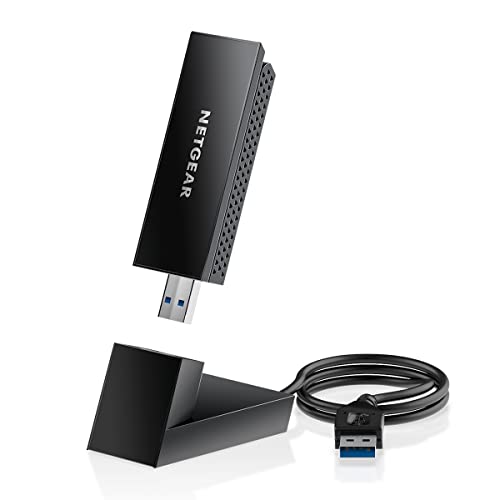
NETGEAR Nighthawk A7000 AC1900 WiFi USB Adapter
The included cradle is the reason to consider this, because it lets you lift the adapter off the floor and away from a metal case, which often matters more than raw specification. Dual high gain antennas and beamforming support help it hold a link at distance. It is a WiFi 5 device and a physically large one, so it lives on a desk rather than plugged directly into a port.
Pros
- Cradle allows optimal placement away from the case
- Adjustable antennas hold distant signals
- Reliable throughput on WiFi 5 networks
Cons
- Large footprint on the desk
- No WiFi 6 support
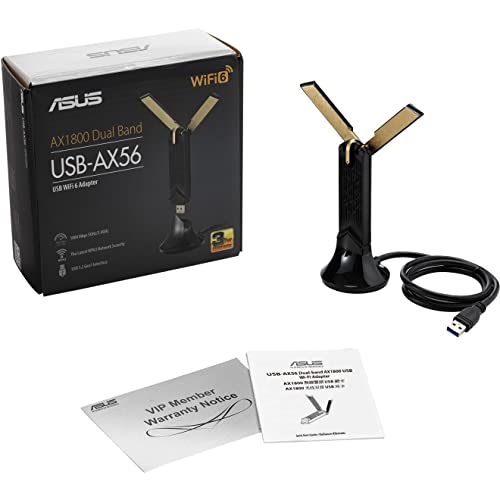
ASUS USB-AX56 AX1800 Dual Band USB Adapter
ASUS combines WiFi 6 support with a docking cradle, so you get modern standards and the ability to position the adapter where reception is best. That combination suits a machine used for high bitrate streaming or large file transfers over the network. The cradle and cable add clutter, and the unit runs warm during sustained transfers.
Pros
- WiFi 6 with flexible antenna placement
- Holds high bitrate streams reliably
- External antennas fold for storage
Cons
- Runs warm under sustained load
- Cradle and cable add desk clutter
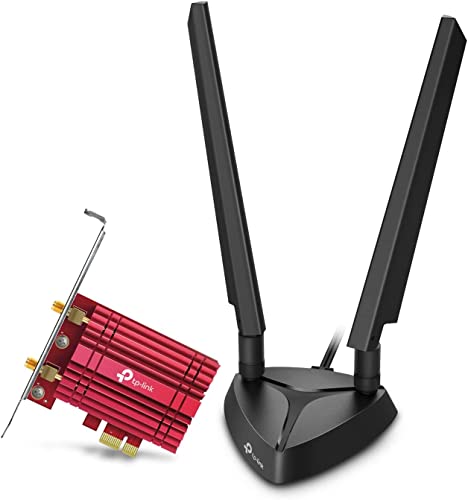
TP-Link Archer TXE75E WiFi 6E PCIe Adapter
The 6 gigahertz band is the argument here, because it is uncrowded compared with 2.4 and 5 gigahertz in a dense apartment block, and that emptiness is often worth more than headline speeds. You need a WiFi 6E router for any of it to apply. Range on 6 gigahertz is shorter than 5, so it works best in the same room or one wall away.
Pros
- Access to the uncongested 6 GHz band
- Tri band flexibility as networks upgrade
- Internal card avoids USB limitations
Cons
- Needs a WiFi 6E router to be worth it
- 6 GHz range drops off quickly through walls

Panda Wireless PAU06 300Mbps Wireless N USB Adapter
Panda built its following by shipping adapters with chipsets that Linux distributions support natively, so this connects without hunting for drivers or compiling modules. That is genuinely valuable on a Raspberry Pi or an older machine running a lightweight distribution. It is 2.4 gigahertz only at Wireless N speeds, so treat it as a compatibility tool rather than a performance part.
Pros
- Works on Linux without driver hunting
- Small and low power for single board computers
- Inexpensive backup adapter
Cons
- 2.4 GHz only, so speeds are limited
- Congested band in built up areas
How they stack up
| # | Model | Standard | Best for | Score | Price |
|---|---|---|---|---|---|
| 1 | TP-Link Archer TX20U Plus AX1800 USB WiFi Adapter | WiFi 6, AX1800 class | Best overall | 9.4 | Check price |
| 2 | ASUS PCE-AX58BT WiFi 6 PCIe Adapter | WiFi 6, AX3000 class | Best for desktops | 9.2 | Check price |
| 3 | TP-Link Archer T3U Plus AC1300 USB WiFi Adapter | WiFi 5, AC1300 class | Best value | 9.0 | Check price |
| 4 | NETGEAR Nighthawk A7000 AC1900 WiFi USB Adapter | WiFi 5, AC1900 class | Best for long range | 8.8 | Check price |
| 5 | ASUS USB-AX56 AX1800 Dual Band USB Adapter | WiFi 6, AX1800 class | Best for streaming | 8.6 | Check price |
| 6 | TP-Link Archer TXE75E WiFi 6E PCIe Adapter | WiFi 6E, tri band | Best for WiFi 6E | 8.3 | Check price |
| 7 | Panda Wireless PAU06 300Mbps Wireless N USB Adapter | Wireless N, 300 Mbps class | Best for Linux | 8.0 | Check price |
Frequently asked questions
Will a WiFi adapter make my internet faster?
It can improve the link between your computer and the router, which helps if that link was the bottleneck. It cannot exceed the speed your internet connection delivers. If you already get full speed near the router, the adapter is not the limiting factor.
Is a USB WiFi adapter as good as a PCIe card?
For most everyday use, yes. PCIe cards have the edge in sustained throughput, heat handling and antenna placement, which shows up during large transfers. USB adapters are more convenient and work with laptops, which PCIe cards cannot.
Do I need WiFi 6?
Only if your router supports it. WiFi 6 improves performance most in homes with many connected devices competing for airtime. On a WiFi 5 router, a WiFi 6 adapter connects at WiFi 5 speeds and the extra spend achieves nothing today.
Why does my WiFi adapter keep disconnecting?
Common causes are USB power saving settings suspending the device, outdated drivers, USB 3.0 port interference on the 2.4 gigahertz band, or simply weak signal. Disabling USB selective suspend and moving the adapter onto an extension cable resolves many cases.
Can I use a WiFi adapter with a Mac?
Sometimes, but macOS support for third party adapters is inconsistent and some manufacturers no longer update drivers for recent macOS versions. Check current compatibility with your specific macOS release before buying rather than relying on the packaging.
What is the difference between 2.4 GHz and 5 GHz?
2.4 gigahertz travels further and penetrates walls better but is crowded and slower. 5 gigahertz is faster with less interference but has shorter range. Dual band adapters let you pick whichever suits your distance from the router.
Do WiFi adapters work with any router?
Yes, WiFi standards are backwards compatible, so a WiFi 6 adapter connects to an older router at the older standard and an older adapter connects to a new router. You only get the newer features when both ends support them.
Should I use the included cradle or plug directly in?
Use the cradle when one is included. Getting the adapter away from the metal case and up to desk height often improves signal more than any specification difference between adapters.
The bottom line
For most machines the TP-Link Archer TX20U Plus is the right buy, giving WiFi 6 speeds and useful antenna gain without opening a case. Desktop owners with a spare slot should choose the ASUS PCE-AX58BT instead, since an internal card handles heat and bandwidth better and lets you place the antennas properly. If the network only needs to carry browsing and streaming, the TP-Link Archer T3U Plus does that job at a fraction of the cost.


