Window Exhaust Fans Compared by Airflow and Noise
Airflow, twin fan independence and frame width separate this lineup. The Air King 9166F Whole House Window Fan pulls the most air, rated near 3,200 CFM. Renters and shallow windows do better with the Hurricane Classic Twin Window Fan, since each side reverses independently. A quiet bedroom favors the Genesis Twin Window Fan instead.
A stuffy room needs air pulled out, not stirred around, and CFM rating tells you how fast that happens. The Air King 9166F Whole House Window Fan moves the most air here, rated near 3,200 CFM on high, though its housing needs real sill depth to mount securely. Apartments and shallower windows suit a slimmer twin fan such as the Hurricane Classic Twin Window Fan, which reverses each side on its own switch. That flexibility trades away some raw airflow compared with the Air King.
Twin window fans pull air in on one side while pushing it out the other at the same time, something a single large fan cannot do at once. We compared CFM ratings where listed, frame width ranges, speed counts, thermostat and remote features, and owner reports on noise and vibration to sort these seven.
Before you buy
What to look for in a window exhaust fan Airflow, direction control and frame width decide most of this purchase. A higher CFM rating clears a room faster, but a twin fan that reverses each side independently often matters more day to day. Frame width decides whether the fan fits your window at all, so measure before buying. Noise and extras like a thermostat or remote come after those three basics are settled.
Twin fans versus a single reversible fan A twin fan lets one side pull air in while the other pushes air out, moving air through a room instead of just around it. A single large fan like the Air King only moves air in one direction at a time, though it usually moves more of it. Small or oddly shaped rooms benefit from twin fans placed at opposite ends of a house. Large single windows or attic style openings favor a single high powered fan.
Best window fan for a small bedroom A bedroom window fan needs to run quiet more than it needs raw power. Rubber cushioned models like the Genesis Twin Window Fan cut vibration noise against the sill. A thermostat equipped fan such as the Bionaire BW2300-N also helps, since it shuts down once the room cools instead of running all night at full speed. Skip the loudest whole house fans in a room where you sleep.
Running a window fan safely when rain is around Most window fans are not built to get wet, so check the housing rating before running one with the window open in a storm. A weather resistant housing like the one on the Lasko 2155A tolerates humidity and light splash better than basic plastic models. Even a weather resistant fan should come inside during heavy rain or wind. Unplug any fan before removing it from a wet windowsill.
The top picks, ranked

Air King 9166F 20 Inch Whole House Window Fan
Mounted in a window opening, this fan pulls air through an entire house and is rated near 3,200 CFM on high according to the listing. Steel blades and a powder coated housing hold up to years of seasonal mounting and removal. Many owners run it overnight to draw in cooler outside air instead of running central air.
Pros
- Highest airflow rating in this lineup
- Steel construction holds up to repeated seasonal use
- Reversible motor pulls or pushes air
Cons
- Loud on high next to any twin fan here
- Needs a deep enough sill to mount securely

Hurricane Classic Twin Window Fan 16 Inch
Each of the two 16 inch blades reverses on its own switch, letting one side exhaust hot air while the other draws in cooler air at the same time. Three speeds times two directions on two fans creates nine usable combinations. Owners often run intake on a shaded side and exhaust on a sun facing side during the same afternoon.
Pros
- Each fan reverses independently of the other
- Nine total speed and direction combinations
- Sturdy housing for its size
Cons
- No remote or thermostat control
- Switches sit behind the fan, making them a stretch to reach

Bionaire BW2300-N Twin Window Fan
A built in electronic thermostat cycles the twin fans on and off around a set temperature, so a room does not overcool overnight. Two independently reversible fan heads still handle intake and exhaust together. Setting a target temperature once lets the thermostat manage the rest through the night.
Pros
- Thermostat cycles fans on and off automatically
- Digital display shows the current temperature
- Runs quieter on low than most twin fans
Cons
- Only 2 speeds per fan
- Thermostat sensor can misread near a warm wall

Comfort Zone CZ319R2WT Twin Window Fan with Remote
An included remote changes speed and direction on both fan heads without a trip to the window. An LED display on the housing shows the current setting and room temperature. Owners running the fan from a bed or couch across the room cite the remote as the main reason they bought it.
Pros
- Remote adjusts speed and direction from across the room
- LED display stays readable in the dark
- Two fans run in independent directions
Cons
- Remote needs a clear line of sight to the sensor
- Bulkier housing than basic twin fans

Holmes Dual Blade Twin Window Fan HAWF2043
Expandable side panels stretch to fit a wider range of window openings than most twin fans in this group, according to the listing. Two independently controlled blades handle intake and exhaust at once. Owners with older or nonstandard window frames report an easier fit than square edged competitors.
Pros
- Fits a wider range of window widths
- Independent control on each blade
- Light enough for easy seasonal install and removal
Cons
- Only 2 speeds available
- Plastic housing feels less sturdy than steel models

Lasko 2155A Twin Window Fan
A weather resistant housing on this twin fan handles the light rain and humidity that come through a cracked window during a storm, according to the listing. Each of the two fans reverses independently on its own 3 speed switch. Owners in humid climates report less housing warping over multiple seasons than with basic plastic twin fans.
Pros
- Weather resistant housing suits humid climates
- Independent reversible control on each side
- 3 speed settings per fan
Cons
- No thermostat or remote included
- Still needs to come inside during heavy rain
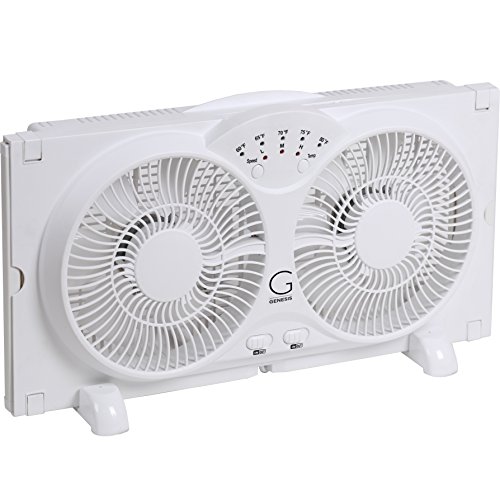
Genesis Twin Window Fan
Rubber corner cushions and a lower top speed keep this twin fan quieter than most on this list, which suits a bedroom window. Two reversible fans still handle basic intake and exhaust duty. Owners buying a second or third fan for other rooms point to the low cost as the main draw.
Pros
- Quieter running than most twin fans here
- Rubber cushions cut vibration noise against the sill
- Low cost makes buying several easy
Cons
- Lower airflow than the Air King or Hurricane
- No thermostat or remote control
How they stack up
| # | Model | Airflow | Best for | Score | Price |
|---|---|---|---|---|---|
| 1 | Air King 9166F 20 Inch Whole House Window Fan | Up to 3,200 CFM on high speed | Best overall | 9.4 | Check price |
| 2 | Hurricane Classic Twin Window Fan 16 Inch | Two 16 inch blades | Best for independent reversible airflow | 9.1 | Check price |
| 3 | Bionaire BW2300-N Twin Window Fan | Electronic thermostat with digital display | Best with thermostat control | 8.8 | Check price |
| 4 | Comfort Zone CZ319R2WT Twin Window Fan with Remote | Included handheld remote | Best with remote control | 8.6 | Check price |
| 5 | Holmes Dual Blade Twin Window Fan HAWF2043 | Expandable panels for a wide range of window sizes | Best expandable frame fit | 8.4 | Check price |
| 6 | Lasko 2155A Twin Window Fan | Weather resistant plastic housing | Best weather resistant housing | 8.2 | Check price |
| 7 | Genesis Twin Window Fan | Rubber corner cushions reduce vibration against the sill | Best budget quiet pick | 8.0 | Check price |
Good to know
Do window fans actually cool a room?
They move air rather than lower its temperature, which still helps a room feel cooler through evaporation and airflow across skin. Pulling in cool night air and closing windows during the hot part of the day works better than running one constantly. A window fan will not replace air conditioning on a genuinely hot, humid day.
Should a window fan face in or out?
Facing out to exhaust hot air works best when a cooler room or hallway feeds air toward that window. Facing in to intake works best when outside air runs cooler than the room. Twin fans like the Hurricane Classic handle both directions from the same unit at once.
What size window fan do I need?
Match the fan’s expandable frame range to your window’s actual width, measured with the sash open to where the fan will run. Most twin fans expand to fit standard double hung windows in the 24 to 37 inch range. A whole house fan like the Air King 9166F needs a deeper sill to sit securely.
Are twin window fans better than single fans?
Twin fans give independent intake and exhaust control, which single fans cannot match. Single large fans like the Air King usually move more total air on high. Pick a twin fan for flexible daily use and a single high CFM fan when the goal is clearing a whole house fast.
How loud are window exhaust fans?
Noise varies by speed and design more than by brand alone. Whole house fans like the Air King run louder on high than most twin fans. Models with rubber corner cushions, such as the Genesis Twin Window Fan, run noticeably quieter, which matters most for a bedroom window.
Can you leave a window fan on all night?
Most are rated for continuous overnight use, and many owners run them nightly through summer. A thermostat equipped model such as the Bionaire BW2300-N adds a safety margin, since it shuts off once the target temperature is reached instead of running unattended at full speed.
Do window fans use much electricity?
No. A typical window fan draws far less power than a window air conditioner, since it only moves air rather than cooling it. Running one overnight costs a small fraction of what a portable AC unit uses over the same hours.
Can a window fan get wet from rain?
Basic plastic housings are not built for direct rain exposure and can short out or warp if soaked repeatedly. A weather resistant housing like the one on the Lasko 2155A tolerates humidity and light splash better, according to the listing, but none of these fans are meant to sit in a downpour.
What is the best window fan for renters?
Renters without a deep sill or the option to drill do best with a twin fan that mounts with expandable side panels, such as the Hurricane Classic Twin Window Fan. It skips the deeper mounting depth a whole house fan like the Air King 9166F needs. Independent reversible sides also make it easy to adapt to different room layouts across apartments.
Our pick
Clearing a whole house fast points to the Air King 9166F Whole House Window Fan, since nothing else in this lineup rates as high on CFM. Renters and anyone without a deep sill should pick the Hurricane Classic Twin Window Fan instead, since its independent reversible sides work in a shallower window. Buyers furnishing a bedroom where quiet matters more than raw power are better served by the Genesis Twin Window Fan.