Wood Finishing Tools for a Smooth, Even Topcoat
The Wagner Control Spray Max HVLP Sprayer is our top pick for a flawless sprayed topcoat on cabinets and doors. The Bosch ROS20VSC Random Orbit Sander is the essential surface prep tool, and the Purdy XL Glide Brush is the best value for anyone finishing by hand.
The single biggest jump in finish quality comes from spraying rather than brushing, and the Wagner Control Spray Max HVLP Sprayer is the accessible way into that. Before any finish goes on, the Bosch ROS20VSC Random Orbit Sander does the work that actually determines the result, and the Purdy XL Glide Brush lays down varnish with minimal marks if hand application is your route.
Finishing frustrates people because the visible defects almost never come from the can. Swirl marks are a sanding problem, brush ridges are a bristle problem, and the small bumps in an otherwise perfect topcoat are dust that was never removed. We compared abrasive backings, sander orbit and extraction, bristle materials, spray adjustment and dust removal methods, then ranked seven tools by the specific defect each one exists to prevent.
The best picks, ranked

Wagner Control Spray Max HVLP Sprayer
A turbine driven HVLP system that atomises finish finely enough to leave no brush marks at all, which is the point of spraying. Adjustable air and material controls let you dial in thin lacquers or thicker latex without changing guns. It needs masking and ventilation, so it suits a garage or a workshop rather than a living room.
Pros
- Leaves no brush marks on flat panels
- Handles thin and thicker finishes
- Fast coverage on doors and cabinets
Cons
- Requires masking and good ventilation
- Cleaning the gun after each session takes time

Bosch ROS20VSC Random Orbit Sander
The random orbit pattern is what keeps this from leaving the repeating swirls a rotary sander produces, and variable speed lets you slow down for final passes. Dust collection is better than most sanders in its class, which directly reduces nibs in the topcoat. Owners report low vibration makes long sanding sessions tolerable.
Pros
- Random pattern avoids visible swirls
- Good dust extraction for its class
- Low vibration during long sessions
Cons
- Onboard canister fills quickly
- Pad hooks wear out with heavy use

Purdy XL Glide Paint Brush
A blended nylon and polyester brush that holds a full load of finish and releases it evenly, which is what keeps ridges from forming at the end of a stroke. The angled sash version is the most useful shape for trim and frame work. It cleans up well and lasts for years if it is never left to dry loaded.
Pros
- Even release reduces brush ridges
- Works with both finish types
- Holds shape over many projects
Cons
- Costs several times more than throwaway brushes
- Ruined quickly if not cleaned promptly

Diablo SandNet Sanding Discs
An open mesh backing that lets dust pass through the entire disc rather than only through eight holes, which keeps the abrasive cutting far longer on finish sanding. They are reusable after a quick clean, which offsets the higher price per disc. Best paired with a sander connected to a vacuum.
Pros
- Resists clogging on sealed surfaces
- Dust extraction works across the whole disc
- Longer usable life than paper discs
Cons
- Higher cost per disc
- Mesh can tear on sharp edges
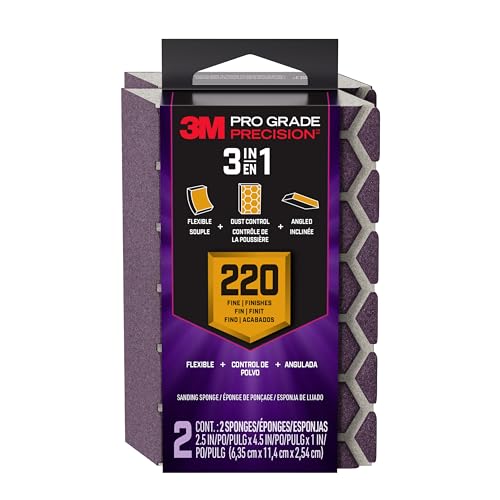
3M Pro Grade Precision Sanding Sponge
Flexes into mouldings, spindles and carved detail where a flat sander cannot reach, and it can be rinsed and reused rather than discarded. The consistent grit means it does not leave the deeper scratches that folded sandpaper often does on curves. It is the tool that saves a good finish on turned or profiled work.
Pros
- Conforms to curves and mouldings
- Rinses clean and lasts several projects
- Consistent scratch pattern on profiles
Cons
- Slower than a powered sander
- Edges round off with heavy pressure

Bahco 474 Cabinet Scraper
A card scraper takes a fine shaving rather than abrading, leaving a surface that reflects light more evenly than any sanded finish. It also removes dried drips and runs from a cured topcoat without dishing the surrounding area. There is a learning curve to turning the burr, and that is the barrier for most people.
Pros
- Produces a surface sanding cannot match
- Removes drips without dishing
- No dust and no consumables
Cons
- Sharpening the burr takes practice
- Slow across large panels

Trimaco SuperTuff Tack Cloth
The cheapest item here and the one most often skipped, which is why so many otherwise good finishes end up with small bumps. A light wipe lifts sanding dust that a vacuum and a dry rag leave behind. Use it with almost no pressure, since pressing hard leaves residue that can interfere with some finishes.
Pros
- Removes fine dust a vacuum misses
- Costs very little per project
- Works on flats, edges and profiles
Cons
- Can leave residue if pressed hard
- Single use once loaded with dust
How they compare
| # | Model | Type | Best for | Score | Price |
|---|---|---|---|---|---|
| 1 | Wagner Control Spray Max HVLP Sprayer | Turbine HVLP sprayer | Best overall | 9.4 | Check price |
| 2 | Bosch ROS20VSC Random Orbit Sander | 5 inch random orbit sander | Best value | 9.2 | Check price |
| 3 | Purdy XL Glide Paint Brush | Nylon and polyester blend | Best brush | 9.0 | Check price |
| 4 | Diablo SandNet Sanding Discs | Open mesh net | Best abrasive discs | 8.8 | Check price |
| 5 | 3M Pro Grade Precision Sanding Sponge | Flexible sanding sponge | Best for contours | 8.6 | Check price |
| 6 | Bahco 474 Cabinet Scraper | Hand card scraper | Best for a glass smooth surface | 8.3 | Check price |
| 7 | Trimaco SuperTuff Tack Cloth | Tacky treated cloth | Best budget | 8.0 | Check price |
What to look for
Surface prep decides the finish, not the can Nearly every complaint about a finish traces back to preparation. Work up through grits without skipping more than one step, since each grade removes the scratches left by the previous one, and stop at around 180 to 220 grit for most film finishes because sanding too fine can prevent stain absorption. Sand with the grain on the final passes even with a random orbit sander, and inspect under a raking light before committing to a topcoat.
Brush, wipe or spray Brushing suits trim, frames and small pieces, and a good brush with a slow drying finish leaves acceptable results. Wiping on thinned finish in several coats is the most forgiving method for beginners and works well on flat panels. Spraying gives the smoothest result and the fastest coverage but demands masking, ventilation and cleanup time. Match the method to the piece rather than buying equipment first.
Dust control between coats Every mote of dust that lands on wet finish becomes a permanent bump. Vacuum the workshop and let it settle before you start, extract dust at the sander rather than sweeping it into the air, and wipe with a tack cloth immediately before each coat. Between coats, a light scuff with fine abrasive knocks down nibs and gives the next coat something to grip.
Cleaning and storing the tools Brushes are ruined by being left loaded, so clean them with the appropriate solvent immediately and store them hanging or in their keeper to hold the shape. Spray guns need full disassembly and cleaning after every session, since dried finish in the nozzle is the most common cause of spitting later. Sanding discs and sponges last far longer if cleaned rather than run until glazed.
Questions worth asking
What grit should I stop at before finishing?
For most film finishes such as polyurethane and lacquer, 180 to 220 grit is the usual stopping point. Sanding finer can burnish the surface and reduce stain absorption, leading to a patchy colour. Oil finishes can benefit from going slightly finer.
Do I need a random orbit sander or will a sheet sander do?
A sheet sander works but leaves a straighter scratch pattern that shows more under a clear finish. Random orbit motion produces scratches in no repeating direction, which is far less visible once a topcoat goes on. It is the single most useful powered tool for finishing prep.
Why does my brushed finish have ridges?
Usually the finish is setting before it can level, or the brush is being overworked. Use a quality brush, load it properly, lay the finish on in one direction and stop brushing it. A slower drying finish or a compatible extender gives the surface more time to flow out.
Is an HVLP sprayer worth it for occasional projects?
For a set of cabinet doors or several pieces of furniture, yes, because the time saved and the quality gained are substantial. For a single small item, the masking and cleanup time outweigh the benefit and wiping the finish on is the better route.
What is a card scraper for?
Taking a very fine shaving to produce a smooth surface without dust, and levelling drips or runs in a cured finish. It is a traditional tool that many woodworkers rate above sanding for final smoothing, though it requires learning to turn a burr on the edge.
How do I get dust off before the final coat?
Vacuum first, then wipe with a tack cloth using very light pressure. On water based finishes some people prefer a slightly damp lint free cloth instead, since tack cloth residue can occasionally cause fisheye. Let the workshop air settle for a while before spraying.
Should I sand between coats?
A light scuff with fine abrasive between coats removes dust nibs and improves adhesion for the next layer. Use a very fine grit or an abrasive pad, remove all dust afterwards, and avoid cutting through to bare wood at edges.
Can I use the same brush for oil and water based finishes?
A blended synthetic brush handles both, which is why it is the sensible single purchase. Natural bristle brushes should be kept for oil based products only, since water swells the bristles and ruins the shape.
Final word
If you finish cabinets or doors regularly, the Wagner Control Spray Max HVLP Sprayer changes the quality of the result more than any other purchase here. For everyone else the Bosch ROS20VSC Random Orbit Sander plus a Purdy XL Glide Brush covers ninety percent of finishing work, and a box of tack cloths costs almost nothing while preventing the defect people notice most.