Bulk Disposable Cameras: Which Ones Actually Deliver Photos
The Fujifilm QuickSnap Flash 400 is the strongest bulk pick, with dependable flash and accurate color on every unit. The Kodak FunSaver covers big parties on a tighter budget, and the Ilford HP5 Plus single-use camera adds genuine black-and-white shots for a distinct look among color prints.
Fujifilm’s QuickSnap Flash 400 delivers the most consistent results across a full case, which matters when dozens of guests each get one shot. Budget-conscious hosts lean toward the Kodak FunSaver instead, since it fills tables without straining the total spend. Guests wanting something different can reach for the Ilford HP5 Plus, a genuine black-and-white single-use camera.
Disposable cameras have returned to weddings and reunions, yet per-unit pricing swings wildly between brands and flash reliability is not guaranteed. A cheap case means little if half the units misfire indoors or the film speed can’t handle a dim reception. We compared exposure counts, flash performance, film speed and case pricing to identify which cameras hold up when bought by the dozen.
The shortlist, ranked

Fujifilm QuickSnap Flash 400
Fujifilm built the QuickSnap Flash 400 around a fixed focus lens and a built-in flash that fires consistently across a full case order. Its ISO 400 color negative film renders skin tones accurately under mixed event lighting. Owners buying multiple boxes report the fewest dud units of any brand on this list.
Pros
- Flash fires reliably unit after unit
- Accurate skin tones on ISO 400 stock
- Sold in bulk cases at most retailers
Cons
- Costs more per camera than Kodak or Agfa
- Fixed focus limits close-up sharpness

Kodak FunSaver
Kodak prices the FunSaver low enough to buy by the case without straining an event budget. Its ISO 800 film and built-in flash handle indoor party lighting better than slower stock. Warm color rendering gives prints a nostalgic look that guests recognize from disposable cameras of the past.
Pros
- Low per-camera cost in bulk cases
- ISO 800 copes with dim indoor light
- Recognizable warm Kodak color
Cons
- Flash takes longer to recycle between shots
- Grain shows more than in Fujifilm prints

Ilford HP5 Plus Single Use Camera
Ilford loads its professional HP5 Plus stock into a disposable body instead of a generic mono film. That choice gives events an editorial, timeless look distinct from every color camera on the table. A built-in flash keeps the black-and-white shots usable indoors, not just in daylight.
Pros
- Genuine professional HP5 Plus film stock
- Editorial black-and-white look for events
- Built-in flash works in low light
Cons
- Requires a lab that develops mono film
- Priced above most color disposables
Kodak Daylight Single Use Camera
Kodak strips the flash from the Daylight model to keep bright outdoor shoots cheap and simple. With 39 exposures per camera, it outlasts standard 27-shot models at beach days and garden ceremonies. Point-and-shoot operation suits guests who have never handled film.
Pros
- 39 exposures beats standard 27-shot cameras
- Lowest cost per shot in direct sunlight
- No settings to fumble with
Cons
- No flash for any indoor use
- Underexposes quickly once guests move into shade
Fujifilm QuickSnap Waterproof
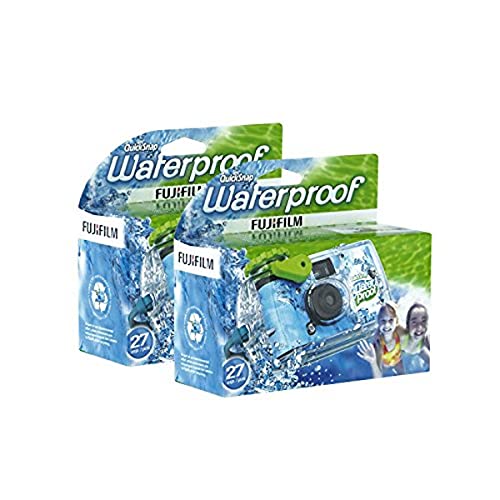
Fujifilm seals the QuickSnap Waterproof to roughly 33 feet, so it survives pool games and beach waves that would ruin a paper-bodied camera. Faster ISO 800 film compensates somewhat for the flash it lacks. Mixing a handful into a bulk order covers any water-themed segment of an event.
Pros
- Sealed housing rated to about 33 feet
- ISO 800 film suits overcast poolside light
- Handles splashes standard cameras cannot
Cons
- No built-in flash for shaded areas
- Priced above standard QuickSnap models

Kodak Sport Single Use Camera
Kodak built the Sport for hikes, camping trips and boat outings rather than banquet tables. Its housing resists water to about 50 feet, deeper than the QuickSnap Waterproof, and shrugs off drops that would crack a standard shell. A grippy textured body stays secure in wet or gloved hands.
Pros
- Water resistance to about 50 feet
- Rugged housing survives drops and knocks
- Textured grip stays secure when wet
Cons
- No flash for dim or shaded scenes
- Bulkier than paper-bodied disposables

AgfaPhoto LeBox Flash
AgfaPhoto positions the LeBox Flash as the lowest-cost flash camera sold by the case, which matters for large giveaways with dozens of guests. ISO 400 color film handles well-lit rooms and daytime events without issue. Basic optics keep the price down but still produce usable, shareable prints.
Pros
- Lowest per-camera cost among flash models
- Built-in flash included at a budget price
- Well suited to large giveaways
Cons
- Color rendering trails Kodak and Fujifilm
- Flash coverage falls off at a distance
Compared at a glance
| # | Model | Exposures | Best for | Score | Price |
|---|---|---|---|---|---|
| 1 | Fujifilm QuickSnap Flash 400 | 27 shots | Best overall | 9.2 | Check price |
| 2 | Kodak FunSaver | 27 shots | Best value | 9.0 | Check price |
| 3 | Ilford HP5 Plus Single Use Camera | 27 shots | Best for black and white | 8.7 | Check price |
| 4 | Kodak Daylight Single Use Camera | 39 shots | Best for outdoors | 8.4 | Check price |
| 5 | Fujifilm QuickSnap Waterproof | 27 shots | Best for pool and beach | 8.5 | Check price |
| 6 | Kodak Sport Single Use Camera | 27 shots | Best for rugged use | 8.3 | Check price |
| 7 | AgfaPhoto LeBox Flash | 27 shots | Best budget | 8.1 | Check price |
Before you buy
How many exposures do you actually need per camera? Total shot count matters more than camera count once you’re buying dozens at once. A 39-exposure model like the Kodak Daylight covers more frames than a 27-shot QuickSnap at a similar price. Match exposures to guest count before ordering, not the other way around. Add a few spare cameras so no table runs dry mid-event.
Do disposable cameras need a flash indoors? Flash-free daylight cameras fail once guests move inside. Dim reception halls turn unlit frames dark and mostly unusable. Reserve models like the Kodak Daylight for patios, beaches and garden ceremonies instead. Every camera headed indoors should carry a working built-in flash, the way the Fujifilm QuickSnap Flash 400 and Kodak FunSaver do.
What ISO film speed works best for parties? ISO measures how a film reacts to available light. Faster ISO 800 stock, used in the FunSaver and QuickSnap Waterproof, gathers more detail from dim rooms and evening receptions. Slower ISO 400 film, found in the QuickSnap Flash 400 and Ilford HP5 Plus, still performs fine once a flash fires. Outdoor daytime shooters can lean on either speed without much difference.
What does developing bulk disposable cameras cost? Camera price covers only half the expense. Every unit still needs film processed and scanned at a lab, and that per-camera fee adds up across a full case order. Sticking to one film type across the order, color or black and white, often speeds up drop-off and keeps the lab bill predictable. Budget for developing before you finalize how many cameras to buy.
Questions worth asking
How many disposable cameras do I need for a wedding?
Many planners use one camera per table, or roughly one per four to six guests. Count total exposures rather than camera units, then add two or three spares so no group runs out before the reception ends.
Do disposable cameras work indoors without a flash?
Rarely. Flash-free daylight models like the Kodak Daylight are built for bright outdoor light and produce dark, muddy frames inside. Route any camera headed indoors, such as the QuickSnap Flash 400 or FunSaver, toward built-in flash instead.
Which film speed is better for indoor parties, ISO 400 or ISO 800?
ISO 800, used in the Kodak FunSaver and QuickSnap Waterproof, reads dim indoor and evening light more accurately. ISO 400, found in the QuickSnap Flash 400 and Ilford HP5 Plus, is better suited to bright daytime settings.
Are bulk disposable cameras actually cheaper per shot?
Usually, yes. Buying a full case lowers the per-camera price compared with individual purchases at a drugstore. Developing is billed per camera regardless of how the cameras were bought, so factor that cost in separately.
Can you buy black-and-white disposable cameras?
Yes. Ilford loads genuine HP5 Plus black-and-white film into its single-use camera, giving events an editorial look distinct from color prints. Most labs need to run mono film through a separate developing process.
Do waterproof disposable cameras have a flash?
Most do not. The Fujifilm QuickSnap Waterproof and Kodak Sport skip the flash to keep their sealed housings simple, so both work best in bright, open water settings rather than shaded or dim ones.
Is a Kodak or Fujifilm disposable camera better for events?
Fujifilm’s QuickSnap Flash 400 tends to produce the most consistent flash and color across a full case, based on specifications and owner feedback. Kodak’s FunSaver still wins on price when the budget matters more than uniformity.
How do you get photos off a disposable camera after the event?
You return the entire sealed camera to a photo lab or mail-in service, which develops the film and returns prints or digital scans. There is no way to reload or reopen a disposable camera yourself.
How long can an unused disposable camera sit before I use it?
Each camera carries a best-by date printed on the packaging, and shooting before that date keeps colors accurate. Store spare cameras somewhere cool and dry so heat and humidity don’t degrade the film early.
What is the difference between the Kodak Sport and the QuickSnap Waterproof?
The Kodak Sport resists water to about 50 feet versus roughly 33 feet for the QuickSnap Waterproof, and its housing is built for hikes and boat trips rather than just pools. Neither camera includes a flash.
The bottom line
Fujifilm’s QuickSnap Flash 400 remains the safest case to order when consistency across every table matters most. Kodak’s FunSaver fills a big guest list without straining the budget, and a handful of Ilford HP5 Plus cameras add a distinctive black-and-white set to the mix. Match exposures and flash to each event space before checkout, then let owner feedback and specifications guide the final split between brands.