How High Should Your Monitor Be for Good Posture?
Your monitor should be positioned so the top of the screen sits at or just below your eye level, roughly 20 to 28 inches from your face, with the screen tilted back 10 to 20 degrees. When you look straight ahead without tilting your head, your gaze should land near the top third of the display, and your eyes should drop slightly to read the center of the screen.
Why eye level at the top of the screen matters
Posture problems with monitors almost always come from the same root cause: the screen sits too low, so you tip your chin down and round your upper back to see it. Ergonomics guidance from organizations like OSHA and the Mayo Clinic consistently points to the same reference: the top of the screen should be at or slightly below eye level, not the center. If the whole screen is below eye level, your neck spends hours in mild flexion, which is a common contributor to the tension people describe as “tech neck.”
The reverse problem happens too. Monitors propped on stacks of books or mounted too high force your chin up and your neck into extension, which is just as tiring over a full workday. The goal is a neutral neck position where your head balances directly over your shoulders, not tilted forward or back.
How to actually measure the right height
Sit in your normal working position with your feet flat and your back supported. Close your eyes, relax your neck, and then open them. Wherever your gaze naturally lands is close to where the top of your screen should be. For most people at a standard desk, this puts the top edge of a monitor somewhere between 20 and 25 inches above the seat of the chair, though this varies with desk height, chair height, and how tall you are.
Distance matters as much as height. Sitting too close forces you to lean forward, which pulls your shoulders and neck out of alignment even if the vertical height is correct. An arm’s length away, roughly 20 to 28 inches, gives your eyes enough room to focus comfortably while keeping the screen close enough to read without leaning.
For anyone using a large or curved display, positioning shifts slightly. With a best ultrawide monitor, the extra horizontal real estate means the edges of the screen sit further into your peripheral vision, so centering the display directly in front of you becomes more important than with a smaller screen, and a slightly greater viewing distance is often more comfortable.
Common setups and how to fix them
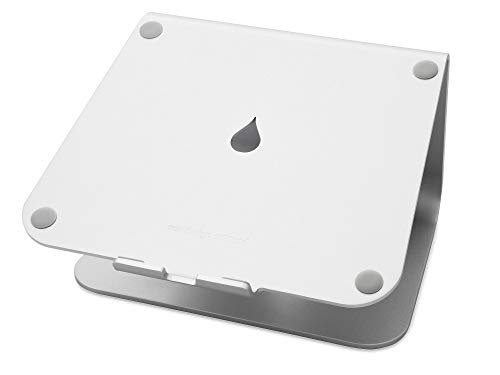
- Laptop used alone: Laptop screens sit far too low for most people, forcing the neck down for hours. Manufacturer and physical therapy guidance both recommend raising the laptop on a stand and using an external keyboard and mouse so the screen reaches eye level without your hands following it upward.
- Single external monitor: A monitor stand, monitor arm, or even a stack of sturdy books can raise the display so its top edge meets eye level. Most stands and arms include tilt adjustment, which should be set so the screen leans back slightly rather than sitting bolt upright.
- Dual monitor setup: If you use two screens equally, center the seam between them directly in front of your body and keep both at the same height. If one screen is a primary display and the other is used only occasionally, the primary screen gets the eye level position and the secondary can sit slightly to the side.
- Standing desk: Height needs to be rechecked every time you switch between sitting and standing. A fixed monitor height that works while seated will almost always sit too low once you stand up.
Signs your monitor height still needs adjusting
Aggregated owner feedback on ergonomic monitor arms and stands repeatedly mentions the same before-and-after pattern: users who raised a screen that had been sitting too low reported less end-of-day neck and shoulder tightness within days, not weeks. If you notice yourself tilting your head down to read text, feeling tension across the base of your skull, or catching yourself hunched forward by mid-afternoon, that is usually a sign the screen is positioned too low or too far away rather than a sign you need a different chair or desk entirely.
Frequently asked questions
Should the center of my monitor be at eye level?
No. The common recommendation is that the top of the screen, not the center, should be at or slightly below eye level. This lets your eyes travel down naturally to read the middle and bottom of the display without tilting your whole head forward.
How far should my monitor be from my eyes?
A general guideline from ergonomics references is 20 to 28 inches, roughly an arm’s length. Larger screens, including ultrawide models, are often set at the further end of that range for comfortable focus.
Is it bad to look slightly down at a monitor?
A small downward gaze angle, generally cited as around 10 to 20 degrees below horizontal, is considered normal and comfortable. The problem is a bent or dropped neck, not a slightly lowered gaze.
Do I need a monitor arm to fix the height, or can a stand work?
Either can work. A fixed stand or a stack of books can get a screen to the right static height, while a monitor arm adds the ability to fine tune height, tilt, and distance, which is useful if you switch between sitting and standing or share a desk with someone else.
You might also need
How to Prevent Neck Pain from a Low Monitor
How to Set Up Dual Monitors for a Home Office
How to Choose Wireless Earbuds Worth Wearing Daily