Which Alphabet Learning Toys Actually Help Kids Read Sooner?
LeapFrog Fridge Phonics tops this list because it says each letter sound, not only the name. Melissa and Doug See and Spell moves a child from single letters into three letter words. Osmo Little Genius adds app feedback for households that already own a compatible iPad.
Start with the LeapFrog Fridge Phonics Magnetic Letter Set, which links every letter to the sound it makes. Move to the Melissa and Doug See and Spell Learning Toy once your child assembles short words. Osmo Little Genius Starter Kit fits families who want guided feedback and already own a compatible iPad.
Most alphabet toys teach letter names, which children absorb from songs anyway. Sounds are the part that unlocks decoding, and far fewer products cover them properly. We compared phonics handling, stated age ranges, material durability and how much adult time each toy demands. Owner feedback about attention past the first fortnight decided several placements.
The top picks, ranked

LeapFrog Fridge Phonics Magnetic Letter Set
Slot a letter into the base and it names the letter, says the sound and sings a short verse. Fridge placement matters more than it sounds, because children return in short bursts across a whole day. Chunky magnets suit a toddler grip, and the base survives being knocked to the floor.
Pros
- Says the sound as well as the letter name
- Fridge height invites frequent short sessions
- Wide magnets match a developing grip
Cons
- Songs repeat quickly for adults in the room
- Loose letters slide under appliances

Melissa and Doug See and Spell Learning Toy
Wooden boards pair a picture with letter shaped cutouts, so a wrong letter simply will not seat. That built in self correction is why the set works as a step beyond recognition. No batteries and no speaker means an adult names the pictures during the first few sessions.
Pros
- Cutout shapes correct mistakes without an adult stepping in
- Silent play suits shared rooms and car journeys
- Wooden pieces pass down to a second child
Cons
- Early sessions need someone naming the pictures
- 64 small letters scatter fast

Osmo Little Genius Starter Kit for iPad
A reflector clips over the tablet camera so the app reads real pieces on the table instead of taps on glass. Silicone sticks and rings let a child bend letter shapes by hand, and costume pieces drive a storytelling game. Even lighting and a compatible iPad are hard requirements, not suggestions.
Pros
- Physical pieces stay in the child’s hands throughout
- Feedback on letter formation arrives instantly
- Extra game packs extend the base kit for years
Cons
- Dim rooms confuse the camera reflector
- Total outlay climbs once you count the tablet
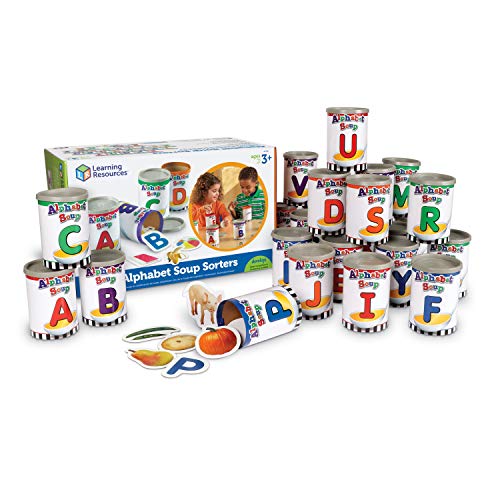
Learning Resources Alphabet Soup Sort and Serve
Children ladle plastic letters out of a soup pot and match them against picture cards. Scooping trains fine motor control while the matching drills beginning sounds. Two players work better than one here, since turn taking is what carries the game forward.
Pros
- Sound practice hides inside a pretend cooking game
- Older and younger siblings can play the same round
- Ladle work strengthens the pincer grip
Cons
- Pot walls feel thin under rough handling
- An adult runs the rules for the first week

Melissa and Doug Alphabet Sound Puzzle
Dropping a wooden piece into its slot triggers that letter’s sound from the board. Peg sized pieces suit a pincer grip that is still forming, which is why this suits younger toddlers than most sets here. Everything stays on one board, and the fixed volume plus single sound per letter keeps it deliberately simple.
Pros
- Works from around two, earlier than most alphabet toys
- Board frame stops pieces wandering off
- Peg shaping develops the pincer grip
Cons
- Volume cannot be turned down
- Most children move past it within a year

VTech Touch and Learn Activity Desk Deluxe
Interchangeable activity pages cover letters, numbers, music and early vocabulary on one desk. Fold it up and the same frame becomes an easel and a chalkboard, with a stool included. Breadth is the trade: no single subject goes as deep as a dedicated phonics toy, and the desk claims permanent floor space.
Pros
- One purchase spans several subjects and several years
- Converts into an easel and a chalkboard
- Matching stool arrives in the box
Cons
- Needs a permanent corner of the room
- Phonics coverage is shallower than dedicated sets

Coogam Wooden Alphabet Flash Cards Matching Puzzle
Each wooden card carries a picture plus a recess that accepts only its matching letter block. Nothing here needs power, so the set travels to a cafe, a car or a waiting room without preparation. Sounds must come from whoever is sitting alongside, since the cards stay silent.
Pros
- Lowest outlay here and no batteries to replace
- Packs flat enough for a bag or glovebox
- Wood holds up better than laminated card
Cons
- Supplies no letter sounds by itself
- Small blocks need watching around under threes
Compared at a glance
| # | Model | Age range | Best for | Score | Price |
|---|---|---|---|---|---|
| 1 | LeapFrog Fridge Phonics Magnetic Letter Set | About 2 to 5 years | Best overall | 9.4 | Check price |
| 2 | Melissa and Doug See and Spell Learning Toy | About 4 to 6 years | Best for building words | 9.2 | Check price |
| 3 | Osmo Little Genius Starter Kit for iPad | About 3 to 5 years | Best interactive | 9.0 | Check price |
| 4 | Learning Resources Alphabet Soup Sort and Serve | About 3 to 6 years | Best for two children together | 8.8 | Check price |
| 5 | Melissa and Doug Alphabet Sound Puzzle | About 2 to 4 years | Best first alphabet toy | 8.6 | Check price |
| 6 | VTech Touch and Learn Activity Desk Deluxe | About 2 to 5 years | Best all in one | 8.3 | Check price |
| 7 | Coogam Wooden Alphabet Flash Cards Matching Puzzle | About 3 to 6 years | Best budget | 8.0 | Check price |
Before you buy
What to look for in an alphabet learning toy Sound coverage separates a useful toy from a decorative one. Reciting the alphabet song does not move a child closer to reading; knowing that a letter makes a sound does. Check the product description for the word phonics, or for a stated sound per letter. Age guidance, piece count and whether the toy needs an adult present are the next three things worth reading before you buy.
How do I match an alphabet toy to my child’s stage? Peg puzzles and sound boards fit two and three year olds still working on grip and shape recognition. Word building sets assume most letters are already familiar. Buying a year ahead usually means a box sits unopened, and buying behind means the toy is abandoned inside a fortnight. Compare the age guidance against what your child does today, not what they managed last month.
Electronic or wooden: which works better at home? Battery powered toys give feedback with nobody supervising, which buys a parent ten minutes. Repetition and volume are the standard complaints in owner reviews, and batteries drain when a toy is left switched on. Wooden and card sets stay quiet and last through siblings, but somebody has to sit alongside and supply the sounds. Plenty of families keep one of each and use them at different times of day.
Will an alphabet toy survive daily play and stay complete? Twenty six loose pieces disappear at a predictable rate. Boards and trays that hold their letters lose far fewer than magnet sets on a fridge door. Wooden sets from established brands tend to outlive moulded plastic, and anything shipped with a storage box has a better chance of being whole a year later. Note the piece count on the packaging so you know what a full set looks like.
Common questions
What age should a child start using alphabet toys?
Around two suits chunky peg puzzles and sound boards, once grip and shape matching are developing. Letter sounds usually click between three and four. Word building sets land best from four upward. Normal ranges are wide, so follow the child rather than the birthday.
Should children learn letter names or letter sounds first?
Phonics approaches teach sounds first or alongside names, because sounds are what a child uses to decode a word. Naming a letter is a labelling task. Blending sounds is the reading task. Toys that supply both cover more ground than ones that only name letters.
Are electronic alphabet toys better than wooden ones?
Neither wins outright; they solve different problems. Electronic sets support independent play when no adult is free. Wooden sets stay quiet, last longer and pull an adult into the game. Many households run an electronic toy for solo time and a wooden set for time together.
How long do alphabet toys hold a toddler’s attention?
Owners report that first enthusiasm for any single toy fades after a couple of weeks. Where the toy lives then decides everything. Fridge magnets and a puzzle on a low shelf get picked up repeatedly, while cupboard storage usually ends the relationship.
Which alphabet toy works for two children of different ages?
Learning Resources Alphabet Soup Sort and Serve handles the gap best, since an older child can lead the game while a younger one scoops and matches. Word building sets frustrate the younger sibling. Sound boards bore the older one within minutes.
Are magnetic alphabet letters safe for toddlers?
Large moulded letters made for toddlers, including the LeapFrog set, are sized against choking risk. Small high strength magnets from craft or office kits are a genuine hazard if swallowed, so store those separately. Follow the age marking printed on the packaging.
Do these toys need batteries, and how do the compartments work?
Electronic models here run on standard cells behind screw secured covers, as required for children’s products. Check the screws stay tight after a fall. Keep spare cells out of reach, and switch toys off, because battery life drops fast when a unit is left running.
Can alphabet toys replace reading with my child?
No, and none of them claim to. Shared reading builds vocabulary, comprehension and attention. These toys build letter and sound recognition that reading then puts to work. Treat them as practice between books rather than a substitute for them.
Is Osmo worth it if we already have an iPad?
It becomes a reasonable choice at that point, because the tablet is the largest part of the cost. Osmo Little Genius earns its place by keeping physical pieces in play while the app checks letter shapes. Without a compatible iPad and a well lit table, pick something else.
Our take
LeapFrog Fridge Phonics Magnetic Letter Set earns first place because it teaches sounds and sits somewhere children pass a dozen times a day. Once letters are familiar, Melissa and Doug See and Spell is the logical next step into words without adding another electronic voice to the kitchen. Households with a compatible iPad and a bright table will get more from Osmo Little Genius.