Aquarium Heaters for Steady Indoor Tank Temps
The Eheim Jager TruTemp is our top pick for accurate, repeatable thermostat control in indoor tanks. The Cobalt Aquatics Neo-Therm is the safest slim option thanks to its shatter resistant body, and the Fluval E Series adds a display that shows what the water is actually doing.
If you want one heater that holds a steady figure in a normal indoor room, the Eheim Jager TruTemp is the pick, with the Cobalt Aquatics Neo-Therm for shatter resistance and the Fluval E Series when you want an on unit temperature readout. All three are current listings covering common tank sizes.
Heater shopping is harder than it should be because the number on the dial and the number in the water often disagree, and failure modes matter more than features. A stuck thermostat can cook a tank, and a glass tube can break when a large fish knocks it. We compared published accuracy claims, housing materials, calibration options and safety cut outs, then weighed those against what owners report about long term drift and reliability.
The best picks, ranked

Eheim Jager TruTemp Aquarium Heater
The Jager has been the default recommendation in freshwater circles for years, largely because the dial can be recalibrated against a trusted thermometer instead of forcing you to live with a factory offset. It runs dry safe and shuts down if the water level drops. Owners report units running for many years without meaningful drift, which is the whole point of a heater.
Pros
- Dial can be recalibrated by the owner
- Long standing reliability record
- Wide wattage range for most tank sizes
Cons
- Glass body is vulnerable to knocks
- Fully submersible only, needs depth

Cobalt Aquatics Neo-Therm Heater
The Neo-Therm uses a flat thermoplastic body rather than glass, so a boisterous cichlid or a careless net does not turn it into a hazard. An LED display shows the set point and the current reading, and the electronic thermostat holds a tight band. The slim profile also hides behind decor more easily than a round tube.
Pros
- No glass to break
- Flat profile hides easily
- Clear set and actual readings
Cons
- Electronics are not user calibratable
- Costlier than glass tube heaters

Fluval E Series Electronic Heater
The E Series wraps the heating element in a slotted guard so fish cannot press against the hot surface, and the front LCD shows the water temperature in colour coded form. It also flags when the reading has drifted outside the set band, which is a useful early warning. A good fit for community tanks with curious bottom dwellers.
Pros
- Guard prevents burn contact
- Readable at a glance from outside
- Warns when temperature drifts
Cons
- Bulkier than a bare tube
- Guard traps debris and needs cleaning
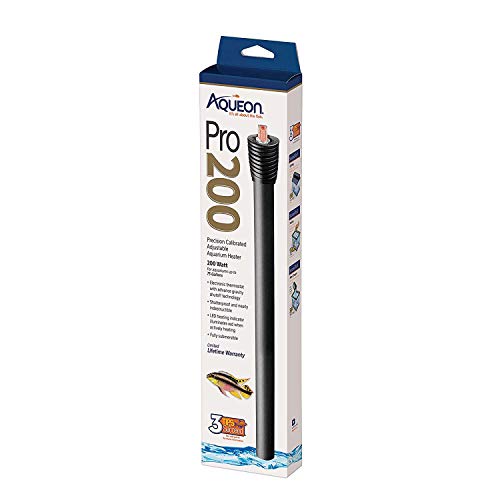
Aqueon Pro Adjustable Heater
Aqueon builds the Pro around an aluminium core in a shatter resistant shell, which puts it in the same safety bracket as pricier models without the electronics. The thermostat is a simple dial with an LED that tells you when it is drawing power. Owners report it is a dependable workhorse for standard community tanks, though the dial marking is approximate.
Pros
- Break resistant at a modest cost
- Clear heating indicator light
- Fully submersible in any orientation
Cons
- Dial markings are not precise
- No temperature readout

Hygger Titanium Aquarium Heater
A titanium tube paired with an external controller keeps the fragile part out of the water entirely. The controller shows the current reading and lets you set a target in single degree steps, which suits larger volumes where you want precise control from outside the cabinet. The titanium tube itself is effectively immune to the knocks that kill glass heaters.
Pros
- Titanium tube resists impact
- Precise external control
- Suits large water volumes
Cons
- Separate probe adds cable clutter
- Controller needs a dry mounting spot

Tetra HT Submersible Aquarium Heater
The Tetra HT is a preset heater aimed at small community tanks where a tropical target is all you need. There is no dial to misread, just an indicator light showing heating or holding. Owners report it is a sensible pick for a first betta or small community setup, but the fixed set point rules it out for species needing a specific figure.
Pros
- Nothing to set incorrectly
- Clear status indicator
- Compact for nano setups
Cons
- No adjustment for species needs
- Not suitable for larger volumes
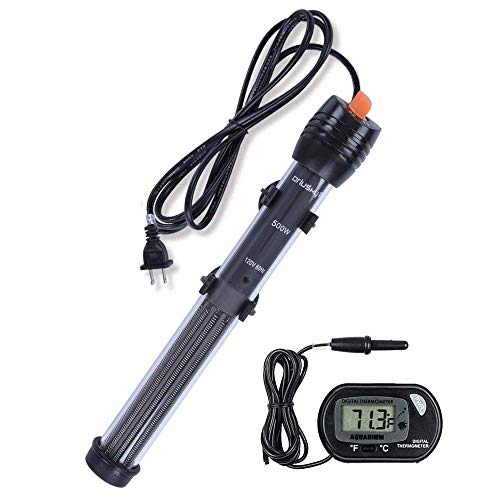
Orlushy Submersible Aquarium Heater
The Orlushy is a straightforward glass tube heater with an external dial and a heating light, sold at the low end of the market. It does the core job in a stable indoor room, and the external dial is easier to adjust than a submerged collar. Owners report a wider factory offset than premium units, so pair it with an independent thermometer.
Pros
- Dial sits outside the water
- Lowest cost option here
- Simple to install and replace
Cons
- Factory calibration can be off
- Glass body needs careful handling
How they compare
| # | Model | Housing | Best for | Score | Price |
|---|---|---|---|---|---|
| 1 | Eheim Jager TruTemp Aquarium Heater | Laboratory glass | Best overall | 9.4 | Check price |
| 2 | Cobalt Aquatics Neo-Therm Heater | Shatterproof thermoplastic | Best for safety | 9.2 | Check price |
| 3 | Fluval E Series Electronic Heater | Guarded glass core | Best display | 9.0 | Check price |
| 4 | Aqueon Pro Adjustable Heater | Shatter resistant composite | Best value | 8.8 | Check price |
| 5 | Hygger Titanium Aquarium Heater | Titanium tube | Best for large tanks | 8.6 | Check price |
| 6 | Tetra HT Submersible Aquarium Heater | Sealed plastic body | Best for small tanks | 8.3 | Check price |
| 7 | Orlushy Submersible Aquarium Heater | Quartz glass | Best budget | 8.0 | Check price |
What to look for
Sizing wattage to the tank and the room The common rule of thumb is roughly three to five watts per gallon, but the room matters as much as the tank. A tank in a heated living room needs far less capacity than one in a cool spare bedroom or a garage conversion, because the heater is only making up the difference between room air and target water. Oversizing slightly gives faster recovery after water changes, while heavily oversizing raises the stakes if a thermostat ever sticks on.
Two smaller heaters beat one large one Experienced keepers often split the required wattage across two heaters placed at opposite ends of the tank. If one fails off, the other keeps the tank survivable while you notice. If one sticks on, it lacks the capacity to overheat the whole volume quickly. The setup also evens out warm and cool zones in longer tanks, which single heaters struggle with unless flow is good.
Glass, composite and titanium Glass tubes are accurate and inexpensive but they break, and a broken heater in a live tank is both an electrical and a safety problem. Composite shatter resistant bodies remove that risk for a modest premium and suit tanks with large or clumsy fish. Titanium is the toughest option and pairs with an external controller, which keeps the electronics dry, though the extra probe and cable make for a busier setup.
Trust a separate thermometer, not the dial Every heater dial carries some offset, and it can drift over years of use. Keep an independent thermometer in the tank at the opposite end from the heater and set the dial to whatever produces the reading you actually want. Check it during your regular maintenance rather than only when something looks wrong. Heaters that let you recalibrate the dial make this easier to live with over the long run.
Questions worth asking
What wattage heater do I need for my tank?
Roughly three to five watts per gallon is the usual starting point, adjusted for how cool the room gets. A tank in a consistently warm room can sit at the low end, while one in a cold room needs the high end or a split across two units.
Should I use one heater or two?
Two smaller heaters is the safer arrangement for anything above a small tank. It protects against both failure modes, keeps temperature more even along the tank, and means a single failure does not become an emergency.
Do aquarium heaters need to be fully submerged?
Most modern heaters are fully submersible and should be, since the thermostat needs to read water rather than air. Some older designs have a maximum immersion line. Always check the marking on the tube before installing.
Where should the heater go in the tank?
Near the filter outflow or in an area with steady water movement, so heated water circulates instead of pooling. Placing a heater in a dead corner is the most common cause of uneven readings across a tank.
How accurate are heater dials?
Less accurate than most people assume. Treat the dial as a starting point, confirm with a separate thermometer, and adjust from there. Heaters with a user calibratable dial or a digital readout make this less of a guessing game.
Can a heater overheat a tank?
Yes, if the thermostat sticks in the on position. This is why splitting wattage across two heaters and checking readings during regular maintenance matters. Models with an over temperature cut off add a further layer of protection.
How long do aquarium heaters last?
Several years is typical for a good unit, but they are consumable equipment rather than permanent fixtures. Many keepers replace them proactively every few years rather than waiting for a failure with fish in the tank.
Do I need to unplug the heater during water changes?
Yes, if the water level will drop below the heater. Heaters with run dry protection tolerate this better, but unplugging removes the risk entirely and costs nothing. Let the heater cool before removing it from the water.
The bottom line
The Eheim Jager TruTemp remains the sensible default because it holds a steady figure and lets you correct the dial when it drifts. If breakage worries you, the Cobalt Aquatics Neo-Therm delivers the same stability in a shatter resistant body, and the Fluval E Series is worth the bulk for its readable display and drift alerts. Whichever you choose, run a separate thermometer alongside it.


