How UV Sterilisers Keep Aquarium Water Clean and Clear
Coralife Turbo-Twist 6X UV Sterilizer 12W takes the lead because a spiral chamber stretches dwell time without throttling flow. AA Aquarium Green Killing Machine 24W clears green water fastest with no plumbing at all. SunSun JUP-01 covers small tanks at the lowest outlay.
Coralife Turbo-Twist 6X is the steriliser to fit on most freshwater and marine tanks, since its twist chamber earns real exposure time from a modest lamp. AA Aquarium Green Killing Machine 24W is the quickest route out of a bloom because it needs no plumbing. Nano and small community tanks are covered by the SunSun JUP-01.
UV units are easy to buy wrongly, because wattage on the box means nothing on its own. Killing free floating algae takes roughly a tenth of the exposure that kills parasites, and the same lamp achieves either depending on water speed. We compared rated wattage against published flow windows, chamber design, sleeve material and owner reports on bulb access and leaks.
The best picks, ranked

Coralife Turbo-Twist 6X UV Sterilizer 12W
A spiral internal baffle sends water on a longer swirling path around the lamp, raising dwell time without slowing flow to a crawl. Vertical or horizontal mounting both work, and a built in wiper clears the quartz sleeve. Bulb changes happen without breaking the plumbing apart.
Pros
- Twist chamber raises exposure time
- Wiper restores sleeve clarity in seconds
- Bulb swaps without disconnecting hoses
Cons
- Needs a canister filter or separate pump
- Fittings often want extra sealing on first setup

AA Aquarium Green Killing Machine 24W Internal UV Sterilizer
Everything lives in one submersible housing with its own pump, so no plumbing or flow matching is involved. A 24 watt lamp is powerful for the class and clears a pea soup bloom within days on tanks up to about 220 litres. An indicator signals when the bulb is due for replacement.
Pros
- Drops straight in with no plumbing
- Powerful lamp clears blooms in days
- Indicator removes bulb replacement guesswork
Cons
- Occupies visible space inside the tank
- Integrated pump is a single failure point

Aqua Ultraviolet Classic 15 Watt UV Sterilizer
Thick walled polycarbonate and a genuine quartz sleeve are why these turn up on reef systems and koi ponds alike. Run at the slower flow the manufacturer specifies, exposure reaches parasite level rather than only clarifying. Replacement lamps and sleeves stay available years after purchase.
Pros
- Reaches parasite level dose at rated flow
- Serviceable with long parts availability
- Body suits marine and pond duty
Cons
- Highest outlay in this roundup
- Requires a correctly sized separate pump

Fluval UVC In-Line Clarifier
Quick release couplings splice this into a canister return hose and let it detach for bulb changes without draining anything. Stepped adaptors cover common hose diameters. Output sits at clarifier level, so treat it as a polishing tool rather than disease control.
Pros
- Hides entirely inside the cabinet
- Quick disconnect for maintenance
- Adaptors fit most canister hose sizes
Cons
- Clarifier output, not parasite control
- Adds head pressure to the filter return
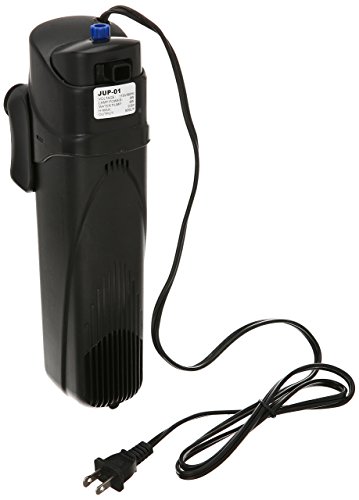
SunSun JUP-01 9W Submersible UV Sterilizer
A small pump, a sponge pre filter and a 9 watt lamp share one submersible housing, so it doubles as supplementary filtration. Tanks up to roughly 150 litres are within reach. Materials are basic and the sponge needs frequent rinsing, yet green water still clears.
Pros
- Lowest outlay for aquarium UV
- Adds mechanical filtration and circulation
- No plumbing or flow matching needed
Cons
- Basic materials and short bulb life
- Bulky inside a small aquarium

AquaTop IL-UV5 In-Line UV Sterilizer
A short body fits stands where full length sterilisers will not, and barbed adaptors cover common tubing sizes. Water passes through a straight bore chamber, simpler than a twist design but with low flow resistance. Keep flow modest and tanks under about 200 litres.
Pros
- Short body fits shallow cabinets
- Low flow restriction on the return line
- Simple to open and service
Cons
- Five watts limits it to clarification
- Barb fittings want extra hose clamps
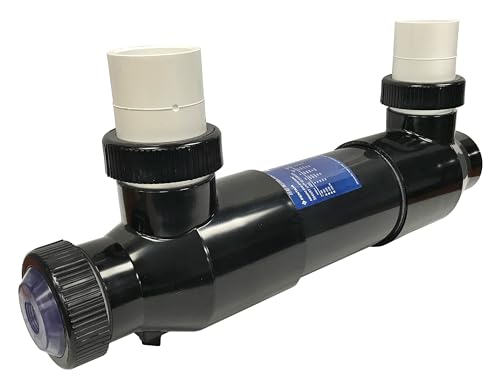
Pentair 02020 Smart UV Clarifier 18W
An 18 watt lamp behind a quartz sleeve runs on an electronic ballast that reports lamp status, which matters because UV output fades long before a bulb looks dead. Inline plumbing or a hang on mount both work. Physical size is substantial, so measure the cabinet first.
Pros
- Wattage suits big display tanks
- Lamp status reporting removes guesswork
- Quartz sleeve transmits UV efficiently
Cons
- Large footprint needs cabinet planning
- Excessive for tanks under 200 litres
How to choose
Why wattage means nothing without flow rate A UV steriliser kills by dose, and dose is lamp output multiplied by time beside the lamp. Push water past too quickly and even a large lamp only clarifies. Slow it down and a modest lamp reaches parasite level exposure. Manufacturers publish two flow figures, one for algae and a much lower one for parasites, so size the pump to the job you actually want.
Do you want clarity or disease control? Free floating algae dies at roughly a tenth of the dose that kills ich or velvet tomites. That is why a small inline clarifier clears green water beautifully yet does nothing during a parasite outbreak, while an Aqua Ultraviolet Classic run slowly handles both. Be honest about the problem, because the simpler answer is often the correct one.
Quartz sleeves, wipers and keeping output up The lamp never touches tank water directly. It sits inside a sleeve, and anything that films over that sleeve blocks UV before it reaches an organism. Quartz transmits far better than glass, and a built in wiper restores output with a twist rather than a strip down. Clean the sleeve every couple of months regardless of design.
Replace UV bulbs on a schedule, not on failure Lamps keep emitting visible light long after germicidal output has faded, which is why so many aquarists think their unit stopped working for no reason. Nine to twelve months of continuous running is the usual replacement interval. Units with a status indicator handle the reminder for you, and a date written on the cabinet door works otherwise.
Compared at a glance
| # | Model | Wattage | Best for | Score | Price |
|---|---|---|---|---|---|
| 1 | Coralife Turbo-Twist 6X UV Sterilizer 12W | 12 W | Best overall | 9.4 | Check price |
| 2 | AA Aquarium Green Killing Machine 24W Internal UV Sterilizer | 24 W | Best for green water | 9.2 | Check price |
| 3 | Aqua Ultraviolet Classic 15 Watt UV Sterilizer | 15 W | Best for parasite control | 9.0 | Check price |
| 4 | Fluval UVC In-Line Clarifier | Inline clarifier | Best for canister filters | 8.8 | Check price |
| 5 | SunSun JUP-01 9W Submersible UV Sterilizer | 9 W | Best budget | 8.6 | Check price |
| 6 | AquaTop IL-UV5 In-Line UV Sterilizer | 5 W | Best for shallow cabinets | 8.3 | Check price |
| 7 | Pentair 02020 Smart UV Clarifier 18W | 18 W | Best for larger tanks | 8.0 | Check price |
Good to know
Will a UV steriliser kill beneficial bacteria?
No. Nitrifying bacteria live on filter media and substrate surfaces, not floating in the water column, so UV never reaches them. Only free floating organisms passing the lamp are affected.
How long does UV take to clear green water?
Most aquarists report visible improvement in two to three days and clear water within a week. No change after ten days points at excessive flow, a filmed sleeve or a lamp past its service life.
Can UV cure an ich outbreak on its own?
Not reliably. UV only kills the free swimming stage as it passes the lamp, which slows reinfection rather than clearing infested fish. Combine it with temperature management and a dedicated treatment, running at the slower parasite flow.
Should a UV steriliser run all the time?
Continuous running is normal for ongoing clarity. Some keepers run UV seasonally or when adding new stock to save lamp hours. Check fertiliser labels, since UV degrades a few compounds including some chelated iron.
Does UV work in saltwater as well as freshwater?
Yes, under the same sizing rules. Reef keepers often prefer inline units on a dedicated pump for precise flow. Remember UV also kills free floating plankton, which matters for filter feeding corals and refugium populations.
Where should a UV unit sit in the plumbing?
After mechanical filtration, so water reaching the lamp is already clear. Suspended particles shade organisms and cut effectiveness sharply. The return line from a canister filter is the standard position.
Is a submersible or inline UV steriliser better?
Submersible units include their own pump and need no plumbing, at the cost of visible hardware. Inline units hide in the cabinet, allow precise flow control and scale better, but need correct pump matching.
What wattage UV steriliser do I need?
Roughly one watt per 20 litres for clarification, and closer to one watt per 8 litres for parasite control. Confirm against the manufacturer flow chart, since a slower flow through a modest lamp beats fast water through a big one.
Can a UV steriliser harm fish or plants?
No, because the lamp is enclosed and water only passes through the chamber. Fish and rooted plants never encounter the light directly.
The verdict
Coralife Turbo-Twist 6X is the steriliser to recommend to most aquarists, since the twist chamber earns real dwell time from a modest lamp and the wiper keeps output steady. Reach for the AA Aquarium Green Killing Machine 24W when a green water bloom needs clearing without touching any plumbing. Step up to the Aqua Ultraviolet Classic 15 Watt when parasite control on a valuable display is the actual goal.