9 Backpacking Backpacks Built for Multi-Day Trails
Osprey Atmos AG 65 suits most backpackers, pairing a suspended mesh back with a wide torso adjustment range. Gregory Baltoro 65 carries loads past fifty pounds more comfortably than anything else here. Osprey Exos 58 drops to roughly 2.6 pounds while keeping a real frame.
Osprey Atmos AG 65 is the pack we would point most backpackers toward, because its adjustment range fits a wide spread of body shapes. Gregory Baltoro 65 takes over once loads get genuinely heavy. Osprey Exos 58 makes sense after your base weight drops below the point where a heavy pack earns its keep.
Capacity on the label says nothing about comfort, which comes down to torso length, hipbelt position and how the frame moves load onto your pelvis. We compared published torso ranges, suspension designs, stated comfortable carry weights, ventilation approach and empty weight across seven currently sold packs. Owner reports on hipbelt slipping, shoulder pressure and long trail durability filled in what specification sheets leave out.
Our top picks

Osprey Atmos AG 65
Suspended mesh holds the pack body off your back, so sweat has somewhere to go on a hot climb. Harness and hipbelt adjust across a wide range, which means fit does not depend on your torso matching a fixed size. That frame costs weight, and it is the reason this pack is not competing with ultralight designs.
Pros
- Mesh back panel keeps your shirt drier on climbs
- Wide torso and hipbelt adjustment range
- Moves load onto the hips effectively
Cons
- Heavier than minimalist framed packs
- Curved mesh eats into usable pack depth

Gregory Baltoro 65
Hipbelt and shoulder harness pivot independently, so the pack follows your stride instead of fighting it on broken ground. Thicker hipbelt padding moulds to shape across the first few trips and stays put under weight. Empty weight is high, which makes this a pack for camera kit, winter gear or multi day food carries.
Pros
- Handles loads past fifty pounds without collapsing comfort
- Hipbelt padding moulds to your shape with use
- Suspension tracks your hips over uneven terrain
Cons
- Heavy before a single item goes in
- Contact back panel runs warmer than suspended mesh
Osprey Exos 58
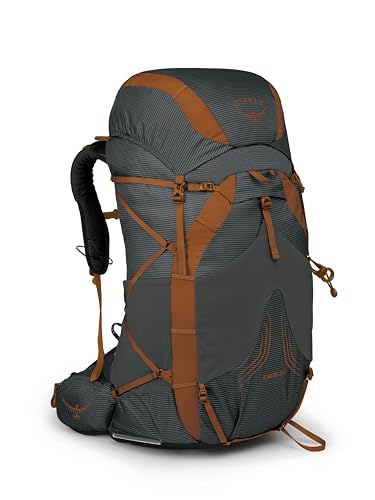
Around 2.6 pounds empty, this pack keeps a peripheral frame and ventilated back while stripping padding and features elsewhere. Removing the lid sheds further weight for trips where a top pocket is optional. Comfort falls away above roughly thirty five pounds, which is a design boundary rather than a defect.
Pros
- Very light for a pack with a real frame
- Removable lid trims further weight
- Keeps genuine back ventilation despite the low weight
Cons
- Uncomfortable once loads pass 35 pounds
- Thinner fabrics need care around abrasive rock

Deuter Aircontact Core 60+10
An extension collar adds ten litres on resupply days when a week of food has to fit somewhere. Contoured foam with air channels trades some airflow for very direct load transfer to the hips. Owners describe hardware and fabrics that survive seasons rather than single thru hikes.
Pros
- Extension collar absorbs big resupply loads
- Direct and stable load transfer
- Durable fabrics and hardware
Cons
- Foam back holds more heat than suspended mesh
- Heavier than rivals of similar capacity

Granite Gear Crown3 60
Framesheet and hipbelt both come out, so one pack covers a fast overnight and a five day trip. A roll top closure absorbs overpacking better than a fixed lid and saves weight at the same time. Load ceiling sits lower than traditional packs by design, not by compromise.
Pros
- Strips down or builds up to match the trip
- Roll top copes with variable pack volume
- Light for sixty litres of capacity
Cons
- Lower comfortable load than framed rivals
- Hipbelt padding is thinner than premium packs

Kelty Coyote 65
Torso adjustment happens without tools and without a second person, which matters when nobody fitted the pack in a shop. Front zip access saves digging through the main compartment for a stove at lunchtime. Fabrics and refinement sit below the premium packs, though the load transfer fundamentals are sound.
Pros
- Torso length adjusts alone in a few minutes
- Front zip reaches the main compartment directly
- Sound load transfer for a first pack
Cons
- Bulkier and heavier than premium options
- Fabrics show wear sooner over long distances
TETON Sports Scout 3400
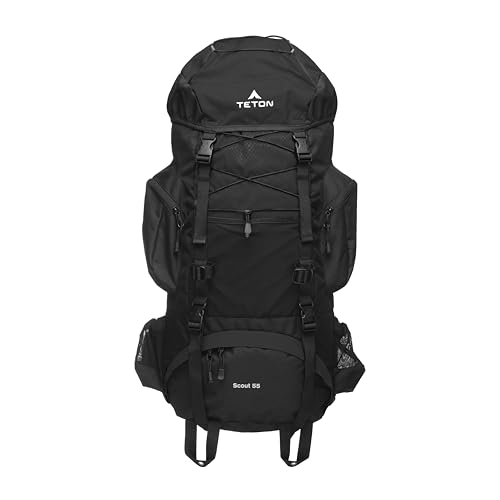
Roughly 55 litres, an internal frame, adjustable torso and a rain cover in the box cover the basics of an overnight trip. Suspension quality shows its limits once the load passes thirty pounds. As a way to find out whether backpacking suits you before spending more, it does the job.
Pros
- Rain cover included rather than sold separately
- Torso length adjusts to the wearer
- Lowest barrier to a first multi day trip
Cons
- Suspension struggles above 30 pounds
- Empty weight is high for the capacity
Compared at a glance
| # | Model | Capacity | Best for | Score | Price |
|---|---|---|---|---|---|
| 1 | Osprey Atmos AG 65 | 65 litres | Best overall | 9.4 | Check price |
| 2 | Gregory Baltoro 65 | 65 litres | Best for heavy loads | 9.2 | Check price |
| 3 | Osprey Exos 58 | 58 litres | Best for lightweight trips | 9.0 | Check price |
| 4 | Deuter Aircontact Core 60+10 | 60 litres plus 10 litre extension | Best for long trips | 8.8 | Check price |
| 5 | Granite Gear Crown3 60 | 60 litres | Best value | 8.6 | Check price |
| 6 | Kelty Coyote 65 | 65 litres | Best for beginners | 8.3 | Check price |
| 7 | TETON Sports Scout 3400 | About 55 litres | Best budget | 8.0 | Check price |
What matters most
How do you choose a backpacking backpack that fits? Torso length decides pack size, and it has almost nothing to do with your height. Measure from the bony bump at the base of your neck straight down your spine to the level of your iliac crest, with someone else reading the tape. Compare that figure to the manufacturer’s chart, because Osprey, Gregory and Deuter all draw their size boundaries differently. A pack in the wrong torso size cannot be adjusted into comfort, however good the suspension is.
What capacity do you need for weekend versus week long trips? Forty to fifty litres covers one and two night trips when your gear is compact and modern. Fifty to sixty five litres handles three to five days, which is where most of these packs sit. Sixty five litres and up suits week long routes, winter kit or carrying food for a group. Bulk drives this more than nights do, so a compressible down bag can pull you a size down while a synthetic bag pushes you a size up.
Where should the weight sit on your body? Roughly eighty percent of a loaded pack belongs on your hips, with shoulder straps stabilising rather than supporting. That only works when the hipbelt sits on top of the iliac crest instead of around your waist. Load lifter straps should run at about forty five degrees from the top of the shoulder straps to the pack body. Inside, heavy items go against your back between the shoulder blades, sleeping bag at the bottom, day items in the lid and hipbelt pockets.
Ultralight versus traditional packs: what do you give up? Osprey Exos 58 and Granite Gear Crown3 60 shed padding, frame material and fabric weight, which pays off only if your kit list stays disciplined. Push either past thirty five pounds and the saved weight turns into shoulder pain. Traditional packs like the Baltoro 65 add a pound or two of frame and padding, then repay it when you are carrying a bear canister and four days of food. Work out your realistic loaded weight first, then buy the pack that carries it.
Common questions
What size backpack do I need for a weekend trip?
Forty to fifty litres covers most one and two night trips with compact modern gear. Bulky synthetic sleeping bags, heavier tents or extra cold weather layers push that toward fifty five litres. Capacity tracks the bulk of your kit, not the number of nights.
How do I measure my torso length for a pack?
Tilt your head forward and find the bony bump at the base of your neck, then measure straight down your spine to a point level with the top of your hip bones. Have someone else read the tape, since reaching behind yourself distorts the number. Check the result against the specific brand’s chart, because sizing boundaries differ.
How much weight can a backpacking pack carry comfortably?
Suspension sets that limit, not capacity. Framed packs like the Atmos AG 65 handle forty to fifty pounds, the Baltoro 65 goes beyond that, and lightweight packs top out near thirty five. A common guideline keeps total loaded weight under twenty percent of body weight, though terrain and fitness move that considerably.
Is a rain cover or a pack liner better?
A liner keeps the contents dry regardless of what the outside is doing, and a heavy duty bin bag weighs almost nothing. Rain covers protect the pack fabric and external pockets, but wind lifts them and water runs down your back into the top opening. Plenty of backpackers use both together.
Are women’s backpacking packs actually different?
Yes, in ways that affect fit rather than marketing. Women’s specific versions typically use shorter torso ranges, more curved shoulder straps and hipbelts shaped for a different pelvis angle. Fit matters more than the label, so try both if the sizing is borderline.
Which backpacking backpack is best for beginners?
Kelty Coyote 65 makes the most sense for a first pack, because its torso adjustment can be set up alone without a shop fitting. TETON Sports Scout 3400 lowers the barrier further if you are unsure whether multi day trips will stick. Both carry weekend loads well enough to learn on.
Top loading or panel loading: which is better?
Top loaders weigh less, resist water better and have fewer failure points, which is why traditional packs use them. Panel loaders let you reach a stove at the bottom without unpacking everything above it. Many current packs, including the Deuter Aircontact Core and Kelty Coyote, offer both openings.
How long should a backpacking pack last?
A quality pack used regularly lasts many seasons, with hipbelt padding compressing and mesh abrading before the main fabric fails. Owners report zips and buckles as the usual first failures, and most reputable brands repair or replace those components. Lightweight packs with thin fabrics wear faster around rock and scree.
Can one pack cover both weekend and week long trips?
A sixty to sixty five litre pack with a compression system does this well, since straps pull an underfilled pack into a stable shape. Deuter Aircontact Core 60+10 goes further with an extension collar for the biggest food carries. Using a seventy litre pack for overnights invites overpacking rather than solving anything.
Final word
Osprey Atmos AG 65 is the pack to buy first, because the suspended mesh back and wide adjustment range suit a broad range of bodies and loads. Anyone regularly carrying winter kit, camera gear or long food carries will be better served by Gregory Baltoro 65. Once your base weight comes down, Osprey Exos 58 saves well over a pound while keeping a frame and real ventilation.