How to Choose a Safe First Trampoline for Kids
SkyBound’s Stratos 12-Foot Trampoline fits most beginner households, with a no-gap net and 250-pound capacity. Zupapa’s 15 FT Trampoline offers a higher 375-pound capacity for less. Little Tikes’ My First Trampoline suits toddlers, with a low frame and handlebar built for smaller kids.
SkyBound’s Stratos 12-Foot Trampoline suits most beginner households. Its no-gap net bolts to the frame, closing off the pinch points where kids get hurt. It holds jumpers up to 250 pounds, though toddlers need something lower and smaller.
Beginner trampolines vary mostly in enclosure design and weight capacity, not bounce height. We compared spring counts, net attachment methods, frame diameter, and age guidance from product listings and owner feedback.
The top picks, ranked

SkyBound Stratos 12-Foot Trampoline with Enclosure
A heavy-gauge steel frame anchors 72 galvanized springs and holds one jumper up to 250 pounds. Its enclosure net bolts straight to the frame instead of resting on the pad, closing the gap where fingers usually get pinched. Owners report the powder-coated frame surviving multiple outdoor seasons.
Pros
- Net bolts directly to the frame, leaving no pinch gap
- Galvanized springs resist rust in wet climates
- Padding covers the entire spring area
Cons
- Assembly needs two people and a few hours
- A 12-foot footprint still needs an open yard
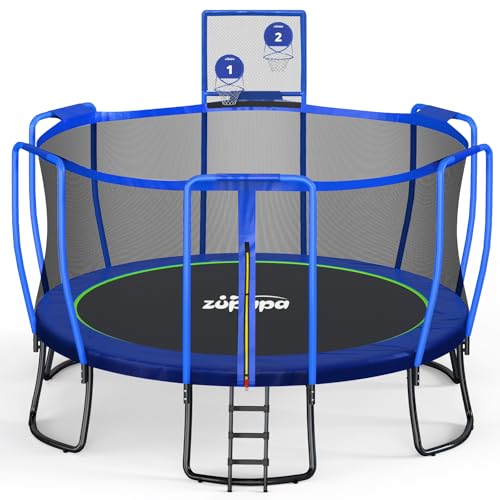
Zupapa 15 FT Trampoline with Enclosure Net
Ninety-six springs and thicker frame tubing push weight capacity to 375 pounds, high for a 15-foot ring. Padding wraps the full spring bed, and the net zips shut from either side for faster entry. Zupapa backs the frame with a multi-year warranty, unusual at this price point.
Pros
- 375-pound capacity ranks high for this size class
- Net zips open from two sides for quick entry
- Multi-year frame warranty included
Cons
- A 15-foot diameter needs a large, clear yard
- Ladder and hoop accessories sell separately

Little Tikes My First Trampoline
A padded center handlebar gives young jumpers something to grip while they find their balance. Its frame sits low to the ground, and mesh netting wraps the entire jumping surface. Little Tikes rates it for ages three and up, younger than most spring-based trampolines allow.
Pros
- Center handlebar helps beginners balance
- Low frame height suits young children
- Full enclosure needs no separate net purchase
Cons
- 150-pound capacity excludes older kids and adults
- Small mat limits how many kids can jump together

Skywalker Trampolines 8-Foot Round Trampoline with Enclosure
An 8-foot frame clears patios and townhouse yards where a 15-foot ring would hit the fence line. Thirty-six springs keep the bounce softer than larger models, matching lighter kids. Steel poles run padded along their full length, supporting the enclosure net.
Pros
- Compact footprint fits small yards and patios
- Softer bounce suits lighter, younger jumpers
- Poles stay padded along their entire height
Cons
- 100-pound capacity rules out older children
- Small mat limits space for more than one child

JumpKing 10-Foot Trampoline with Safety Net Enclosure
Curved enclosure poles lean inward over the mat, so a jumper drifting toward the edge meets net sooner than on a straight-pole design. JumpKing sews the netting to the jump mat rather than the frame, removing a seam where feet can catch. Foam sleeves cover the poles from top to bottom.
Pros
- Inward-curved poles reduce contact with hard frame parts
- Net sewn to the mat removes a common entrapment gap
- Foam padding covers the poles’ full length
Cons
- 10-foot size limits it to one or two jumpers
- Zipper entry needs supervision to seal fully for young kids

SereneLife Foldable Trampoline 36-Inch Mini Trampoline
At 36 inches across, this rebounder fits a playroom or garage without taking over the floor. Its frame folds flat, so it tucks behind furniture between sessions. No enclosure net ships with it, which suits indoor use with an adult nearby.
Pros
- Folds flat for storage between uses
- Compact size suits indoor play spaces
- Padded edge cover guards against spring contact
Cons
- No enclosure net means young kids need direct supervision
- Bounce feels noticeably smaller than a backyard trampoline
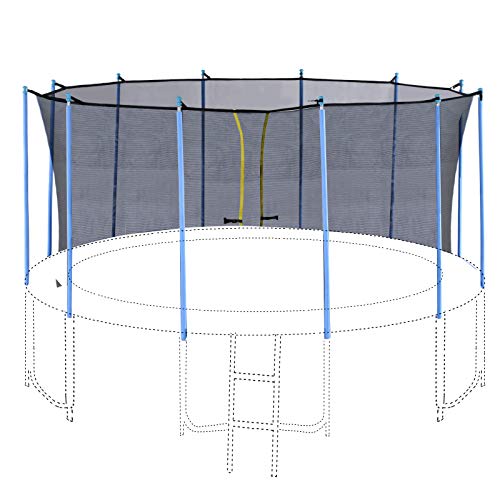
Exacme 15FT Trampoline with Enclosure Net
A full-size 15-foot mat and 96 springs cost less than most competitors in this class. Spring pad covers the entire ring, and an entry ladder ships in the box rather than as an add-on. Owners note the assembly hardware feels basic but workable with two people.
Pros
- Full 15-foot size costs less than most rivals
- Ladder included for younger kids to climb up
- Spring pad covers the entire spring ring
Cons
- Frame tubing feels thinner than premium options
- Assembly instructions get mixed reviews for clarity
What to look for
What makes a trampoline beginner-friendly Beginner trampolines favor predictable bounce over height. Padded poles, sewn or no-gap netting, and moderate spring tension matter more than mat size. New jumpers notice how the frame feels underfoot on the first few bounces, not how high they fly. Softer spring tension, like the 36-spring layout on the Skywalker 8-Foot model, keeps beginners closer to the mat while they learn control.
How much weight capacity do you need Weight capacity applies per jumper, not total household weight. Toddler models such as the Little Tikes My First Trampoline cap out around 150 pounds, enough for one small child. Elementary-age kids need at least 200 pounds of headroom, close to the JumpKing 10-Foot rating. Households with several kids taking turns should look toward 300 to 375 pounds, the range covered by the Exacme and Zupapa models.
Does an enclosure net actually prevent injuries No enclosure stops every fall, but net placement changes how often kids reach the frame. JumpKing sews its net directly to the mat, removing the seam where feet slip through. SkyBound and Zupapa instead bolt netting to the frame, closing a different gap near the pad. Indoor mini trampolines, like the SereneLife model, skip a net entirely and rely on supervision instead.
Sizing a trampoline to your yard Manufacturers list diameter, but clearance needs several extra feet on every side. A 15-foot model such as the Zupapa or Exacme needs nearly 20 feet of open yard once the net goes up. Small yards and patios do better with an 8-foot frame like the Skywalker. Indoor rebounders sidestep the space issue completely, since they fold away between uses.
How they stack up
| # | Model | Diameter | Best for | Score | Price |
|---|---|---|---|---|---|
| 1 | SkyBound Stratos 12-Foot Trampoline with Enclosure | 12 feet | Best overall | 9.4 | Check price |
| 2 | Zupapa 15 FT Trampoline with Enclosure Net | 15 feet | Best value | 9.2 | Check price |
| 3 | Little Tikes My First Trampoline | 7 feet | Best for toddlers | 9.0 | Check price |
| 4 | Skywalker Trampolines 8-Foot Round Trampoline with Enclosure | 8 feet | Best for small backyards | 8.7 | Check price |
| 5 | JumpKing 10-Foot Trampoline with Safety Net Enclosure | 10 feet | Best safety net design | 8.5 | Check price |
| 6 | SereneLife Foldable Trampoline 36-Inch Mini Trampoline | 36 inches | Best for indoor use | 8.2 | Check price |
| 7 | Exacme 15FT Trampoline with Enclosure Net | 15 feet | Best budget | 8.0 | Check price |
Common questions
What age is safe to start on a trampoline?
Most brands set a minimum age near 3 for toddler models with handlebars, like the Little Tikes My First Trampoline. Full-size trampolines with springs generally start at age 6, since younger kids lack the balance to control the bounce.
What size trampoline works best for a small backyard?
An 8- to 10-foot trampoline fits most small to mid-size yards while leaving clearance around the enclosure. Larger 15-foot models need nearly 20 feet of open space once poles and netting go up.
Do beginner trampolines need an enclosure net?
Outdoor spring models should include one; it’s standard for a reason. A net cuts down how often a jumper lands off the mat. Indoor mini trampolines, such as the SereneLife foldable model, typically skip the net and rely on supervision instead.
How much weight can a beginner trampoline hold?
Capacity ranges widely by size, from around 150 pounds on toddler models to 375 pounds on larger 15-foot trampolines like the Zupapa. Check the rating against the heaviest single jumper, not everyone’s combined weight.
Can a trampoline be used indoors?
Yes, but only a mini trampoline built for it, like the SereneLife 36-inch foldable model. Full-size backyard trampolines need outdoor clearance and aren’t designed for indoor floors or ceilings.
How hard is it to assemble a backyard trampoline?
Assembly usually runs one to three hours and goes faster with two people. Spring-based frames require stretching each spring into place, which takes hand strength or a spring tool, included by brands like Zupapa and Exacme.
Is a springless trampoline safer for beginners?
Springless designs use flexible rods instead of metal springs, removing the gap where fingers get pinched. They’re less common in beginner sizes, though worth considering for households with very young children. Most beginner models here still use springs.
How many kids can jump on a trampoline at once?
Most manufacturers recommend one jumper at a time, regardless of trampoline size, since collisions cause most injuries. Weight capacity ratings assume a single jumper, not several kids bouncing together.
Round trampoline vs rectangular: which suits beginners better?
Round trampolines, like all seven models here, funnel a jumper back toward the center, which suits beginners learning control. Rectangular trampolines bounce higher and more evenly across the mat, a feature competitive gymnasts want more than first-time jumpers.
Our pick
SkyBound’s Stratos 12-Foot Trampoline remains the strongest all-around start, thanks to its no-gap netting and 250-pound capacity. Families with a toddler should choose the Little Tikes My First Trampoline instead, since its low frame and handlebar suit smaller kids better. Anyone short on yard space gets more use from the compact Skywalker 8-Foot model than from squeezing a 15-foot ring into a small lot.


