How to Light a Reptile Tank Without Overspending
The Zoo Med ReptiSun 10.0 T5 HO is the best value UVB source because of its strong output and predictable replacement schedule. The Zoo Med Repti Basking Spot Lamp is the cheapest reliable heat source, and Fluker’s ceramic heat emitter covers night warmth without light.
Three products cover most budget reptile setups well: the Zoo Med ReptiSun 10.0 T5 HO tube, the Zoo Med Repti Basking Spot Lamp, and Fluker’s ceramic heat emitter. Together they handle ultraviolet, daytime heat and night time warmth, the full set most enclosures need.
Saving money on reptile lighting most often backfires, since a bulb can look bright while producing almost no usable UVB. We compared stated UVB output, basking temperature at realistic distances, how long each bulb stays effective, and what fixture it needs, so economising lands on the fittings rather than the animal’s health.
The top picks, ranked

Zoo Med ReptiSun 10.0 T5 HO UVB Bulb
High output T5 form spreads strong UVB across a long tube rather than a single hot spot, suiting desert species that bask widely. Keepers report consistent output through a twelve month cycle, which makes replacement planning straightforward.
Pros
- Strong reliable UVB across a wide area
- Predictable output over its service life
- Widely available in several tube lengths
Cons
- Needs a matching T5 HO fixture
- Must be replaced yearly even if still lit
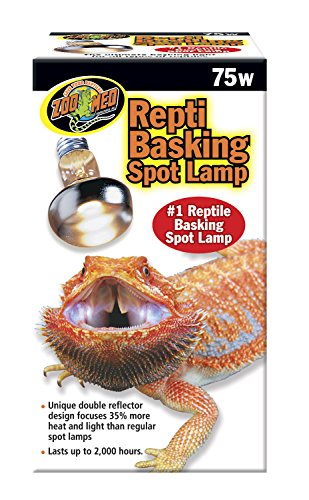
Zoo Med Repti Basking Spot Lamp
Most keepers reach for this tight beam basking bulb, which concentrates heat onto a specific spot so the animal can thermoregulate. Low cost and easy replacement come standard, and enough wattage options exist to dial in a target basking temperature.
Pros
- Very low cost and easy to replace
- Tight beam creates a proper basking spot
- Multiple wattages to tune temperature
Cons
- Produces visible light, so unsuitable at night
- Shorter lifespan than LED alternatives

Fluker’s Ceramic Heat Emitter
Heat with no light at all keeps night time temperature up without disrupting the animal’s day cycle. Service life runs far longer than a bulb, so the higher initial outlay gets recovered over a season or two, and pairing it with a thermostat controls output precisely.
Pros
- Heat without disturbing the day cycle
- Very long service life
- Works well with a thermostat
Cons
- Must be used in a ceramic rated fixture
- Gets extremely hot and needs guarding
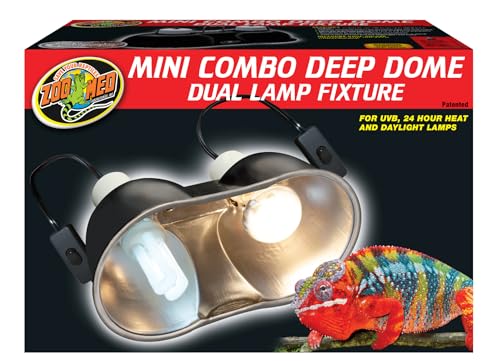
Zoo Med Mini Combo Deep Dome Lamp Fixture
One fixture holding two bulbs runs a basking lamp and a compact UVB bulb from a single unit, cutting clutter above a small enclosure. Depth on the dome shape recesses the hot bulb away from curious animals.
Pros
- Runs two bulbs from one fixture
- Deep dome improves safety and beam control
- Good value for small setups
Cons
- Wattage limit restricts large bulbs
- Compact UVB bulbs cover a small area only

Exo Terra Solar Glo Mercury Vapour Bulb
Heat, visible light and UVB combine in a single fitting, simplifying a setup considerably. Larger enclosures suit it best, where the higher wattage will not overheat the space, and no separate UVB fixture becomes necessary.
Pros
- One bulb covers heat and UVB
- Reduces fixture clutter
- Strong output for tall enclosures
Cons
- Too powerful for small enclosures
- Cannot be used with a dimming thermostat

Fluker’s Repta-Sun Fluorescent Fixture
This straightforward strip fixture holds a linear UVB tube above a screen top without adding much cost. No reflectors or refinements come with it, but it positions a tube correctly over the enclosure, which is the essential job.
Pros
- Low cost way to run a UVB tube
- Available in common enclosure lengths
- Simple with nothing to fail
Cons
- No reflector, so some UVB is wasted upward
- Basic build compared with premium fixtures

Zilla Mini Halogen Bulb
Low wattage delivers a concentrated basking spot, suiting small enclosures where a standard basking lamp would overheat everything. Efficient heat output at that wattage fits compact fixtures used above smaller terrariums.
Pros
- Suits small enclosures without overheating
- Efficient heat output for the wattage
- Inexpensive to replace
Cons
- Too weak for large enclosures
- Produces no UVB at all
How to choose
Why UVB is the one place not to economise Visible brightness tells you nothing about UVB output, and a bulb can keep lighting long after its useful ultraviolet has faded. Without adequate UVB, most diurnal reptiles cannot process calcium and develop metabolic bone disease. Buy a known brand tube such as ReptiSun, note the installation date, and replace on schedule. Save money on the fixture instead.
How do you get basking temperatures right? The goal is a temperature gradient, with a warm basking spot at one end and a cooler retreat at the other. Wattage alone does not set the basking temperature, since distance and enclosure size matter just as much. Measure the actual surface temperature at the basking spot with a probe or infrared thermometer rather than trusting a stick on dial gauge.
What about day cycle, night heat, and thermostats? Reptiles need a proper day and night cycle, so coloured night bulbs that emit visible light are best avoided. A ceramic emitter provides warmth in darkness instead. Running any heat source through a thermostat protects the animal and cuts wasted electricity, making it the single most worthwhile addition to a budget setup.
Does mesh and distance affect where UVB actually lands? A mesh screen top can cut UVB reaching the animal by a large margin, and output falls off quickly with distance. Position the tube over the basking area at the distance the manufacturer specifies for your mesh type. A perfectly good bulb mounted too high delivers almost nothing useful, a common and invisible failure.
How they compare
| # | Model | Type | Best for | Score | Price |
|---|---|---|---|---|---|
| 1 | Zoo Med ReptiSun 10.0 T5 HO UVB Bulb | T5 high output linear UVB tube | Best overall | 9.4 | Check price |
| 2 | Zoo Med Repti Basking Spot Lamp | Incandescent spot basking bulb | Best value heat source | 9.1 | Check price |
| 3 | Fluker’s Ceramic Heat Emitter | Ceramic infrared heat emitter | Best for night heat | 8.9 | Check price |
| 4 | Zoo Med Mini Combo Deep Dome Lamp Fixture | Dual socket dome fixture | Best budget fixture | 8.6 | Check price |
| 5 | Exo Terra Solar Glo Mercury Vapour Bulb | Mercury vapour bulb | Best all in one bulb | 8.4 | Check price |
| 6 | Fluker’s Repta-Sun Fluorescent Fixture | Linear fluorescent strip fixture | Best low cost tube fixture | 8.2 | Check price |
| 7 | Zilla Mini Halogen Bulb | Mini halogen basking bulb | Best for small enclosures | 8.0 | Check price |
Questions worth asking
How often should UVB bulbs be replaced?
Most linear tubes need replacing around every twelve months and compact bulbs sooner, even though they still light. Write the installation date on the bulb so it does not get forgotten.
Do all reptiles need UVB lighting?
Most diurnal species do, including bearded dragons and tortoises. Some nocturnal species such as certain geckos and snakes need much less, though low level UVB is increasingly considered beneficial.
Can a household bulb work for basking?
A regular incandescent bulb produces heat, but the beam pattern is wrong and it provides no UVB. A proper spot basking bulb creates the focused warm area a reptile needs.
Is a mercury vapour bulb better than separate bulbs?
It is simpler and suits larger enclosures, but it cannot be dimmed and is often too powerful for small setups. Separate heat and UVB sources give more control overall.
Do coloured night bulbs disturb reptiles?
Yes, visible light at night interferes with the natural cycle. A ceramic heat emitter provides the same warmth without any light.
Does mesh block UVB from reaching a reptile?
Fine mesh can cut UVB substantially. Follow the manufacturer’s recommended mounting distance for a screened top, or mount the tube inside the enclosure where it is safe to do so.
Is a thermostat necessary on a budget reptile setup?
It is the one accessory worth stretching for. It prevents overheating, protects the animal, and reduces electricity use over time.
How do you know if reptile UVB lighting is still working?
Without a meter it cannot be judged visually, which is why replacement schedules matter. Keepers with several enclosures often buy a UV meter once and use it across all of them.
What is the cheapest way to light a reptile tank properly?
Pairing a linear UVB tube such as the ReptiSun 10.0 with a basic basking spot lamp covers the essentials without a premium fixture. Spending on the bulbs rather than the housing keeps the setup affordable without cutting corners on health.
Our pick
The Zoo Med ReptiSun 10.0 T5 HO is where a budget lighting setup should start, since UVB is the one component that genuinely affects a reptile’s health. Pair it with a Zoo Med Repti Basking Spot Lamp for daytime warmth, and add a Fluker’s ceramic heat emitter if the room drops too cold overnight.


