Which Camp Rug Actually Keeps Sand Out of Your Tent?
For most campers, the CGEAR Sand-Free Multimat wins on mesh that drains sand instead of trapping it. Budget shoppers should check the Prime Pacific Reversible Outdoor Patio Mat. RV owners get a better fit from the RecPro RV Awning Mat, sized for standard awning lengths.
The CGEAR Sand-Free Multimat is the strongest all-around pick for beach and desert campers. Its two-layer mesh lets sand fall through instead of collecting on top. It costs more than a basic woven tarp, so budget campers may want a plainer option instead.
Camp rugs range from woven tarps to RV-length awning mats, and the wrong size leaves sand in a tent or mud tracked across a floor. We compared weave material, sand and mud handling, packed size and dimensions across seven mats sold on Amazon, then weighed owner feedback on durability and cleanup.
The best picks, ranked
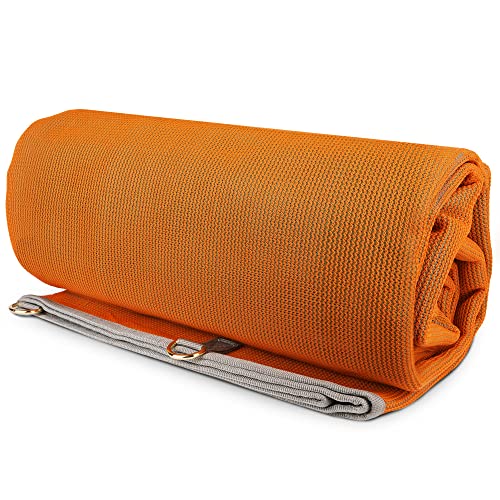
CGEAR Sand-Free Multimat
Two layers of coated polyester mesh let sand and dirt fall through while trapping larger debris on top. Hot beach days feel cooler underfoot than on solid mats, according to owner reports. Corner grommets accept stakes when wind picks up across an open site.
Pros
- Sand falls through instead of collecting on top
- UV-resistant coating on both mesh layers
- Corner grommets hold stakes in wind
Cons
- Costs more than a basic woven tarp
- Rolled storage tube takes more trunk space than a folded mat

Camco Large Reversible Outdoor Mat
Two colorways in one mat let campers flip sides to match a site or hide stains. Woven polypropylene resists mildew and rinses clean with a hose. Corner grommets hold it down in open fields exposed to wind.
Pros
- Reversible design doubles the color options
- Rinses clean with a garden hose
- Covers a full campsite for less than sand-free mesh mats
Cons
- Not sand-proof, so dirt sits on the surface
- Fold lines become permanent creases over time
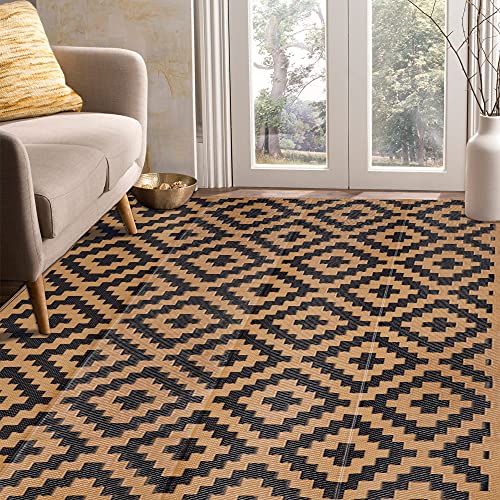
Prime Pacific Reversible Outdoor Patio Mat
A 5×7 ft footprint covers less ground than the 9×12 ft options here, but it costs less overall. Accordion folding keeps it flat and rectangular inside a stuff sack. Tent vestibules and picnic layers suit it better than a full site rug.
Pros
- Lowest price point among mats in this size class
- Light enough to toss in a daypack
- Fits small tent footprints without excess overhang
Cons
- Too small to cover a full car-camping site or RV awning
- Thinner weave shows wear faster under heavy foot traffic

RecPro RV Awning Mat
An 8×20 ft shape matches typical RV awning lengths instead of a square tent pad. That narrow, long footprint covers the strip beneath an awning without extra mat on either side. A carry bag and ratchet straps ship included for storage between stops.
Pros
- Dimensions match common RV awning lengths
- Ratchet strap system speeds up rolling and storage
- Holds up to repeated setup and teardown at RV parks
Cons
- Long, narrow shape wastes material on a square tent site
- Heaviest mat in this roundup at 9 lbs

Ming’s Mark Reversible RV Patio Mat
A 9×18 ft size covers a full car-camping site with room for chairs and a table. Reversible geometric weave hides dirt better than a solid color. Canopy tents at group campouts and tailgates often sit on this mat, per owner reports.
Pros
- Largest single-mat coverage in this lineup
- Patterned weave camouflages dirt between cleanings
- Doubles as a tailgate or group-event mat
Cons
- Bulkier to fold and store than smaller mats
- Needs two people to shake out and reposition easily

WaterHog Indoor/Outdoor Scraper Mat
Scraper fibers pull mud and moisture off boots before they reach a tent floor. Recycled rubber backing keeps the mat from sliding on wet ground. A beveled edge lowers the trip hazard at a tent doorway or RV step.
Pros
- Scrapes and traps mud better than woven mats
- Rubber backing resists sliding on wet grass
- Compact size fits directly at an entry point
Cons
- Coverage area too small to use as a full site rug
- Rubber backing adds weight relative to its size
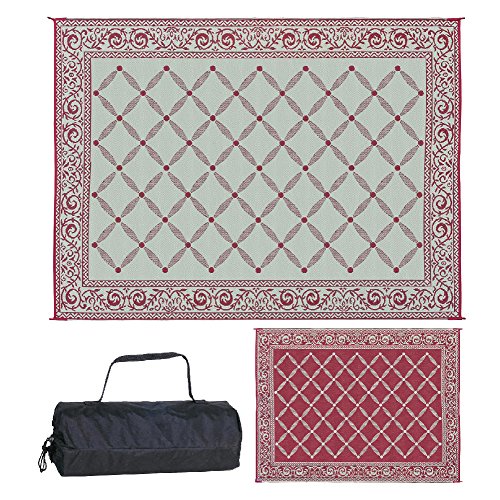
B. Ella Bordeaux Reversible Outdoor Rug
A patterned, boho-style print stands out in a category dominated by solid colors. Recycled plastic weave handles grass stains and light rain the same as plainer mats. Backyard camping, glamping setups and patio use between trips all suit it well.
Pros
- Distinct patterned design compared to solid camp mats
- Recycled plastic construction supports sustainability
- Light enough for one-person setup
Cons
- Patterned dye may fade faster than solid colors under constant sun
- Not offered in the largest awning-length sizes
How to choose
What to look for in a camp rug Most camp rugs use woven polypropylene, a plastic ribbon fabric that resists mildew and wipes clean with a hose. CGEAR swaps that weave for two-layer mesh, letting sand and dirt fall through rather than sitting on top. Weight ranges from about 2 lbs for compact 5×7 ft mats to 9 lbs for 8×20 ft RV awning mats. Grommets at the corners let campers stake a mat down when wind picks up across an open site.
Which mats actually keep sand out? Sand-proof mesh works best on beaches and dry desert sites where loose sand collects fast. Solid woven mats trap sand and dirt on the surface instead, so they need shaking out more often. Polypropylene resists mold and mildew even after sitting damp overnight, which matters on humid coastal trips. Rubber-backed scraper mats like the WaterHog form a third category, built to pull mud off boots rather than cover open ground.
What size mat fits your camping style? Backpackers and small-tent campers do fine with compact mats around 5×7 or 6×9 ft that pack down small. Car campers with canopy tents or larger group sites benefit from 9×12 or 9×18 ft mats that cover chairs, coolers and a table. Ming’s Mark’s 9×18 ft option suits tailgates and multi-family campouts better than a single 6×6 ft square. Packed size matters as much as flat dimensions when trunk space runs tight.
RV awning mats vs tent and entrance mats RV awning mats run long and narrow, often 8×20 ft, matching the footprint under a rolled-out awning instead of a square tent pad. RecPro’s version ships with ratchet straps built for that roll-and-store routine at RV parks. Tent campers are better served by a square or rectangular mat sized to their tent footprint plus a small margin. A separate small scraper mat at the tent door keeps mud from spreading onto sleeping bags.
Side by side
| # | Model | Material | Best for | Score | Price |
|---|---|---|---|---|---|
| 1 | CGEAR Sand-Free Multimat | Two-layer coated polyester mesh | Best overall | 9.4 | Check price |
| 2 | Camco Large Reversible Outdoor Mat | Woven polypropylene | Best value | 9.1 | Check price |
| 3 | Prime Pacific Reversible Outdoor Patio Mat | Woven polypropylene | Best budget | 8.8 | Check price |
| 4 | RecPro RV Awning Mat | Woven polypropylene | Best for RV awning setups | 8.6 | Check price |
| 5 | Ming’s Mark Reversible RV Patio Mat | Woven polypropylene | Best for large groups and car camping | 8.4 | Check price |
| 6 | WaterHog Indoor/Outdoor Scraper Mat | Polypropylene fiber face with recycled rubber backing | Best for muddy tent entrances | 8.2 | Check price |
| 7 | B. Ella Bordeaux Reversible Outdoor Rug | Recycled plastic polypropylene weave | Best for patio-style camp decor | 8.0 | Check price |
Questions worth asking
What is the best material for a camp rug?
Woven polypropylene is the most common choice because it resists mildew and rinses clean with a hose. CGEAR’s Multimat uses a different two-layer mesh that lets grit fall through instead of sitting on the surface.
Are camp rugs sand-proof?
Only mesh-style mats such as the CGEAR Multimat let sand fall through. Standard woven polypropylene mats, including the Camco and Prime Pacific, hold sand on top and need regular shaking out.
What size camp mat do I need for a 10×10 ft tent?
A 9×12 ft mat gives a 10×10 ft tent a small margin on each side without much overhang. Group sites with canopies and tables do better with a 9×18 ft mat like Ming’s Mark’s, which leaves room for extra gear.
Camp rug vs tarp, what is the difference?
A basic tarp is a flat sheet with no woven structure for gripping the ground. Camp rugs use a woven or mesh construction with grommeted corners for staking, and they resist mildew and abrasion better over repeated trips.
Can you use an RV awning mat for tent camping?
An 8×20 ft awning mat like RecPro’s will work under a tent, but its long, narrow shape wastes material on a square footprint. A 9×12 ft square mat fits a typical tent site more efficiently.
How do you clean a camping rug after a muddy trip?
Shake off loose dirt first, then hose down woven polypropylene mats and let them air dry before rolling or folding. Rubber-backed scraper mats like the WaterHog rinse the same way, and a stiff brush clears packed mud from the fibers.
Is a reversible camp mat worth it?
Reversible mats like the Camco and Ming’s Mark give two color options in one purchase. A stained side can face down while the cleaner side faces up, which extends the time between full washes.
Which camp rug is best for beach camping?
The CGEAR Sand-Free Multimat suits beach sites best because its mesh layers let sand drain through instead of piling up. Solid woven mats work at the beach too, but they need more frequent shaking to stay usable.
Do camp rugs work on grass or only sand?
Woven polypropylene mats like Ming’s Mark and B. Ella handle grass, gravel and dirt sites without special features. Sand-proof mesh only offers its main advantage on loose sand or fine dust, so grass campers do not need it.
How much does a camp rug weigh?
Compact 5×7 ft mats like the Prime Pacific weigh about 2 lbs, light enough for a daypack. Full-length RV awning mats such as RecPro’s run closer to 9 lbs once the carry bag and straps are included.
Final word
The CGEAR Sand-Free Multimat remains the strongest pick for anyone camping near sand or loose dirt, since its mesh design skips the shake-out routine solid mats require. RV owners should pass on square mats entirely and choose the RecPro RV Awning Mat, sized to match awning length instead of tent footprint. Campers on a tight budget still get solid coverage from the Prime Pacific Reversible Outdoor Patio Mat, just in a smaller footprint.