Battery Disconnect Switches That Actually Stop Drain
Blue Sea Systems’ 6006 m-Series Mini tops this list for its sealed housing and high continuous amp rating. Ampper’s top post switch offers the easiest value pick for a stored daily driver. Moroso’s 74100 remains the standard choice when a racing organization mandates a cut off switch.
Blue Sea Systems’ 6006 m-Series Mini wins this comparison for corrosion resistance and amp headroom. Ampper’s top post disconnect clamps straight onto a negative terminal for a car that sits over winter. Moroso’s 74100 fits when a racing organization specifies a particular cut off switch.
Battery disconnects look interchangeable in listings but differ enormously in the details. A switch rated below your starter draw runs hot, and a mismatched top post clamp loosens and arcs. We compared published specifications, terminal fitment, and aggregated owner reports, watching for melted knobs, corroded contacts, and switches that stopped isolating after a season outdoors.
How to choose
How do you size a disconnect switch to your engine? The number that matters is momentary cranking current, which reaches several hundred amps on a gas engine and more on a diesel. A switch rated at 100 continuous amps suits accessory loads but heats and pits its contacts under repeated cranking. Look for a continuous rating comfortably above normal load and an intermittent rating that covers cranking. A rating quoted without a duration means little on its own.
Should the switch go on the positive or negative terminal? Negative side disconnects are the safer default, since isolating the chassis ground means a dropped wrench touching bodywork cannot complete a circuit. Racing and marine applications sometimes require positive side switches by regulation or system design, and they work fine when installed carefully. Avoid fitting switches on both sides, which adds resistance and complexity without adding safety.
Clamp on or panel mount: which fits your situation? A top post clamp switch fits in minutes with no cable modification, suiting a vehicle that sits in storage. A panel mount switch needs cable cutting and crimped lugs, but it handles higher current, seals better, and can sit somewhere reachable without opening the hood. Weekly use justifies the panel mount effort. Twice a year use makes the clamp switch the easier call.
What happens to your car’s memory when you disconnect it? Cutting power wipes volatile memory on many vehicles, resetting the clock and radio presets. Some cars need a relearn cycle for idle, one touch windows, and steering angle sensors, and a few require a security code for the audio system. Modern vehicles with complex body control modules can behave oddly for a short drive afterward. Check the handbook before isolating a newer car often, and consider a memory saver if resets become a nuisance.
What we recommend

Blue Sea Systems 6006 m-Series Mini Battery Switch
Blue Sea builds this for marine service, with a sealed housing, tinned copper studs, and an ignition protected design that shrugs off damp engine bays. A positive detent on the knob removes any doubt about circuit state. Owners report it handles daily switching without the contact wear that plagues cheaper rotary units.
Pros
- Sealed construction resists moisture and salt air
- High continuous amp rating for its size
- Positive detent confirms switch state instantly
Cons
- Needs cable lugs and a mounting location
- Costs more than a clamp on terminal switch

Ampper Top Post Battery Disconnect Switch
Ampper’s switch clamps directly onto a standard top post terminal, skipping cable cutting, lugs, and panel drilling entirely. A quarter turn of the knob isolates the battery, ideal for a car, motorhome, or boat parked for weeks. Owners report the brass construction holds up well when the knob stays finger tight rather than forced.
Pros
- Installs in minutes with no cutting required
- Operates easily with one hand
- Fits the majority of standard top post batteries
Cons
- Added height can foul a tight battery box lid
- Does not suit side post batteries
WirthCo 20500 Battery Doctor Top Post Battery Disconnect
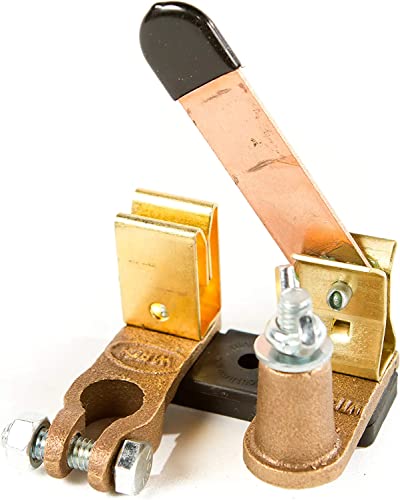
WirthCo’s Battery Doctor has served RV and stored vehicle owners for years, using a knife style blade that swings clear rather than a rotating knob. That mechanism shows isolation state at a glance, which owners appreciate when checking a stored vehicle. Build quality stays basic, but the simple mechanism leaves little to fail.
Pros
- Isolation state is visible at a glance
- Simple mechanism limits failure points
- Lowest cost route to a proper disconnect
Cons
- Lever can get knocked closed by accident
- Plastic components feel basic
Moroso 74100 Battery Disconnect Switch
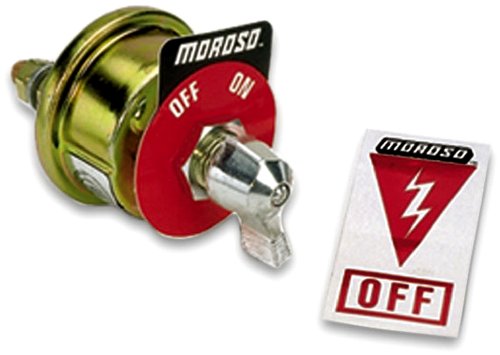
Moroso built this to satisfy cut off switch requirements many racing organizations impose, using a heavy duty rotary mechanism with a removable key. Large gauge cable fits the studs, which matters for a trunk mounted battery. Based on specifications, it is overbuilt for a road car, which explains why it survives track use.
Pros
- Meets common racing cut off requirements
- Removable key prevents accidental reconnection
- Handles large gauge relocation cable
Cons
- Bulky for a standard engine bay
- Needs proper panel mounting and lugs

Perko 8501DP Battery Selector Switch
Perko’s selector switches between battery one, battery two, both, or off, the standard setup for a boat running a starting battery alongside a house bank. An ignition protected housing suits enclosed engine compartments. Owners report long service life, though the make before break behavior needs understanding before switching underway.
Pros
- Manages two batteries from a single control
- Ignition protected housing suits enclosed spaces
- Long track record with wide support
Cons
- More switch than a single battery car needs
- Switching under load requires care

Blue Sea Systems 9003e m-Series Dual Circuit Plus
Blue Sea packs two switched circuits into one body here, letting a starting battery and a house battery isolate independently, with a combine position for charging both. Van conversions favor this setup to keep the leisure system separate from the vehicle starting circuit. Owners report clean, well documented installation that still demands planning.
Pros
- Separates starting and house circuits cleanly
- Combine position simplifies charging both banks
- Shares the sealed build of the smaller m-Series
Cons
- Overkill for a single battery vehicle
- Wiring plan needs thought before installing
Sea Dog 422700-1 Battery Disconnect Switch
Sea Dog keeps this switch deliberately simple: a rotary on and off isolator with stud terminals and a marine grade housing at a friendlier cost than premium brands. Trailers, small boats, and workshop bench supplies suit this kind of straightforward isolator. Owners report it works best as an occasional use switch rather than a daily one.
Pros
- Simple to understand and install
- Marine grade housing at a lower cost
- Compact footprint for tight panels
Cons
- Lower amp headroom than premium rivals
- Better suited to occasional than daily use
The lineup, side by side
| # | Model | Type | Best for | Score | Price |
|---|---|---|---|---|---|
| 1 | Blue Sea Systems 6006 m-Series Mini Battery Switch | Panel mount rotary switch | Best overall | 9.4 | Check price |
| 2 | Ampper Top Post Battery Disconnect Switch | Top post terminal clamp switch | Best value | 9.2 | Check price |
| 3 | WirthCo 20500 Battery Doctor Top Post Battery Disconnect | Top post knife style disconnect | Best budget | 9.0 | Check price |
| 4 | Moroso 74100 Battery Disconnect Switch | Heavy duty rotary cut off | Best for motorsport | 8.8 | Check price |
| 5 | Perko 8501DP Battery Selector Switch | Four position battery selector | Best for dual battery boats | 8.6 | Check price |
| 6 | Blue Sea Systems 9003e m-Series Dual Circuit Plus | Dual circuit rotary switch | Best for camper and van builds | 8.3 | Check price |
| 7 | Sea Dog 422700-1 Battery Disconnect Switch | Panel mount on and off isolator | Best simple panel mount | 8.0 | Check price |
Common questions
Should a battery disconnect go on the positive or negative terminal?
Negative is the safer default for most vehicles, since it isolates the chassis ground and keeps accidental tool contact with bodywork from completing a circuit. Positive side switches show up in racing and marine setups where regulations or layout require them. Fitting one on either side matters more than which side you choose.
Will a disconnect switch stop parasitic drain completely?
A properly rated switch in the open position breaks the circuit, so the alarm, clock, body control module, and other standby loads stop drawing power. Residual self discharge inside the battery itself continues regardless. A battery left for many months still benefits from a maintainer even with the switch fitted.
Can I leave a disconnect switch fitted permanently?
Yes, provided it is rated for your cranking current and installed with clean, tight, properly sized connections. Owner reported failures almost always trace back to an undersized switch, a loose clamp, or terminal corrosion rather than the switch simply wearing out.
What do I lose when I disconnect my car battery?
Expect to lose the clock, radio presets, and trip computer data. Some vehicles need a relearn cycle for idle and window settings, and a few require an audio security code. Check the handbook first, and plug a memory saver into the diagnostic port if resets would be inconvenient.
Is a battery disconnect switch a theft deterrent?
It helps, particularly a key operated switch mounted out of sight, but it is no substitute for a proper immobilizer. Treat it as one more obstacle rather than real security, since a determined thief with time under the hood can bypass the switch.
Do I still need a battery maintainer if I install a disconnect?
Yes, for storage beyond a couple of months. The disconnect stops the vehicle from draining the battery, but lead acid batteries self discharge on their own and sulfate when left at partial charge. A maintainer keeps the battery healthy in a way isolation alone cannot.
Will a top post disconnect switch fit my battery?
Most fit standard SAE top post terminals, covering the majority of cars and light trucks. Side post batteries and the smaller Japanese post standard need an adapter. Check both post type and battery box lid clearance before ordering, since these switches add height.
Can I switch a battery disconnect while the engine is running?
Avoid it. Interrupting the circuit while the alternator charges can spike voltage and damage sensitive electronics. Switch only with the engine and ignition off, and learn the make before break behavior on multi position marine selectors before changing positions underway.
Car battery disconnect vs battery maintainer: do I need both?
A disconnect switch stops parasitic drain from the vehicle’s electronics during storage. A maintainer counters the battery’s own internal self discharge, which continues regardless of any switch. Long term storage benefits from running both together rather than picking one.
Our take
Blue Sea Systems’ 6006 m-Series Mini suits anyone wanting a sealed, properly rated switch built for years of regular use. Ampper’s top post clamp handles winter isolation in minutes with no cable work. Moroso’s 74100 answers the call whenever a racing organization dictates the requirement.