Ceiling Fans That Move Real Air Without the Rattle
The Hunter Dempsey 52 Inch is our top ceiling fan for its quiet DC-style performance and low profile mount. The Minka-Aire Light Wave F844-DK wins on looks and smooth air, while the Honeywell Carmel 48 Inch gives most of the airflow for a much smaller outlay.
The Hunter Dempsey 52 Inch is the ceiling fan we would hang in most rooms, with the Minka-Aire Light Wave F844-DK for spaces where the fan is part of the decor and the Honeywell Carmel 48 Inch as the value choice. Each moves enough air for a normal bedroom or living room without dominating the ceiling.
Picking is harder than it looks because the number that matters, airflow in cubic feet per minute, is rarely the number on the box. Blade span, motor type, ceiling height and downrod length all change the result. We ranked these on published CFM and efficiency figures, motor type, mount style and what owners report about wobble and hum after a year.
The best picks, ranked

Hunter Fan Company Dempsey 52 Inch Low Profile Ceiling Fan
The Dempsey is Hunter’s most recommended all-rounder because it clears low ceilings in a flush mount version while still swinging a full 52 inch blade span. The WhisperWind motor is the part owners praise most, with very few reports of hum at low speed. It ships with a remote and a dimmable LED light kit on most finishes.
Pros
- Genuinely quiet across the speed range
- Flush version suits eight foot ceilings
- Wide choice of finishes
Cons
- Light output is modest for a large room
- Flush mount slightly reduces airflow

Minka-Aire F844-DK Light Wave 52 Inch Ceiling Fan
The Light Wave uses three curved, sculpted blades and a DC motor, a combination that looks like an art piece and draws far less power than a comparable AC fan. Six speeds and a reverse function come through the supplied remote. Owners report a smooth, broad air column rather than the choppy feel some three-blade fans give.
Pros
- Low power draw from the DC motor
- Distinctive sculpted blade profile
- Six speeds give fine control
Cons
- Downrod mount only, not flush
- Three blades move less air than five at equal speed

Honeywell Ceiling Fans Carmel 48 Inch Ceiling Fan
The Carmel ships with both a downrod and a flush mount adapter, plus reversible blade finishes, so one purchase covers a lot of room types. A 48 inch span suits bedrooms and offices better than a 52 inch fan that overhangs the bed. Based on specifications it hits a strong airflow figure for its class and includes a three-speed remote.
Pros
- Both mount styles in the box
- Reversible blade finishes
- Good airflow for the size and outlay
Cons
- Remote receiver space is tight in shallow boxes
- Only three speeds

Big Ass Fans Haiku L 52 Inch Ceiling Fan
The Haiku L is built around an efficient DC motor and airfoil blades, and it is the quietest fan in this group by owner accounts, often inaudible at low speed. It offers a whoosh mode that varies speed slightly to mimic a natural breeze. The trade is a much higher outlay than mainstream fans of the same span.
Pros
- Lowest reported noise of any pick here
- Very low energy draw
- Whoosh mode feels more natural than fixed speed
Cons
- Highest outlay in the group
- Light module is not included on all versions

Westinghouse Lighting Comet 52 Inch Ceiling Fan
The Comet is a traditional five-blade fan with a pull chain, a reversible motor and a frosted glass light bowl, and it costs less than almost anything else with a full 52 inch span. It uses a pull chain rather than a remote, which some owners actually prefer on a rarely-adjusted fan. Reversible blade finishes let it fit two decor schemes.
Pros
- Lowest outlay for a full-size fan
- Uses replaceable standard bulbs
- Handles sloped ceilings
Cons
- No remote included
- Heavier and louder than DC motor picks

Prominence Home Alvina 42 Inch Ceiling Fan
At 42 inches the Alvina fits bedrooms, nurseries, home offices and laundry rooms where a 52 inch blade would crowd the walls. It comes with a flush mount option and a small LED light bowl, so it works on a standard eight foot ceiling without ducking. Owners report easy assembly and a quiet run at the lower two speeds.
Pros
- Fits rooms under about 150 square feet
- Clears low ceilings easily
- Simple assembly reported by owners
Cons
- Small span limits airflow in bigger rooms
- Pull chain only unless you add a wall control
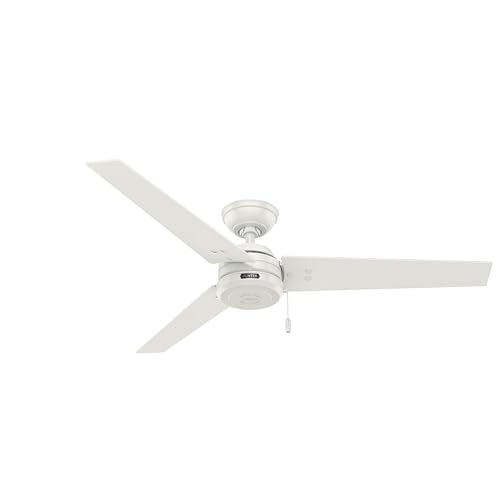
Hunter Fan Company Cassius 52 Inch Outdoor Ceiling Fan
The Cassius is damp rated, meaning it is built for covered porches, sunrooms and patios where humidity and splashback are normal. Plastic blades resist warping in a way that wooden indoor blades will not. It uses a pull chain by default, though Hunter sells a matching remote kit separately.
Pros
- Built for humid covered spaces
- Warp-resistant plastic blades
- Reversible for winter circulation
Cons
- Not rated for fully exposed locations
- Remote is a separate purchase
The lineup, side by side
| # | Model | Blade span | Best for | Score | Price |
|---|---|---|---|---|---|
| 1 | Hunter Fan Company Dempsey 52 Inch Low Profile Ceiling Fan | 52 inches | Best overall | 9.4 | Check price |
| 2 | Minka-Aire F844-DK Light Wave 52 Inch Ceiling Fan | 52 inches | Best for design-led rooms | 9.2 | Check price |
| 3 | Honeywell Ceiling Fans Carmel 48 Inch Ceiling Fan | 48 inches | Best value | 9.0 | Check price |
| 4 | Big Ass Fans Haiku L 52 Inch Ceiling Fan | 52 inches | Best for quiet efficiency | 8.8 | Check price |
| 5 | Westinghouse Lighting Comet 52 Inch Ceiling Fan | 52 inches | Best budget | 8.6 | Check price |
| 6 | Prominence Home Alvina 42 Inch Ceiling Fan | 42 inches | Best for small rooms | 8.3 | Check price |
| 7 | Hunter Fan Company Cassius 52 Inch Outdoor Ceiling Fan | 52 inches | Best for porches and patios | 8.0 | Check price |
How to choose
Match blade span to room size, not ceiling size The usual guidance is a 29 to 36 inch fan for rooms under about 75 square feet, 42 to 48 inches up to roughly 175 square feet, and 52 inches or more beyond that. Oversizing a fan in a small bedroom does not help, because you end up running it on the lowest speed to avoid a gale over the bed.
Read the CFM figure, then read the efficiency figure Cubic feet per minute tells you how much air a fan moves at high speed. Divided by watts, it tells you how efficiently it does that. A DC motor fan such as the Minka-Aire Light Wave or the Haiku L usually wins the second number by a wide margin, which matters if the fan runs for months at a time in a warm climate.
Get the mounting height right or nothing else matters Blades should sit at least seven feet above the floor and about eight to ten inches below the ceiling for good circulation. On a standard eight foot ceiling that means a flush or hugger mount, which is why the Dempsey and the Alvina appear here. On nine foot ceilings and up, a downrod actually improves airflow rather than hurting it.
Wobble is almost always installation, not the fan Owners report wobble far more often than motor failure, and the usual causes are a loose canopy screw, an electrical box that is not fan-rated, or blades installed in the wrong order. Use a brace box rated for fan support, tighten every blade screw, and if wobble persists, use the balancing kit that ships with most fans before assuming a defect.
Frequently asked questions
Which way should a ceiling fan turn in summer?
Counterclockwise when viewed from below. That pushes air straight down and creates the wind chill effect that makes a room feel cooler. In winter, reverse it to clockwise on a low speed so warm air near the ceiling is drawn up the walls and back down without a draught.
Does a ceiling fan actually lower room temperature?
No. A fan cools people, not air, by speeding up evaporation from your skin. That is why leaving one running in an empty room wastes energy. The upside is that the perceived cooling lets you raise a thermostat setting by a few degrees without discomfort.
Is a DC motor fan worth the extra cost?
If the fan runs many hours a day, usually yes. DC motors typically draw a fraction of the power of a comparable AC motor, run quieter and offer more speed steps. For a guest room fan used a few weeks a year, a conventional AC fan like the Westinghouse Comet makes more sense.
Can I put an indoor ceiling fan on a covered porch?
You should not. Indoor fans use materials and motor housings that corrode in humidity, and doing so voids most warranties. Use a damp rated fan such as the Hunter Cassius for covered areas, and a wet rated fan for anywhere exposed to direct rain or spray.
Do I need an electrician to install one?
Not always, but the electrical box is the deciding factor. A standard lighting box cannot carry a fan’s weight and vibration. If a fan-rated brace box is already in place and you are comfortable working with the power off at the breaker, this is a manageable job. If not, hire it out.
How many blades is best?
Blade count matters less than motor quality and blade pitch. Five-blade fans tend to feel smoother at low speed, three-blade fans usually spin faster and look cleaner. Any well-made fan with a 12 to 15 degree blade pitch will move air properly regardless of count.
Why is my new fan humming?
Hum usually traces to a dimmer switch on the fan circuit, a loose canopy, or a remote receiver vibrating in the housing. Never run a ceiling fan motor from a light dimmer. If the fan came with a wall control, use that rather than a general purpose dimmer.
Can I add a remote to a pull chain fan?
Often yes. Universal ceiling fan remote kits fit inside the canopy of most fans that have enough space above the motor housing. Check the canopy clearance first, and confirm the kit is rated for the fan’s wattage including the light kit before ordering.
Our pick
The Hunter Dempsey 52 Inch is the fan that suits the widest range of rooms, especially on standard eight foot ceilings where its flush mount version earns its place. Step up to the Minka-Aire Light Wave for a design statement with lower power draw, or the Big Ass Fans Haiku L if silence is the priority. On a tight budget, the Westinghouse Comet still moves plenty of air.


