Wood Screws for Framing, Decks and Cabinet Joinery
GRK R4 Multi-Purpose Screws are our overall pick for framing and general construction, Hillman Power Pro exterior screws are the best value for decks and outdoor projects, and Kreg Blue-Kote pocket hole screws are the correct choice for cabinet joinery.
For general construction the GRK R4 is the wood screw worth standardising on, because the thread and head geometry lets it sink without pre drilling in most softwoods. Hillman Power Pro exterior screws cover decks and outdoor framing at a lower cost per box, and Kreg Blue-Kote screws are purpose built for pocket hole joinery.
Wood screws are sold by length and count, which hides the details that matter, namely thread pitch, head shape, drive recess and coating. We compared published specifications, corrosion ratings and what builders report about cam out, snapping and splitting, then ranked seven ranges that cover framing, outdoor work and cabinetry.
How to choose
Choose the drive type before the brand Star and square recesses grip a bit far better than Phillips, which cams out and chews the head under real torque. Once you commit to a drive type you also commit to bits, so standardising across your fasteners means fewer bit changes and fewer stripped screws on the job.
Coating has to match the lumber and the exposure Modern pressure treatment is corrosive to plain steel, so outdoor screws need a rated exterior coating at minimum. For coastal air, permanent damp or cedar and redwood where staining shows, stainless is the safer answer even though it costs more and drives a little softer.
Thread design decides splitting and pull down Coarse threads bite quickly in softwood, fine threads suit hardwood and plywood edges, and partially threaded screws pull two boards tightly together because the smooth shank slides through the top piece. Fully threaded screws hold but can leave a gap between the boards.
Length rule of thumb for joining boards Aim for roughly two thirds of the screw length in the receiving piece. Going too short gives weak withdrawal strength, and going too long risks breaking through the far face. When joining thick timbers, structural screws in long lengths are safer than stacking shorter fasteners.
Our top picks

GRK R4 Multi-Purpose Framing and Decking Screws
The R4 combines a cutting point, a shank with reaming ribs and a countersinking head, which together let it drive flush into most softwoods without a pilot hole. The star drive resists cam out even under high torque. Builders report far fewer snapped screws than with generic construction screws.
Pros
- Drives without pre drilling in most softwood
- Star drive almost eliminates cam out
- Countersinks cleanly under the head
Cons
- Higher cost per screw
- Star bits wear and need replacing

Hillman Power Pro Premium Exterior Wood Screws
Exterior coated screws with a sharp point and a star drive, sold in bulk counts that make deck and fence work affordable. The coating is rated for treated lumber, which matters because modern treatments corrode uncoated fasteners quickly. A reliable everyday outdoor screw.
Pros
- Good value in bulk boxes
- Suitable for treated lumber
- Star drive holds the bit well
Cons
- Occasional pre drilling needed in hardwood
- Coating scratches at the head under a driver
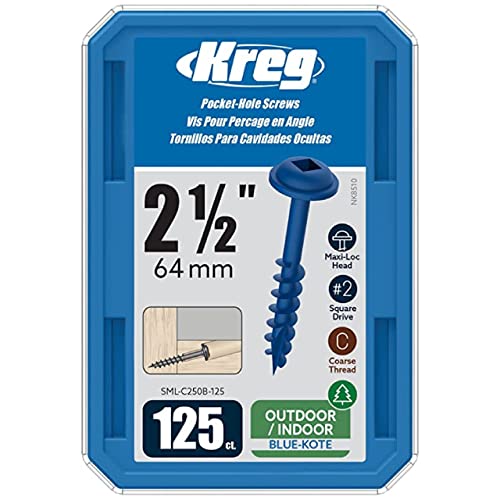
Kreg Blue-Kote Pocket-Hole Screws
Designed specifically for pocket hole joints, with a flat washer head that seats correctly in the pocket and a self tapping tip. The Blue-Kote coating adds corrosion resistance for outdoor furniture. Using the correct screw here is the difference between a tight joint and a split rail.
Pros
- Correct head geometry for pocket joints
- Self tapping tip reduces splitting
- Coating suits outdoor furniture
Cons
- Only useful for pocket hole work
- Square drive bits are less common than star

Spax PowerLags Lag Screws
Heavy gauge screws that replace traditional lag bolts without a pilot hole or a wrench, driving instead with an impact driver. They suit ledgers, posts and beam connections where holding power matters. The washer head seats firmly without crushing surrounding fibre.
Pros
- No pilot hole or wrench required
- High withdrawal strength
- Faster than traditional lag bolts
Cons
- Needs a strong impact driver
- Expensive for general purpose use

FastenMaster TimberLOK Heavy Duty Wood Screws
Available in long lengths for tying together thick members such as headers, rafters and landscape timbers, with a coating designed for exterior exposure. They drive with an impact driver and no pre drilling. Common in deck framing where a fastener must reach through several inches of material.
Pros
- Reaches through thick assemblies
- Drives without pre drilling
- Exterior coating for outdoor framing
Cons
- Hex heads sit proud of the surface
- Costly per fastener

SNUG Fasteners Stainless Steel Wood Screws
Stainless screws for coastal, wet or exposed installations where coated carbon steel eventually fails. They are softer than hardened screws, so pre drilling in dense material prevents twisting off. Sold in useful counts for repairs and mid sized outdoor projects.
Pros
- Best long term corrosion resistance
- No coating to scratch off
- Suits cedar and redwood without staining
Cons
- Softer than hardened steel screws
- Pre drilling advised in hardwood

Simpson Strong-Tie Strong-Drive SD Connector Screws
Screws engineered and load rated for use in metal framing connectors such as hangers and straps, where ordinary wood screws are not an approved substitute. The head is sized for connector holes. If a plan or inspector specifies connector screws, these are what is meant.
Pros
- Correct rated fastener for connectors
- Head fits connector holes properly
- Avoids substitution problems at inspection
Cons
- Not a general purpose wood screw
- Limited length range
Side by side
| # | Model | Drive | Best for | Score | Price |
|---|---|---|---|---|---|
| 1 | GRK R4 Multi-Purpose Framing and Decking Screws | Star recess | Best overall | 9.4 | Check price |
| 2 | Hillman Power Pro Premium Exterior Wood Screws | Star recess | Best value | 9.2 | Check price |
| 3 | Kreg Blue-Kote Pocket-Hole Screws | Washer head for pocket holes | Best for cabinet joinery | 9.0 | Check price |
| 4 | Spax PowerLags Lag Screws | Structural lag screw | Best for heavy timber | 8.8 | Check price |
| 5 | FastenMaster TimberLOK Heavy Duty Wood Screws | Long structural lengths | Best for long spans | 8.6 | Check price |
| 6 | SNUG Fasteners Stainless Steel Wood Screws | Stainless steel | Best for corrosion resistance | 8.3 | Check price |
| 7 | Simpson Strong-Tie Strong-Drive SD Connector Screws | Metal connectors, hangers and straps | Best for metal connectors | 8.0 | Check price |
Questions worth asking
Do I need to pre drill for wood screws?
Modern construction screws with cutting points usually sink into softwood without a pilot hole. Pre drilling is still worthwhile near board ends, in hardwoods and with stainless screws, since those are the conditions where splitting and snapping actually happen.
What is the difference between a wood screw and a deck screw?
Deck screws are wood screws with corrosion resistant coatings, and often a thread pattern designed to pull boards down tightly. The mechanical idea is the same, but an uncoated interior screw used outdoors in treated lumber will corrode within a season or two.
Can I use drywall screws for woodworking?
It is a common shortcut and a poor one. Drywall screws are hardened and brittle, so they snap under lateral load and have almost no withdrawal strength in wood. Construction screws cost slightly more and behave completely differently under stress.
Why do my screws keep snapping?
Usually because the material is dense and there is no pilot hole, or because the screw is being driven with too much impact torque. Stainless and long thin screws are the most vulnerable. A pilot hole and a lower driver setting solve most cases.
Are star drive screws better than Phillips?
For anything structural, yes. A star recess transfers far more torque before slipping, which means fewer stripped heads and less bit wear. Phillips remains fine for light interior work where the driving torque is low.
Which screws should I use with treated lumber?
Use screws explicitly rated for treated lumber, either with an approved exterior coating or in stainless steel. The copper based preservatives in modern treatment corrode ordinary zinc plated screws quickly, especially in ground contact applications.
What screws work for pocket hole joinery?
Pocket hole specific screws with a flat washer head, since the head must seat squarely at the bottom of the pocket. Coarse thread for softwood and plywood, fine thread for hardwood. A standard countersunk screw will not seat correctly and can split the workpiece.
Can I mix stainless screws with other metals?
Stainless in direct contact with plain steel connectors or flashing can accelerate galvanic corrosion in wet conditions. Where a connector is specified, use the fastener the connector manufacturer lists rather than substituting a different metal.
Final word
GRK R4 screws are the ones to keep on the truck for general construction, since they drive clean without pre drilling and rarely snap. Use Hillman Power Pro for deck and fence work where volume matters, and switch to Kreg Blue-Kote for pocket hole joinery, where head geometry rather than strength is the deciding factor.


