Digital Multimeters for Electricians and DIY Repairs
The Fluke 117 is our top digital multimeter for electrical work, with non-contact voltage detection and a CAT III rating built for live panels. The Klein Tools MM600 covers most of the same ground for less, while the AstroAI TRMS meter is the sensible budget choice for light DIY.
The Fluke 117 is the digital multimeter we would recommend to anyone working on mains wiring, with the Klein Tools MM600 as the value alternative and the AstroAI TRMS meter for occasional household use. All three read true RMS, which matters as soon as you measure anything running from a modern electronic supply.
Choosing gets confusing because the numbers people compare, count and accuracy, are rarely the ones that matter. Safety category rating decides whether a meter survives a transient spike on a live panel, and lead quality decides whether you do. We ranked these on CAT rating and voltage limits, true RMS capability, function set, display readability and what owners report about lead durability over years.
The best picks, ranked

Fluke 117 Electricians True RMS Multimeter
The 117 is the meter you see on more electricians’ belts than any other, because it combines true RMS accuracy with VoltAlert non-contact voltage detection and a low input impedance mode that filters out ghost voltages. The compact body fits a pouch and the backlit display reads well in a dark panel. Owners report the leads and body survive years of daily site use.
Pros
- Non-contact voltage detection built in
- LoZ mode eliminates false ghost readings
- Proven durability in daily professional use
Cons
- Higher outlay than most DIY meters
- No temperature measurement function

Klein Tools MM600 Auto-Ranging Digital Multimeter
The MM600 covers CAT III at 1000V and CAT IV at 600V, a higher rating than the Fluke 117, and adds temperature measurement with a bead probe and a duty cycle function. Auto-ranging keeps it quick to use, and the display counts to 6000. Based on specifications it delivers most of a professional meter’s capability at a substantially lower outlay.
Pros
- Higher safety rating than premium rivals
- Temperature probe included
- Auto-ranging speeds up routine checks
Cons
- No non-contact voltage detection
- Bulkier than the Fluke 117

Fluke 87V Industrial True RMS Multimeter
The 87V is the reference instrument for industrial and motor work, with 4.5 digit resolution, a low pass filter for variable frequency drive measurements and CAT IV 600V safety. Its accuracy specification is tighter than anything else in this group. It is a serious investment, so it makes sense for people who calibrate, commission or troubleshoot for a living rather than for occasional use.
Pros
- Best accuracy specification in the group
- Low pass filter handles drive outputs correctly
- Highest safety category rating
Cons
- Largest outlay by a wide margin
- More meter than most DIY users need

AstroAI TRMS 6000 Counts Digital Multimeter
AstroAI’s true RMS meter is remarkable for including a feature set that used to sit well above this bracket, covering voltage, current, capacitance, frequency, duty cycle, temperature and diode testing. It is CAT III 600V rated, which covers household distribution boards. Owners report the supplied leads are the weakest part and are worth replacing if you use it often.
Pros
- True RMS at a very low outlay
- Broad function set including temperature
- Auto-ranging with a clear backlit display
Cons
- Supplied leads are thin and worth upgrading
- Build will not survive daily site abuse
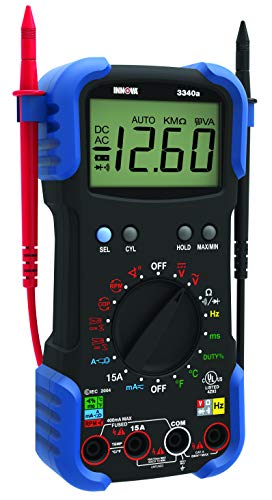
INNOVA 3340 Automotive Digital Multimeter
The 3340 is built around automotive diagnosis rather than mains electrics, adding engine RPM, dwell angle and a temperature probe alongside standard electrical functions. An inductive pickup clamps around a plug wire so you can read engine speed directly. Owners report it is the meter that stays in the garage while a general purpose meter lives in the house.
Pros
- Reads engine RPM and dwell directly
- Comes with the leads and clips car work needs
- Rugged corner protection
Cons
- Automotive focus limits mains usefulness
- Not true RMS

Extech EX330 Autoranging Mini Multimeter
The EX330 packs voltage, current, resistance, capacitance, frequency, temperature and a built-in non-contact voltage detector into a body small enough for a shirt pocket. That combination makes it the meter people carry when they do not want to carry a meter. Based on specifications it is CAT III 600V rated, so it handles household electrical work safely.
Pros
- Genuinely pocketable
- Non-contact voltage detection included
- Wide function set for the size
Cons
- Small display is harder to read at distance
- Not true RMS

KAIWEETS HT118A Digital Multimeter
The HT118A is aimed squarely at householders and hobbyists, with auto-ranging, a large backlit display, a kickstand and a clear function dial that does not require a manual to interpret. It measures voltage, current, resistance, capacitance, frequency and temperature and includes a live wire test. It is a sensible first meter for anyone learning, without being disposable.
Pros
- Very easy to pick up and use
- Large, well-lit display
- Case and leads included
Cons
- Accuracy specification trails professional meters
- Dial detents feel loose over time
The lineup, side by side
| # | Model | Safety rating | Best for | Score | Price |
|---|---|---|---|---|---|
| 1 | Fluke 117 Electricians True RMS Multimeter | CAT III 600V | Best overall | 9.4 | Check price |
| 2 | Klein Tools MM600 Auto-Ranging Digital Multimeter | CAT III 1000V and CAT IV 600V | Best value | 9.2 | Check price |
| 3 | Fluke 87V Industrial True RMS Multimeter | CAT IV 600V and CAT III 1000V | Best for professionals | 9.0 | Check price |
| 4 | AstroAI TRMS 6000 Counts Digital Multimeter | CAT III 600V | Best budget | 8.8 | Check price |
| 5 | INNOVA 3340 Automotive Digital Multimeter | Automotive diagnosis | Best for car work | 8.6 | Check price |
| 6 | Extech EX330 Autoranging Mini Multimeter | CAT III 600V | Best compact meter | 8.3 | Check price |
| 7 | KAIWEETS HT118A Digital Multimeter | CAT III 600V | Best for home DIY | 8.0 | Check price |
How to choose
Safety category rating comes before every other spec CAT ratings describe how much transient energy a meter can absorb without failing dangerously. CAT II covers appliances and outlets, CAT III covers distribution panels and fixed installations, CAT IV covers service entrances and outdoor supply. Buy for the highest environment you will ever work in, and check the voltage figure alongside the category, since CAT III 600V and CAT III 1000V are not equivalent.
True RMS is not marketing An averaging meter assumes a clean sine wave. Modern homes are full of loads that are anything but, including LED drivers, variable speed motors, inverters and switching supplies. Measuring those with an averaging meter gives readings that can be well off. Every serious pick here reads true RMS, and it is the first spec to check on any meter you plan to keep.
The leads matter as much as the meter Owners report that supplied leads are the first thing to fail on budget meters, and a cracked lead near the probe is a genuine hazard on live work. Look for silicone insulated leads with shrouded plugs and finger guards, rated to the same category as the meter. Replacing thin leads on an otherwise decent meter is a worthwhile upgrade.
Match the extra functions to your actual work Automotive users want RPM, dwell and temperature, which is why the INNOVA 3340 exists. Anyone commissioning motors needs the low pass filter on the Fluke 87V. Household users get more from a built-in non-contact voltage detector than from a 20000 count display. Decide which of those describes you and ignore the rest of the feature list.
Common questions
What CAT rating do I need for household electrical work?
CAT III at 600V is the practical minimum for anything at a distribution board or fixed wiring. CAT II is only appropriate for plug-in appliances and low energy circuits. If you might ever work at a service entrance or on outdoor supply cabling, step up to CAT IV.
Is an auto-ranging or manual meter better?
Auto-ranging is faster and safer for most work because you cannot pick the wrong range. Manual ranging is useful when you want a stable reading on a fluctuating signal or want to force a specific resolution. Most modern meters, including every auto-ranging pick here, allow manual range selection as well.
What does true RMS actually change?
On a clean sine wave, nothing. On the distorted waveforms produced by dimmers, variable frequency drives, LED drivers and switching power supplies, an averaging meter can read noticeably low or high. Since almost every modern home contains those loads, true RMS is worth having as standard.
Why is my meter showing voltage on a wire that is switched off?
That is ghost or phantom voltage, caused by capacitive coupling between adjacent cables in a conduit. It carries almost no current and is not dangerous, but it is confusing. A low impedance mode, marketed as LoZ on the Fluke 117, loads the circuit slightly and makes the phantom reading collapse to zero.
Can I measure current with any multimeter?
Any of these will measure current in series, but most are limited to about 10 amps and require moving a lead to a dedicated fused socket. For larger loads, or to avoid breaking the circuit at all, a clamp meter is the right tool. Never connect a meter set to current across a voltage source.
Do multimeters need calibrating?
Professional instruments are usually calibrated annually, and that matters if your readings go into compliance documents. For DIY use, drift is slow and rarely significant. A quick sanity check against a known good source, such as a fresh battery or a known supply voltage, catches most problems.
Is a Fluke worth the extra outlay over a budget meter?
For daily professional use, yes, mostly for safety engineering, input protection and long-term durability rather than headline accuracy. For a homeowner who uses a meter a few times a year, a well-rated meter like the KAIWEETS HT118A or AstroAI TRMS covers the work perfectly adequately.
What is the safest way to take a live measurement?
Inspect leads for damage first, use the correct category meter, keep one hand behind your back where practical, wear appropriate protection, connect the black lead first and remove it last, and confirm the meter works on a known live source before and after testing a circuit you believe is dead.
Final word
The Fluke 117 remains the meter to buy for electrical work, with non-contact detection and ghost voltage filtering that solve real problems on site. The Klein Tools MM600 gives a higher safety rating for a smaller outlay and is the better value pick, while the AstroAI TRMS covers occasional home use well if you replace the supplied leads.


