How to Choose an Automatic Chicken Coop Door
Backyard flocks are best served by the Run-Chicken Model T50, a battery powered door that opens on light with zero wiring. ChickenGuard Premium automates a pop hole you already built, and the insulated Chickcozy Automatic Door keeps cycling through hard frost.
Skip the dusk trip to the coop: the Run-Chicken Model T50 handles it with internal batteries, a light sensor and a screwdriver install. Owners of an existing pop hole should automate it with the ChickenGuard Premium opener instead, and cold climate keepers belong with the insulated Chickcozy Automatic Door.
Coop doors hide their failures for months, then batteries fade in frost, a security lamp confuses the light sensor, bedding jams the track or a raccoon lifts an unguided panel. We compared power sources, timer and sensor options, stated temperature ranges, obstruction detection and mounting, weighting what owners report after a full winter rather than a first week.
The best picks, ranked

Run-Chicken Model T50 Automatic Chicken Coop Door
Motor, light sensor and batteries all live inside one housing, so installation means screwing the T50 over the pop hole and choosing a mode. Ambient light opens it at dawn and closes it after dusk, with a manual override for early lockups. Owners report a full season per battery set and reliable cycling through wet weather.
Pros
- Fully self contained with no cables to run
- Sensor tracks the seasons without adjustment
- Two button setup anyone can manage
Cons
- Base version lacks a timer mode
- Battery life shortens in hard frost

ChickenGuard Premium Automatic Chicken Coop Door Opener
Rather than replacing your hatch, ChickenGuard lifts it, winding a cord onto a drum strong enough for heavy timber doors. That makes it the answer for a coop with a pop hole you would rather not rebuild. Both timer and light sensor triggers come on the Premium version, configured through an LCD menu.
Pros
- Automates the pop hole you already built
- Timer and sensor modes in one unit
- Winds up heavy or slightly stiff doors
Cons
- Door and runners remain your problem to get right
- Menu setup takes longer than sensor only units

Chickcozy Automatic Chicken Coop Door
Winter operation drove this design: a sealed aluminium frame, an insulated door panel and a motor rated well below freezing. Light sensor, timer and manual modes all sit on the front panel. Keepers in northern states report it as one of the few doors still cycling after a hard frost, and obstruction detection halts the panel if a bird lingers.
Pros
- Engineered for freezing conditions
- Obstruction detection protects slow birds
- Insulated panel cuts coop draughts
Cons
- Heavier and bulkier than basic doors
- Wants a flat wall to seal properly

Omlet Autodoor
Horizontal sliding action sets the Autodoor apart: the panel travels sideways in a captive track that resists levering, which matters wherever raccoons work the coop at night. Light sensor and timer control are both built in. Fitted to an Omlet coop or a timber one via the mounting kit, the closed panel cannot be lifted by a determined animal, owners report.
Pros
- Captive track defeats lifting and levering
- Light and time triggers both included
- Fitting instructions are unusually clear
Cons
- Priced above most alternatives
- Timber coops need the mounting kit
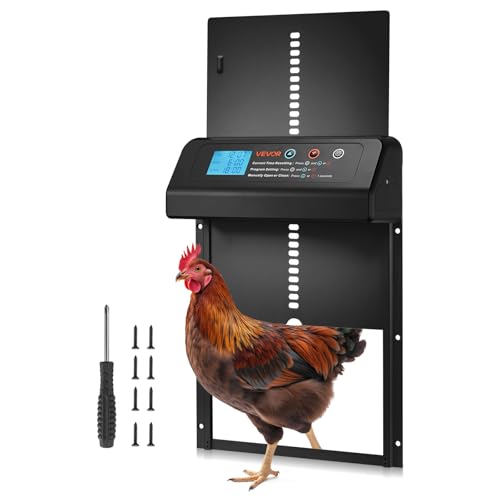
VEVOR Automatic Chicken Coop Door
Light sensor, timer and infrared obstruction detection all arrive at a price below the specialist brands. An aluminium panel running in guided rails feels more solid than the cost suggests. Setup is straightforward by owner accounts, though the thin, awkwardly translated manual rewards a second read before mounting.
Pros
- Feature set outruns its price point
- Infrared sensor halts the door on contact
- Aluminium panel rather than thin plastic
Cons
- Manual reads poorly in places
- Support responds slower than specialist brands

JVR Automatic Chicken Coop Door Opener
AA batteries, a light sensor with a timer option and a small aluminium slide panel cover everything a mild climate flock needs. Surface mounting over an existing pop hole means most keepers finish installation within an hour. Temperate conditions suit it well; deep cold is where owners report it struggling.
Pros
- Lowest outlay in this group
- Mounted and running within an hour
- Ordinary AA batteries last a long time
Cons
- Opening suits bantams better than large breeds
- Cold weather is its weak point
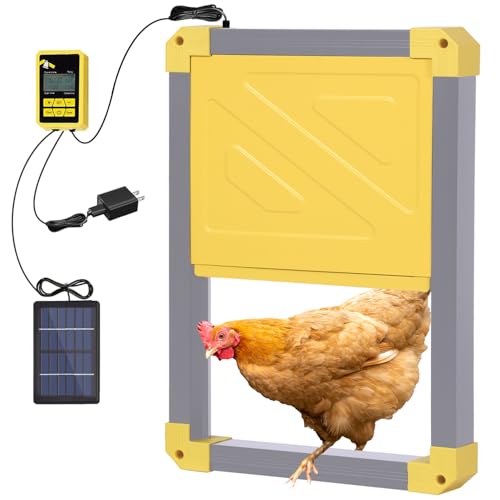
Aivituvin Automatic Chicken Coop Door
Sized for the compact backyard coops Aivituvin also builds, this door fits walls where larger units will not sit flat. Light sensor and timer modes cover daily routines, and a front panel button gives manual control for exceptions. Keepers with A frames and small tractors report it is one of the few doors that physically fits.
Pros
- Fits coops that reject larger units
- Manual override on the front panel
- Light enough for thin coop walls
Cons
- Narrow opening for larger breeds
- Plastic housing trails aluminium rivals
What matters most
How do automatic chicken coop doors work? Every unit pairs a motor with a trigger, and the trigger choice shapes daily life. Light sensors follow the seasons on their own, opening later in winter and earlier in summer, which is why most keepers prefer them. Stray light is their weakness: a porch lamp, a street light or moonlight on snow can fool a cheap sensor. Timers ignore all of that but need seasonal adjustment, so the most flexible doors offer both and let you switch.
Will an automatic coop door keep raccoons out? Track design matters more than motor power. Raccoons lift and lever, so a panel captured in rails on both sides, driven by a mechanism that will not back drive when pulled, is what actually stops them. Cord lift retrofits are convenient but beatable when the door is light and unguided. Under real predator pressure, pick a guided slider like the Omlet Autodoor and pair it with hardware cloth, since a door is only as strong as the coop around it.
Do automatic coop doors work in freezing weather? Winter is when cheap doors die: battery capacity drops in the cold, condensation freezes inside tracks and marginal motors stall. Before buying, find a stated operating temperature range, a sealed or insulated frame and the option of an external power supply. Keepers consistently report that units behaving perfectly in autumn are the ones failing in January, so match the door to your real climate, not the average one.
What size pop door opening do chickens need? Standard large breeds pass comfortably through an opening around 12 inches wide and 14 inches tall, bantams through less, and heavyweights like Jersey Giants want extra height. Measure your biggest bird rather than assuming. Whatever door you fit, confirm you can operate it by hand when batteries die, and spend the first week checking the flock is inside before closing time so you learn how the trigger matches their routine.
Compared at a glance
| # | Model | Power | Best for | Score | Price |
|---|---|---|---|---|---|
| 1 | Run-Chicken Model T50 Automatic Chicken Coop Door | Internal batteries, no mains wiring | Best overall | 9.4 | Check price |
| 2 | ChickenGuard Premium Automatic Chicken Coop Door Opener | Batteries, optional mains or solar adapter | Best for retrofitting | 9.2 | Check price |
| 3 | Chickcozy Automatic Chicken Coop Door | Batteries with optional external supply | Best for cold climates | 9.0 | Check price |
| 4 | Omlet Autodoor | Batteries or mains adapter | Best for predator pressure | 8.8 | Check price |
| 5 | VEVOR Automatic Chicken Coop Door | Batteries with adapter option | Best value | 8.6 | Check price |
| 6 | JVR Automatic Chicken Coop Door Opener | AA batteries | Best budget | 8.3 | Check price |
| 7 | Aivituvin Automatic Chicken Coop Door | Battery powered | Best for small coops | 8.0 | Check price |
Common questions
Are automatic chicken coop doors safe for chickens?
Yes, when set up sensibly. Doors close slowly, and many add infrared or resistance sensing that stops or reverses on contact with a bird. Set the closing trigger late enough for stragglers, then watch the first week’s routine to confirm the flock has adjusted.
Do automatic coop doors work in winter?
The good ones do. Sealed aluminium frames and stated sub freezing ratings, as on the Chickcozy and Run-Chicken designs, are what cold region keepers report succeeding with. Plastic housings and cord lift systems produce most of the January failures.
Is a battery, mains or solar coop door better?
Battery doors win for most gardens because nothing needs cabling to the coop. Mains removes battery anxiety where a supply exists nearby. Solar performs in sunny climates but can starve through dark winters, so choose a solar kit that accepts battery backup.
How big should a chicken coop door opening be?
About 12 inches wide by 14 inches tall for standard large breeds, less for bantams, more height for giants. Sizing against your largest bird avoids the common mistake of a budget door whose opening only suits small hens.
Can a raccoon open an automatic chicken coop door?
A panel held in a captive track resists lifting and levering, which defeats the standard raccoon approach. Weak points shift to hinges, latches and mesh, so back the door with hardware cloth rather than chicken wire and test whether the closed panel can be pried upward.
Can I add an automatic opener to my existing coop door?
Yes. Openers such as the ChickenGuard Premium exist precisely for this: you keep your door and runners, the unit winds it up and down on a cord. Retrofitting usually costs less than replacing a hatch that already fits the coop.
What happens to an automatic door when the batteries die?
Most units freeze in their last position, open or closed, which is why a manual override matters. Learn the low battery warning before you need it, and swap batteries each autumn instead of waiting for a failure on a frozen morning.
How long do batteries last in an automatic coop door?
Commonly a season or more on one set, since the motor runs only seconds per day. Cold weather cuts that noticeably, and light sensor models sip a little extra power on standby, so treat autumn replacement as routine maintenance.
Do I still need to check the coop at night with an automatic door?
Periodically, yes. Automation removes the daily dusk trip, not the responsibility. Check often during the first weeks and after weather that could jam the track, and treat the door as a convenience rather than a substitute for looking in on the flock.
Our pick
Fit the Run-Chicken Model T50 first on a typical backyard coop: no wiring, a predictable light sensor and season long battery life make it the lowest fuss option here. Keepers with a pop hole already built should buy the ChickenGuard Premium opener instead, and anyone facing genuine winters will get more reliable mornings from the insulated Chickcozy Automatic Door.


