Driveway Alarms That Warn You Before Anyone Knocks
The Guardline Wireless Driveway Alarm leads on transmission range and sensor tuning that limits false triggers. The Hosmart 1/2 Mile Wireless Driveway Alarm is the value pick with expandable receivers, and the eMACROS Solar Wireless Driveway Alarm suits long drives where battery changes are a nuisance.
For a long rural driveway, the Guardline Wireless Driveway Alarm is the most dependable choice because its range holds up better than most through trees and outbuildings. The Hosmart 1/2 Mile system is the value alternative for shorter runs, and the eMACROS solar model removes the battery replacement chore entirely.
Driveway alarms are sold on headline range figures that assume line of sight across an open field. Real properties have brick walls, metal siding, mature trees and steel gates, all of which cut that number sharply. Detection method matters just as much, since passive infrared sensors react to sunlight and animals while magnetic probes only see vehicles. We compared stated ranges, sensor types, adjustable sensitivity, power sources and ingress ratings, then weighed those against what owners report about false alerts and winter reliability.
What we recommend

Guardline Wireless Driveway Alarm
A quarter mile rated system with a weather sealed passive infrared sensor and a receiver that supports multiple zones with different chimes. The sensor can be aimed and shielded to ignore a road or a footpath, which is the main defence against constant false alerts. Owners report the range holds up well through typical rural obstructions.
Pros
- Range holds up better than most through obstacles
- Separate chimes identify which zone triggered
- Adjustable aim reduces nuisance alerts
Cons
- Sensor batteries need periodic replacement
- Infrared still reacts to large animals

Hosmart 1/2 Mile Wireless Driveway Alarm
A rechargeable system rated to half a mile in open conditions, with the ability to add extra sensors and receivers as your coverage needs grow. Volume is adjustable across a wide range, which matters if the receiver sits in a workshop. It is a sensible starting point for a suburban property with one or two approach points.
Pros
- Expandable to cover several approaches
- Rechargeable receiver avoids constant batteries
- Wide volume range including a quiet setting
Cons
- Quoted range assumes clear line of sight
- Sensitivity adjustment is coarse

eMACROS Long Range Solar Wireless Driveway Alarm
A solar powered outdoor sensor that removes the need to walk down the drive replacing batteries, which is the main maintenance chore with these systems. The transmitter is rated for long distances and the receiver plugs into a wall socket indoors. Placement matters, since the panel needs meaningful daylight to keep up.
Pros
- Solar panel removes battery replacement trips
- Strong stated transmission distance
- Simple plug in receiver setup
Cons
- Needs a sunny mounting position
- Shaded winter placement reduces reliability

HTZSAFE Solar Wireless Driveway Alarm
A solar sensor with a genuinely useful sensitivity and detection angle adjustment, which lets you narrow the field to the drive itself. That makes a real difference on properties where deer or cats otherwise trigger alerts nightly. The receiver offers multiple chime tones and volume levels.
Pros
- Fine grained sensitivity and angle control
- Solar charging with rechargeable backup
- Multiple chime tones for different zones
Cons
- Setup takes more adjustment than rivals
- Housing is bulkier on a slim post

Mighty Mule FM231 Wireless Driveway Alarm
Instead of infrared motion, this uses a buried magnetic probe that only responds to metal, so it alerts on cars and trucks and ignores wildlife, weather and pedestrians. That makes it the answer for properties plagued by false alerts. The trade off is that it will not tell you when someone walks up the drive.
Pros
- Effectively immune to animal false alerts
- Unaffected by sun, rain and blowing leaves
- Hidden installation with nothing visible
Cons
- Detects vehicles only, not people
- Requires digging to install the probe
Chamberlain CWA2000 Wireless Motion Alert
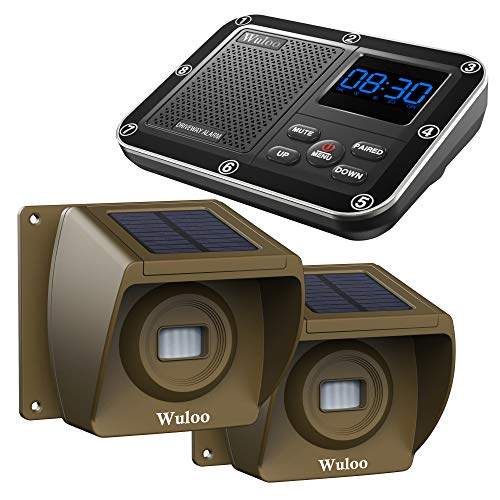
A compact system aimed at suburban driveways, garages and side gates rather than long rural approaches. Setup is close to plug and play and the receiver is small enough to sit on a shelf unnoticed. Based on specifications the range is the shortest here, so match it to the distance you actually need.
Pros
- Very quick to set up
- Compact receiver suits small rooms
- Additional sensors pair easily
Cons
- Effective range drops sharply through walls
- Limited sensitivity adjustment

Dakota Alert DCMA-2500 Wireless Motion Alert
A rugged sensor and receiver pair built for farm and rural use, with a housing designed to survive weather that kills consumer grade units. The alert is a plain tone rather than a menu of chimes, which suits people who want reliability over features. Owners report it keeps working through winters that defeated cheaper systems.
Pros
- Built for sustained outdoor exposure
- Simple, reliable alert behaviour
- Solid transmission over open ground
Cons
- Fewer features than consumer rivals
- Plain tone with limited customisation
Compared at a glance
| # | Model | Range | Best for | Score | Price |
|---|---|---|---|---|---|
| 1 | Guardline Wireless Driveway Alarm | Rated up to 1/4 mile | Best overall | 9.4 | Check price |
| 2 | Hosmart 1/2 Mile Wireless Driveway Alarm | Rated up to 1/2 mile open air | Best value | 9.2 | Check price |
| 3 | eMACROS Long Range Solar Wireless Driveway Alarm | Rated for long distance transmission | Best for long driveways | 9.0 | Check price |
| 4 | HTZSAFE Solar Wireless Driveway Alarm | Rated up to 1/2 mile open air | Best for adjustable sensitivity | 8.8 | Check price |
| 5 | Mighty Mule FM231 Wireless Driveway Alarm | Rated up to 400 feet | Best for vehicles only | 8.6 | Check price |
| 6 | Chamberlain CWA2000 Wireless Motion Alert | Rated up to 1/2 mile open air | Best for short driveways | 8.3 | Check price |
| 7 | Dakota Alert DCMA-2500 Wireless Motion Alert | Rated up to 2,500 feet | Best for harsh weather | 8.0 | Check price |
How to choose
Treat quoted range as a best case number Manufacturers measure range across open ground with nothing in the way. A brick wall, a metal outbuilding, mature trees or a hill between the sensor and the receiver can reduce that figure to a fraction of the headline. As a working rule, buy at least double the range you think you need, and if the receiver will sit in a basement or behind foil backed insulation, plan on more than that.
Choose the detection method for your false alert problem Passive infrared sensors detect heat movement, which means deer, dogs, cats and even sunlight moving across a cold surface can trigger them. Magnetic probe systems only detect metal, so they ignore everything except vehicles. If you want to know about people on foot, infrared is the only option and you should plan on tuning the aim carefully. If you only care about vehicles, a probe removes the nuisance entirely.
Power source decides your maintenance burden A battery powered sensor at the end of a long drive means a walk in winter weather every few months. Solar removes that, provided the panel gets real daylight, which is not guaranteed under trees or on a north facing post. Mains powered receivers indoors are the easy part. Think about the sensor end first and be honest about how shaded the mounting spot is.
Aim and shield the sensor before blaming the product Most complaints about constant false alerts come down to placement. Mount the sensor so its detection field crosses the drive rather than pointing down it, keep it out of direct afternoon sun, and use the supplied hood or a simple shield to mask off a road or footpath. Mounting height matters too, since a sensor set low enough to see a cat will report every cat.
Frequently asked questions
How far can a wireless driveway alarm really transmit?
Expect roughly a third to a half of the quoted figure on a typical property with buildings and trees in the path. Systems rated at half a mile in open air often deliver a few hundred yards through real obstructions, which is still enough for most driveways.
How do I stop animals setting off the alarm?
Raise the mounting height so small animals pass below the detection field, narrow the sensitivity if the model allows it, and aim the sensor across the drive rather than along it. If false alerts persist, a magnetic vehicle probe system removes the problem completely.
Do driveway alarms work in cold weather?
Infrared sensors actually work well in cold because the contrast between a warm body and cold surroundings is greater. The weak point is battery performance, which drops sharply below freezing. Lithium cells hold up far better than alkaline in winter.
Can I add more sensors later?
Most modern systems support additional sensors paired to one receiver, often with different chimes so you can tell which zone triggered. Confirm the maximum number supported before buying, especially if you plan to cover a gate, a shed and a drive.
Do these need wifi or a subscription?
The systems here are self contained radio pairs with no internet connection and no ongoing fees. That also means no phone notifications when you are away, which is the trade off against camera based alternatives.
Where should I mount the sensor?
Around waist height on a post beside the drive, aimed across the path of travel rather than down it, and shaded from direct sun. Keep it far enough from the road that passing traffic falls outside the detection field.
Will a driveway alarm work through a metal building?
Poorly. Metal siding and metal roofing block radio signals badly. Position the receiver near a window facing the sensor, or choose a system with a repeater option. This is one of the most common causes of a system that seems to have far less range than advertised.
Is a magnetic probe better than an infrared sensor?
Better for ignoring animals and weather, worse for detecting people. Probes only sense metal, so a visitor on foot passes unannounced. Many rural properties end up running one of each, using the probe for vehicles and infrared for the area near the house.
Our take
The Guardline Wireless Driveway Alarm is the pick for most properties because its range and sensor tuning hold up where cheaper systems flood you with false alerts. Choose the Hosmart system if your driveway is short and you want room to expand, and the eMACROS solar model if walking down to change batteries is the part you want to avoid. If animals are your real problem, the Mighty Mule FM231 probe solves it outright.