Receipt Scanners That Actually Sort Your Expenses
Our top pick is the Epson RapidReceipt RR-600W, which pairs a fast duplex feeder with receipt specific data capture. The Ricoh ScanSnap iX1600 is the smoothest to operate thanks to its touchscreen profiles, while the Brother ADS-1700W is the strongest compact option for small desks and shared offices.
The Epson RapidReceipt RR-600W is the receipt scanner we would put on most desks, with the Ricoh ScanSnap iX1600 close behind for anyone who wants one button simplicity and the Brother ADS-1700W for tight workspaces.
Receipt scanning is trickier than plain document scanning because thermal paper is thin, curled and inconsistently sized, so feeders jam and software misreads totals. We compared current models on stated feed rates, duplex capability, wireless options and the accounting exports each bundle supports, and we leaned on what long term owners report about paper handling and software updates.
What matters most
Feeder capacity matters more than raw speed A scanner rated at 40 pages per minute is little help if you can only load 20 sheets at a time. If you save receipts and process them monthly, look for a feeder that holds at least 50 sheets so a session is one load rather than five. If you scan a few items each evening, a compact 20 sheet feeder is plenty and saves desk space.
Thermal paper needs gentle handling Most receipts are thin thermal stock that curls, and that is where cheap feeders jam or double feed. Ultrasonic double feed detection and adjustable paper guides make a real difference, and owners report far fewer misfeeds on models that include them. Flattening a batch under a book before scanning also helps more than any setting.
Software decides how much time you actually save Scanning is the easy half. The useful part is software that reads vendor, date, total and tax, then exports to a spreadsheet or your accounting package. Some bundles do this natively, others rely on a third party subscription. Based on specifications, check which export formats are included before you buy rather than after.
Wireless is convenient but not essential Wi-Fi lets you scan straight to a phone or cloud folder and keeps cables off the desk, which is genuinely useful in a shared office. It also adds setup steps and occasional reconnection issues on crowded networks. A USB only scanner is one less thing to troubleshoot if it will live permanently beside your computer.
The best picks, ranked

Epson RapidReceipt RR-600W
Epson built this one specifically around receipts, and it shows in the bundled software that pulls vendor, date and total into a categorised database. The 100 sheet feeder and duplex path mean you can drop in a month of receipts and walk away. Wireless setup keeps the cable clutter down on a shared desk.
Pros
- Receipt data extraction is built in rather than bolted on
- Large feeder handles a full backlog in one sitting
- Exports to common accounting formats
Cons
- Takes up more desk space than a compact model
- Software has a learning curve on first setup

Ricoh ScanSnap iX1600
The colour touchscreen lets you save up to 30 one touch profiles, so a receipt scan and an invoice scan become separate buttons rather than separate dialogs. Owners report it is the model family members will actually use without help. Paper handling is consistently praised, including on thin thermal stock.
Pros
- Profile buttons remove almost all setup friction
- Reliable feeding of thin and curled paper
- Works across Windows, Mac and mobile
Cons
- Receipt data capture depends on partner software
- Larger footprint than portable rivals

Brother ADS-1700W
This is the one to consider when desk space is the constraint. It is roughly the size of a loaf of bread yet still offers a 20 sheet feeder, duplex scanning and a small colour touchscreen for scan to cloud shortcuts. Good choice for a home office that scans in short bursts.
Pros
- Genuinely small footprint for a feeder scanner
- Scans direct to USB drive without a computer
- Touchscreen shortcuts are easy to configure
Cons
- Smaller feeder means more reloading on big batches
- Slower than full size desktop units

Epson WorkForce ES-500W II
If receipts are only part of the job, this handles contracts, statements and business cards with the same feeder. It shares much of the RapidReceipt hardware without the receipt focused software bundle, which suits people who already use their own expense app. Wireless scanning to phones is straightforward.
Pros
- Handles receipts and full size documents equally well
- Fast duplex scanning for the size
- Mobile scanning works without a computer
Cons
- No dedicated receipt database software included
- Wireless setup can be fiddly on busy networks
Canon imageFORMULA R40
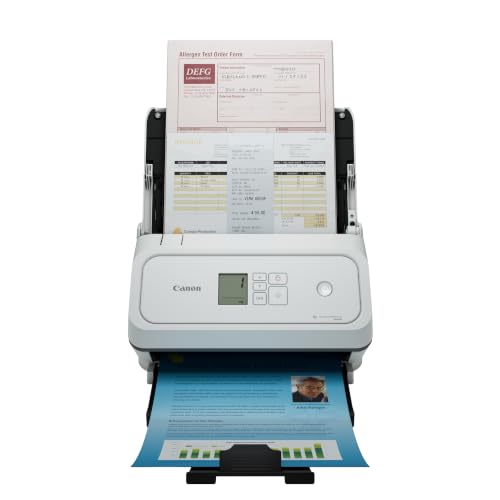
A no nonsense duplex scanner with bundled software that handles searchable PDF output well. There is no wireless, which keeps the setup simple and the price sensible. Owners report steady performance on receipts once the paper guides are set correctly.
Pros
- Strong searchable PDF output out of the box
- Simple wired setup with no network fuss
- Good feeder capacity for the class
Cons
- No wireless or mobile scanning
- Software is more basic than Epson’s receipt tools

Epson RapidReceipt RR-70W
A battery capable mobile scanner aimed at people who capture receipts on the road rather than in a monthly pile. It feeds one sheet at a time, so it is not a batch tool, but the receipt software matches the larger RapidReceipt models. Handy for consultants and rideshare drivers.
Pros
- Small enough for a laptop bag
- Same receipt capture software as the desktop models
- Runs without mains power
Cons
- Manual single sheet feeding only
- Much slower than any desktop unit
Doxie Go SE
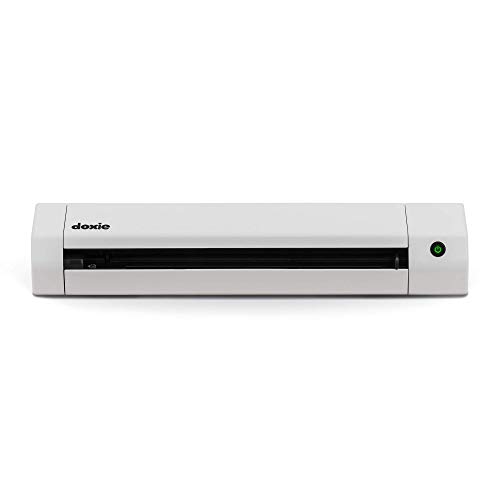
The simplest option here, scanning to internal memory so you can capture receipts anywhere and sync later. There is no feeder and no duplex, so this suits light users rather than bookkeepers. The bundled app makes tidying and exporting scans painless.
Pros
- Works completely untethered from a computer
- Very easy software with clean exports
- Light enough to keep in a glovebox
Cons
- Single sided scanning only
- No automatic document feeder
How they compare
| # | Model | Scan speed | Best for | Score | Price |
|---|---|---|---|---|---|
| 1 | Epson RapidReceipt RR-600W | Up to 35 pages per minute | Best overall | 9.4 | Check price |
| 2 | Ricoh ScanSnap iX1600 | Up to 40 pages per minute | Best for ease of use | 9.2 | Check price |
| 3 | Brother ADS-1700W | Up to 25 pages per minute | Best compact | 9.0 | Check price |
| 4 | Epson WorkForce ES-500W II | Up to 35 pages per minute | Best for mixed paperwork | 8.8 | Check price |
| 5 | Canon imageFORMULA R40 | Up to 40 pages per minute | Best value | 8.6 | Check price |
| 6 | Epson RapidReceipt RR-70W | Mobile sheetfed | Best portable | 8.3 | Check price |
| 7 | Doxie Go SE | Portable sheetfed | Best budget | 8.0 | Check price |
Frequently asked questions
Do receipt scanners read the totals automatically?
The dedicated ones do. Models sold specifically as receipt scanners bundle software that extracts vendor, date, total and tax into editable fields. General document scanners produce a searchable PDF instead, and you then rely on a separate expense app to pull the numbers out.
Will a scanner handle faded thermal receipts?
Usually, but not miraculously. Thermal print fades with heat and time, and no scanner restores information that has already disappeared. Scanning receipts within a few weeks and storing the paper away from sunlight gives the best results.
Is duplex scanning worth it for receipts?
Receipts are usually single sided, so duplex matters less here than for contracts. It still helps because a single pass duplex scanner reads both sides in one go, meaning you never have to check whether something was printed on the back.
Can I use a phone app instead of a scanner?
For a handful of receipts a month, yes. Phone apps have improved and handle single captures well. Once you are processing dozens at a time, a feeder scanner is dramatically faster because you load a stack and let it run rather than photographing each slip.
Do these work with accounting software?
Most export to CSV, which almost every accounting package imports. Several also offer direct connections to popular bookkeeping services. Check the current list of supported integrations on the product page, since these change with software updates.
How long do receipt scanners last?
Owners report several years of steady use from the desktop models. The wear item is the feed roller and separation pad, which are replaceable consumables on most units. Buying a model with available roller kits extends usable life considerably.
Should I scan in colour or black and white?
Colour is safer for receipts because it preserves logos, highlighting and card details that help verify a purchase later. File sizes are larger, but modern compression keeps them manageable and storage is rarely the limiting factor.
Do I still need to keep the paper receipts?
That depends on your local tax rules and how long they require records to be retained, so check with your accountant. Many jurisdictions accept legible digital copies, but the safest approach is to keep originals for the current year and archive the scans.
Final word
For most people the Epson RapidReceipt RR-600W is the sensible choice because the receipt software does the tedious data entry rather than leaving it to you. Choose the Ricoh ScanSnap iX1600 if simple one touch operation matters more than built in expense capture, or the Brother ADS-1700W when desk space is tight. Light users capturing a few slips a week will be fine with the Doxie Go SE.