How Far Does a Wireless Driveway Alarm Actually Reach?
Dakota Alert DCMA-4000 fits most rural driveways with a dependable long-range signal. Guardline Wireless Driveway Alarm extends coverage across bigger rural lots using its optional range accessory. eMACROS Solar Power Wireless Driveway Alarm skips battery changes altogether, running on solar power while still holding a signal past several hundred feet.
Dakota Alert DCMA-4000 covers the ordinary case: a single PIR sensor watching one driveway from a typical house. Guardline Wireless Driveway Alarm targets longer runs across acreage or a gated rural lot. Solar-powered picks like eMACROS remove the battery-swap chore for sensors mounted far from an outlet.
Manufacturer range numbers come from open fields with a clear line of sight. Trees, hills, and metal siding can cut that figure in half or worse. We compared stated detection cones, transmission distances, and power sources across current Amazon listings. Owner reports about false alarms and real-world range filled in what the spec sheet leaves out.
What we recommend

Dakota Alert DCMA-4000 Wireless Motion Sensor Driveway Alarm
Passive infrared detection watches the driveway and relays a signal to a plug-in receiver anywhere in the house. Moderate tree cover between the two units barely dents the range compared with cheaper kits. Four AA batteries run the sensor, housed in casing built to sit outdoors year round.
Pros
- Signal carries farther than most budget alarms once trees or a slight hill get involved
- Outdoor casing holds up through rain, snow, and direct sun for years
- Multiple receivers can pair to a single sensor
Cons
- Base kit includes only one sensor
- Batteries need checking every few months

Guardline Wireless Driveway Alarm
Standard coverage suits a typical suburban driveway, and an optional extended-range accessory pushes that toward half a mile for rural lots. The included ground stake mounts the PIR sensor across roughly 40 feet of detection field. Several tone and volume settings on the plug-in receiver help separate zones.
Pros
- Extended-range accessory works well on long rural driveways
- Receiver offers several tone and volume choices for different zones
- Ground stake mounts without tools
Cons
- Extended-range accessory is a separate purchase
- Runs on batteries rather than solar, so swaps are still needed

eMACROS Solar Power Wireless Driveway Alarm
A compact solar panel keeps this sensor charged, backed by a battery for stretches of cloudy weather. Detection spans a 40 foot PIR cone, and the claimed transmission range sits near a third of a mile in open terrain. DIP switches let several sensors run on separate channels without crosstalk.
Pros
- Solar charging cuts down on maintenance trips
- DIP switch channels prevent interference between multiple sensors
- Backup battery keeps the unit running through overcast days
Cons
- Needs a mounting spot with real sun exposure
- Claimed range drops noticeably once trees get in the way

1Byone Wireless Driveway Alarm
Up to four sensors can pair with the included receivers, suiting properties with more than one entry point. Each sensor covers about 40 feet of detection field on two AA batteries. Transmission tops out near 400 feet, shorter than some rivals but steady across that distance.
Pros
- Expands easily across several driveways or gates
- Two AA batteries hold a charge well between checks
- No wiring or app pairing needed for setup
Cons
- Transmission range trails the long-distance models here
- Receiver volume is modest indoors
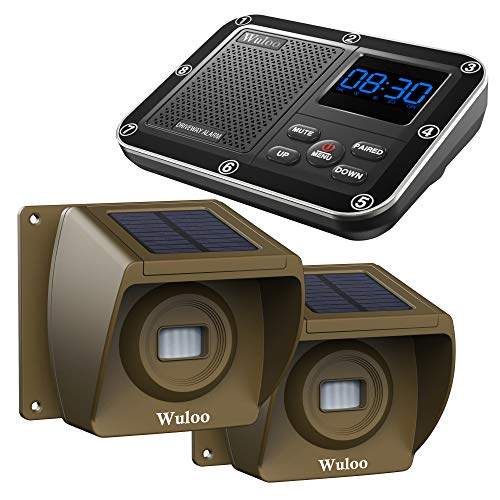
SadoTech Model CX Wireless Driveway Alarm
Setup amounts to plugging the receiver into an outlet and placing the sensor on its stake. Detection spans 30 to 40 feet, with transmission holding to about 500 feet under normal conditions. Multiple chime tones and adjustable volume make it easy to tell zones apart as more sensors join the system.
Pros
- One of the simplest kits to get running out of the box
- Tone variety helps distinguish between sensor locations
- Priced well for a first driveway alarm
Cons
- Range trails the long-distance models in this lineup
- Housing feels lighter duty than pricier kits

HTZSAFE Solar Wireless Driveway Alarm
An IP65 rated housing pairs solar charging with a rechargeable backup battery, so rain exposure rarely causes problems. Its 120 degree PIR cone reaches about 40 feet, and transmission tops out near 500 feet. Mounting hardware and a wall bracket for the receiver ship in the box.
Pros
- IP65 housing shrugs off heavy rain
- Solar charging keeps ongoing upkeep low
- Mounting hardware included, nothing extra to buy
Cons
- Wide detection angle can pick up cars on a nearby road
- Fewer zone channels than the 1Byone system

Mengshen Solar Wireless Driveway Alarm
A tool-free stake plus solar and battery power suit temporary setups at a campsite or seasonal cabin. Claimed transmission reaches around 1,300 feet across open terrain. Sensor and receiver pack down small enough to travel in a glovebox or storage bin.
Pros
- Sets up and breaks down within minutes
- Solar power suits sites with no outlet nearby
- Compact enough to travel along with an RV
Cons
- Less rugged than fixed home installations
- Real-world range falls short of the open-field claim
How they compare
| # | Model | Detection type | Best for | Score | Price |
|---|---|---|---|---|---|
| 1 | Dakota Alert DCMA-4000 Wireless Motion Sensor Driveway Alarm | Passive infrared (PIR) | Best overall | 9.4 | Check price |
| 2 | Guardline Wireless Driveway Alarm | About 40 feet across the sensor field | Best for large properties | 9.2 | Check price |
| 3 | eMACROS Solar Power Wireless Driveway Alarm | Solar panel with battery backup | Best solar powered | 9.0 | Check price |
| 4 | 1Byone Wireless Driveway Alarm | Up to 4 sensors and receivers | Best for multiple zones | 8.8 | Check price |
| 5 | SadoTech Model CX Wireless Driveway Alarm | Plug in receiver, no wiring | Best budget | 8.6 | Check price |
| 6 | HTZSAFE Solar Wireless Driveway Alarm | Solar panel with rechargeable backup | Best value | 8.3 | Check price |
| 7 | Mengshen Solar Wireless Driveway Alarm | Solar panel with battery backup | Best for RVs and campsites | 8.0 | Check price |
What matters most
What to look for in a wireless driveway alarm Most kits rely on a passive infrared sensor that reacts to body heat moving through its field of view. Two numbers matter more than any marketing claim: the detection cone in front of the sensor and the transmission range back to the receiver. Power source comes next, since battery models need periodic swaps while solar units mostly run themselves. Outdoor housing quality matters too, because these sensors sit outside through every season.
How much do trees and hills cut real-world range? Manufacturer range figures come from flat, open terrain with a clear line of sight. A stand of trees, a rise in the yard, or metal siding on the house can cut that number by half or more. Mounting the sensor and receiver as high as practical helps the signal clear obstacles. Long driveways with a curve or hill sometimes need a repeater or a longer-range kit like Guardline’s extended option.
Best driveway alarms for large or rural properties Acreage and gated properties usually need more than one sensor at the mailbox. Multi-zone systems such as the 1Byone kit let separate sensors cover a front gate, a side entrance, and a barn on distinct tones. Solar sensors from eMACROS or HTZSAFE suit entry points far from any outlet. Distance-focused kits like the Dakota Alert DCMA-4000 hold a usable signal even with some obstruction along the way.
How to reduce false alarms from animals, wind, and sun Deer, raccoons, and even large dogs regularly trigger PIR sensors left at full sensitivity. Lowering the sensitivity dial and aiming the sensor away from a busy road cuts down on nuisance alerts. Direct sunlight hitting the lens can also trigger false alarms as the sensor reacts to fast heat changes. Keeping tall grass or shrubs out of the detection cone removes another common source of error.
Frequently asked questions
How far can a wireless driveway alarm detect motion?
Most PIR sensors cover a cone of about 30 to 40 feet from the unit. Transmission range is separate, measuring how far the signal travels back to the receiver, often several hundred feet or more.
Do driveway alarms work through walls or trees?
Signals pass through light foliage and framing, though each obstacle chips away at range. A brick wall or dense tree line can cut the stated distance substantially, so buying more range than the driveway needs pays off.
What is the difference between a driveway alarm and a security camera?
A driveway alarm only signals that motion happened, usually through a chime, without recording footage. A camera captures video for later review. Many owners run both together for alerts plus evidence.
Can a driveway alarm run on solar power alone?
Yes, models like eMACROS and HTZSAFE use a small solar panel backed by a battery for overcast days. Placement in direct sun still matters for reliable charging.
How do I stop a driveway alarm from triggering on animals?
Lower the sensitivity setting if the sensor has one, and angle the unit so its cone avoids a road or a spot where wildlife often passes. Mounting height also affects what size of animal will trip it.
How many sensors can connect to one driveway alarm system?
It depends on the kit. The 1Byone system supports up to four sensors and receivers, while simpler kits like the SadoTech Model CX pair one sensor with one receiver, with extras sold separately.
Is a driveway motion sensor weatherproof?
Most current sensors carry some level of weather resistance, and the HTZSAFE unit specifically lists an IP65 rating. Even weatherproof housings benefit from mounting under a small overhang where possible.
Driveway alarm vs motion sensor light: which one do I need?
A driveway alarm alerts someone inside the house, while a motion light only illuminates the area outside. Properties with frequent after-dark visitors often benefit from pairing a light with an indoor chime.
Best driveway alarm for a long rural driveway?
Guardline Wireless Driveway Alarm and its extended-range accessory push transmission toward half a mile, useful for acreage or a gated rural lot. Dakota Alert DCMA-4000 also holds a dependable signal over long distances.
Do solar driveway alarms work in winter?
Solar panels charge more slowly under short winter days and snow cover, so a battery backup carries the load during that stretch. Clearing snow off the panel periodically keeps charging closer to normal.
The bottom line
Dakota Alert DCMA-4000 remains the solid default for a single driveway, holding range better than most budget kits even with some obstruction. Guardline earns its extra setup step on long rural driveways that need the extended-range accessory. Solar options like eMACROS suit sensors placed far from any outlet, trading a small amount of range for years of low maintenance.


